
Leather Shoe Manufacturing
Leather Shoes Production Process: Approval Handoffs
A buyer-focused framework for defining project inputs, reviewing controlled materials at the incoming boundary, and raising product-specific approval questions.
A list of factory operations cannot tell a footwear buyer which product details have been settled or which reference will govern the next decision. A buyer-usable map of the leather shoes production process needs to show the information carried into each documented review and the questions that remain open afterward.
The available company sources establish two review boundaries. First, the product and commercial frame is reviewed as a whole. Second, the listed controlled-material details and lot identity are reviewed before mixed or unclear materials enter production. The sources also identify appearance points for cap-toe Oxfords, although they describe those points in two distinct product contexts.
Map decisions before factory operations
Cutting, stitching, lasting, finishing, and packing may all be subjects for a production discussion. The supplied excerpts, however, do not provide the company's complete operating sequence or assign people, records, timing, and acceptance rules to those stages.
For that reason, the editorial recommendation is to begin with the boundaries that are documented. At each boundary, a buyer can distinguish the available input from the decision that still requires clarification. Questions about the rest of production can then be recorded separately instead of being treated as confirmed company procedures. For a broader list of factory-stage topics, see the leather shoe manufacturing process guide.
Define the product and commercial frame
The company's contact page states that style, market, quantity, size range, materials, branding, packaging, and delivery need are reviewed together rather than priced as isolated line items. This establishes the scope of the initial review without stating a minimum quantity, response time, development route, or project outcome.
A practical buyer brief should make the status of each input visible. This is an editorial recommendation, not a company-defined classification: mark information as current, under consideration, or still open. The distinction helps prevent an alternative from being read as a settled requirement.
- Style and market
- Describe the proposed footwear and intended market in the terms currently used by the project team.
- Quantity, size range, and delivery need
- State the present requirement or question without implying that it has been accepted.
- Materials
- Identify the current material direction separately from alternatives that require discussion.
- Branding and packaging
- Provide the relevant references and make their revision status visible.
These fields form the documented product and commercial frame. They do not, by themselves, establish feasibility, price, timing, or acceptance of the project.
Prepare for the incoming controlled-material review
The factory quality page calls for review of leather article, color, thickness, lining, outsoles, hardware, packaging, artwork, and lot identity before mixed or unclear materials enter production. The documented scope is the incoming review of those named material, component, packaging, artwork, and lot details.
The excerpt does not describe laboratory methods, supplier certification, approval authority, later production controls, or final inspection. Where those subjects matter, they require separate questions.
As an editorial preparation step, the buyer can organize the listed details in a schedule before the discussion. The schedule below is a suggested buyer tool; it is not presented as a record issued or retained by the company.
| Incoming detail named by the source | Buyer preparation | Question to clarify |
|---|---|---|
| Leather article, color, and thickness | Identify the current leather reference and specification revision. | What reference will distinguish the intended incoming leather? |
| Lining, outsoles, and hardware | Associate each component reference with the proposed style. | How will similar-looking components be distinguished? |
| Packaging and artwork | List the current files and their revision identifiers. | Which versions are intended for incoming review? |
| Lot identity | Leave a field for the relevant lot reference. | What record, if any, will connect the review with lot identity? |
Separate the two Oxford attribute sets
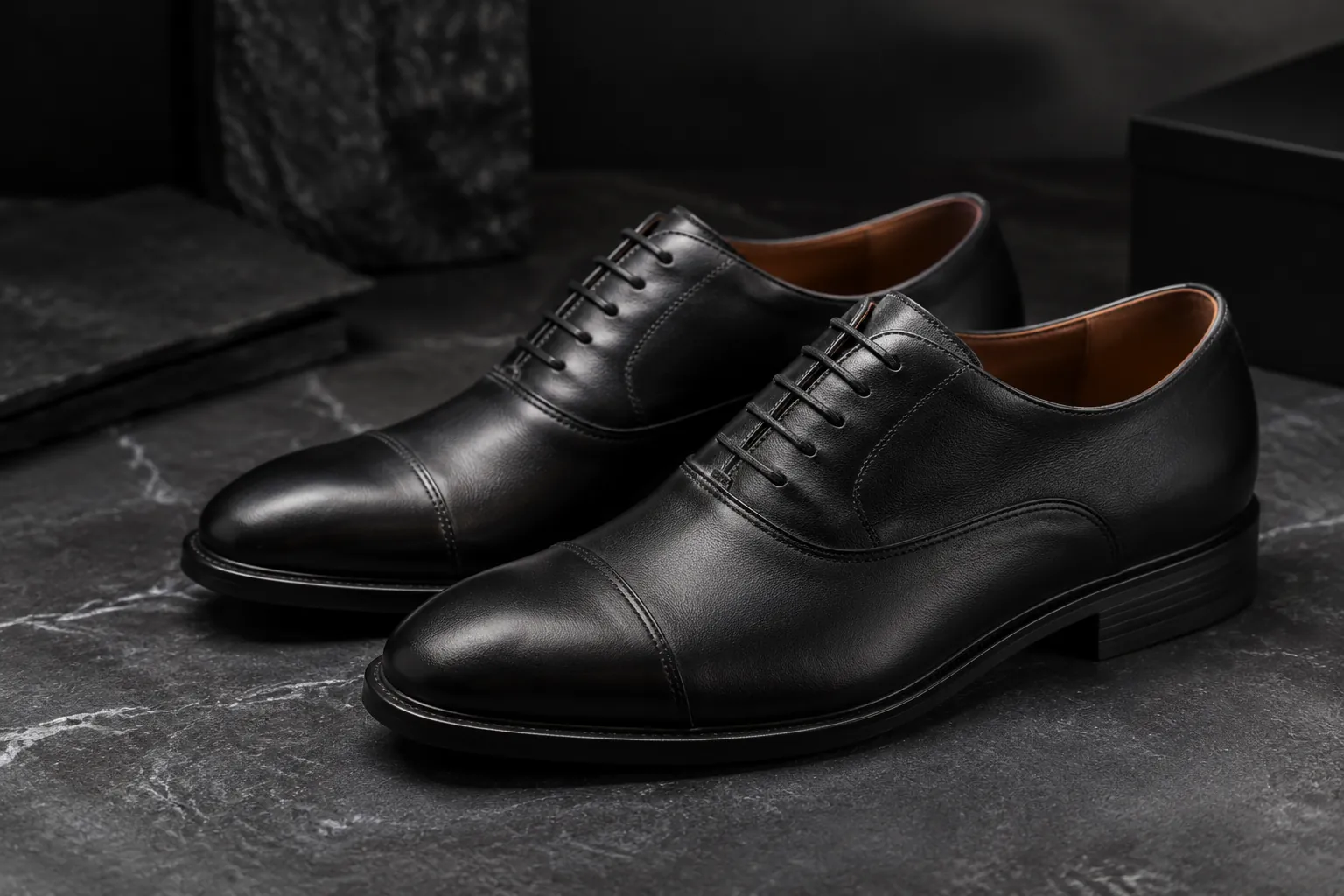
A cap-toe Oxford provides a narrow product lens for examining visible control and approval points. The two cited pages use related but nonidentical wording, so their lists should remain separate.
On the dress-shoes page, facing gap, toe proportion, cap placement, polish, and pair symmetry are treated as control points for the featured cap-toe Oxford. The editorial recommendation is to ask what each applicable point means for the proposed shoe and which project reference could represent it.
On the men's leather shoes page, facing gap, toe shape, polish level, and pair symmetry need a documented approval standard for the featured cap-toe Oxford. A buyer can ask which standard would apply to the project and how the applicable version would be identified.
The wording matters. Toe proportion should not be substituted for toe shape, and polish should not be expanded into polish level. Cap placement appears only in the dress-shoes excerpt. Neither page supplies measurements, tolerances, inspection methods, timing, or assigned approval responsibility.
When a reference is needed, the buyer may propose discussing an annotated image, written description, or physical reference. These are editorial suggestions for the discussion, not documented company methods.
Build the approval-handoff map
The following map keeps company-stated reviews distinct from buyer-proposed Oxford discussions. It also separates source-specific attributes so that one page's list is not attributed to the other.
| Boundary or discussion | Input to identify | Decision to clarify | Record the buyer may discuss |
|---|---|---|---|
| Documented product and commercial review | Style, market, quantity, size range, materials, branding, packaging, and delivery need | Which information is current and which points remain open? | A dated project brief with a revision identifier |
| Documented incoming controlled-material review | Leather article, color, thickness, lining, outsoles, hardware, packaging, artwork, and lot identity | What identifies each intended incoming item or detail? | An identity schedule or another reference discussed for the project |
| Buyer-proposed discussion based on the dress-shoes page | Facing gap, toe proportion, cap placement, polish, and pair symmetry | Which control points apply, and what does each mean for the proposed Oxford? | A project-specific reference considered suitable by the parties |
| Buyer-proposed discussion based on the men's leather shoes page | Facing gap, toe shape, polish level, and pair symmetry | Which documented approval standard would apply? | The applicable standard reference and its revision identifier |
The final column contains editorial suggestions. The excerpts do not assign ownership, approval authority, retention duties, or timing to these proposed records.
Ask about the undocumented stages
The available evidence is insufficient to describe who performs the middle and final production activities, when they occur, or which records and acceptance rules apply. Buyers should therefore keep the following leather shoe factory process questions in the inquiry column until a prospective manufacturer explains the proposed workflow:
- What construction sequence is proposed for the style?
- Would any in-process approvals follow the incoming review?
- Would a first-piece review apply, and what would it cover?
- How would defects be identified, recorded, separated, and resolved?
- What final inspection scope and acceptance rules would be proposed?
- Who would authorize packing release, and which references would inform that decision?
- How would changes to specifications, materials, artwork, or packaging be communicated?
These are inquiry topics, not documented company services or promised footwear production approval points.
Send a definition that can be reviewed
Prepare the inquiry around the fields named on the contact page: the proposed style and market, quantity, size range, materials, branding, packaging, and delivery need. Add the current component references and clearly identify unresolved alternatives. For a cap-toe Oxford, use the attribute wording from the relevant product page rather than combining the two lists.
Share the current footwear definition through the contact page and ask which development, sampling, or quotation options may apply to the project. Those options remain subjects for inquiry. Include unresolved questions about construction, inspection, change control, and packing so that any response can be reviewed against the same project definition.
Sources and verification
- Request a Quote | Leather Shoe Manufacturer First-party site source
- Leather Shoe Factory in China | Capability & Export QC First-party site source
- Custom Leather Dress Shoes Manufacturer | OEM & Private Label First-party site source
- Men's Leather Shoes Manufacturer | Custom Oxfords & Loafers First-party site source
Share the current leather footwear definition and ask which development, sampling or quotation options may apply to the project.
Send your project brief