
Leather Shoe Sourcing
How to Compare a Manufacturer of Leather Shoes
A range-mapping framework for identifying leather shoe specifications that may be shared and decisions that need style-specific review.
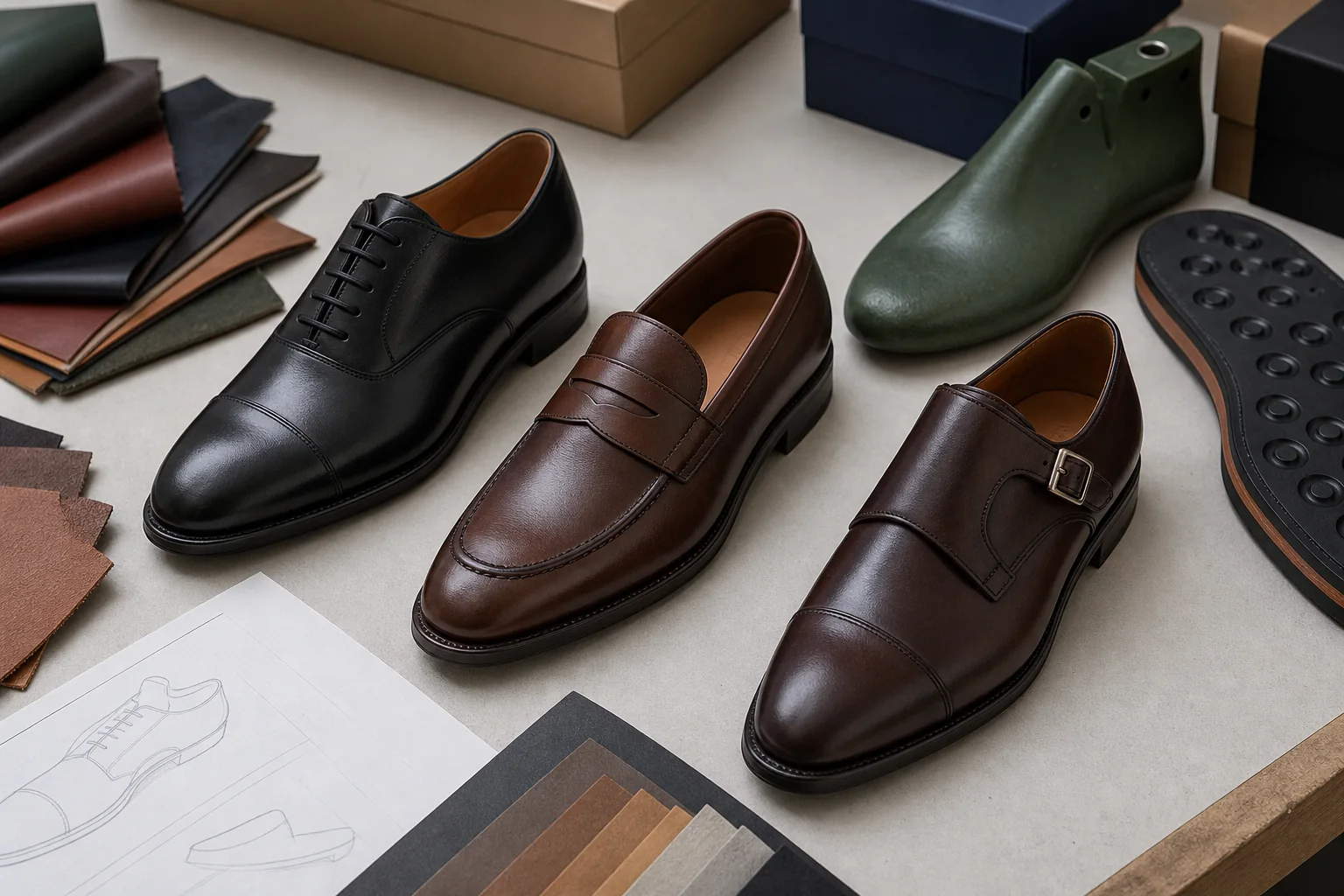
When comparing a manufacturer of leather shoes, treat the collection as a product platform rather than a set of catalog matches. An Oxford, loafer, and monk strap may belong to one commercial range, but that does not mean they should use the same fit assumptions, patterns, components, or development route.
The buyer’s task is to define the range and ask the manufacturer to separate three groups of decisions: specifications that may be shared, specifications that need dedicated development, and questions that cannot be resolved until the submitted designs are reviewed. This range map provides a clearer basis for discussing development and pricing than catalog breadth alone.
Build the range map first
Start with one row for every proposed style and color. The company’s contact page asks buyers to provide the style, quantity, material preference, and target market. It also asks for a style photo or reference pair, target price point, size range, and logo and packaging needs.
The men’s leather shoe page discusses the intended consumer, wearing occasion, price position, last shape, width strategy, target construction, intended size curve, expected pairs by style and color, and existing fit feedback. These inputs can be organized into a working range definition:
- Commercial position: intended consumer, wearing occasion, target market, sales channel, and target price.
- Style definition: reference pair, photograph, sketch, or tech pack for each shoe.
- Fit direction: size range or size curve, width strategy, approved references, and available fit feedback.
- Quantity: expected pairs stated separately for each style and color.
- Product direction: preferred upper, lining, outsole, finish, and construction.
- Brand presentation: logo positions, branding treatment, retail packaging, inserts, and export-packing requirements.
As an editorial recommendation, buyers should give every prospective supplier the same version of this definition. That makes it easier to identify differences in the proposed product rather than comparing prices built around different assumptions.
Classify shared and dedicated decisions
The men’s page says the company can separate specifications that may share a last, outsole, lining, packaging, or leather article from those requiring a dedicated pattern or component. Whether any item can be shared remains a project-specific assessment.
| Specification | Possible shared-platform question | Dedicated-development question |
|---|---|---|
| Last and width | Which submitted styles could be assessed against the same last and width strategy? | Which styles require a separate last or fit definition? |
| Outsole | Could selected styles be reviewed with a common outsole? | Does the pattern or proposed construction require another sole or related component? |
| Lining | Could one lining article be considered for selected styles? | Does any style require a separate lining specification? |
| Leather article | Could related styles be considered with the same leather article? | Does a style call for a different material, surface, or finish? |
| Packaging | Could selected shoes follow one retail and export-packing definition? | Do the product or channel requirements call for separate packaging? |
| Patterns and components | Which details could follow a common design direction? | Which upper patterns or components require dedicated development? |
Do not require every row to be settled at the quotation stage. A response that marks an item for development review is more useful than an unexamined assumption that the whole collection can use one platform.
Use the catalog to shortlist relevant categories
The men’s page identifies Oxfords, Derby and dress styles, loafers, and monk straps. The separate dress-shoe page presents Oxfords, Derbies, monk straps, dress loafers, cap-toe and wholecut styles, and wedding or formal footwear.
Use these categories to open the discussion, then confirm applicability for the submitted design, target price, construction, quantity, and schedule. Catalog inclusion alone does not answer those project questions.
This distinction matters when evaluating a leather shoe manufacturer for private label. A relevant category is a reason to request a technical and commercial response; it is not by itself confirmation that the proposed shoe has been accepted for development or production.
Keep fit approval tied to each style
The men’s page identifies different review topics for Oxfords, loafers, and monk shoes. For Oxfords, it names facing gap and heel hold. For loafers, it names opening retention. For monk shoes, it names strap position.
- Oxford
Define the intended facing appearance on the fit reference and ask how facing gap and heel hold will be reviewed.
- Loafer
Ask which reference, sample stage, or fitting feedback will be used to review opening retention.
- Monk shoe
Mark the intended strap position in the style specification and include that position in the sample review.
These buyer actions do not represent independent test results or confirm that one approval method will apply to every project. For a more detailed discussion of the underlying fit platform, consult the shoe last development guide.
Compare options within their page scope
A useful quotation comparison should identify the proposed upper, color, sole, construction, branding, and packaging for each applicable style. Keep the men’s and dress-shoe option lists separate because the available information does not provide one combined compatibility matrix.
| Source scope | Listed information | Question for the buyer to ask |
|---|---|---|
| Men’s leather shoes | Full-grain leather, corrected grain, suede, and mixed-material upper options are listed. | Which listed upper, if any, is proposed for each submitted men’s style? |
| Men’s leather shoes | Black, dark brown, oxblood, tan, and project-specific shades are listed separately. | Which color specification applies to each style and leather article? |
| Men’s leather shoes | Insole print, outsole logo, embossing, debossing, and box sleeve branding are listed. | Which branding treatment is included in the development or quotation response? |
| Men’s leather shoes | Retail boxes, master cartons, inserts, and an export-packing setup are listed. | Which packaging items are included, and which still require definition? |
| Dress shoes | Full-grain calf, Italian-style leather, and patent uppers are listed for formal shoes. | Which listed upper is proposed for the submitted dress-shoe style and target price? |
| Dress shoes | Cemented TPR, stitched rubber, and Goodyear-welted leather sole options are described. | Which construction and sole description applies to the quoted dress-shoe style? |
Do not assume that every listed upper, sole, and construction can be combined. Ask for the proposed specification by style. The factory-quality page also presents a leather and suede material board for choosing surface feel and visual depth in relation to price position. That statement alone is not evidence of material traceability, certification, laboratory testing, or a quality-management system.
Check page terms and supplier qualification separately
Product-page terms can help frame the inquiry, while supplier qualification requires its own questions and supporting documents. Keeping those checks separate prevents a listed option or commercial statement from being treated as evidence of an unrelated control system.
- Dress-shoe minimum
The dress-shoe page states an MOQ from 300 pairs per style and color. It also says a mixed formal range can share an order if each style meets the minimum. Reconfirm how this language applies to the current dress-shoe range; it should not be extended to other footwear categories or all OEM programs.
- Dress-shoe timing
The dress-shoe page states a sample period of 10 to 15 days. It separately states bulk timing of 35 to 50 days. Ask for a schedule based on the submitted dress-shoe project rather than treating either range as a guaranteed date.
- Export documents
The dress-shoe page says commercial invoices, packing lists, and certificates of origin are provided.
- REACH testing
The dress-shoe page says REACH testing can be arranged on request. Ask what test scope, product, materials, and reporting would apply; the statement is not a claim that the company is REACH certified or that every product has passed testing.
- Buyer diligence
Buyers should separately ask for relevant evidence and contract terms covering capacity allocation, quality systems, inspection protocols, test scope, subcontracting, tooling ownership, change control, approval records, and remedies. These are qualification topics, not services established by the supplied company pages.
Send one focused inquiry
Submit the current style references or tech packs, target market and price point, expected quantity by style and color, size range, material direction, branding positions, and packaging needs.
Include the shared-versus-dedicated map and ask the manufacturer to mark which specifications may use a common platform, which need separate patterns or components, and which require development review. The response should also identify which development, sampling, dress-shoe MOQ, dress-shoe timing, and quotation options may apply to the submitted range.
Share the current definition through the project inquiry page. A response organized against the range map will give the buyer a more consistent basis for evaluating the proposed products and unresolved decisions.
Sources and verification
- Request a Quote | Leather Shoe Manufacturer First-party site source
- Custom Leather Dress Shoes Manufacturer | OEM & Private Label First-party site source
- Leather Shoe Factory in China | Capability & Export QC First-party site source
- Men's Leather Shoes Manufacturer | Custom Oxfords & Loafers First-party site source
Share the current leather footwear definition and ask which development, sampling or quotation options may apply to the project.
Send your project brief