
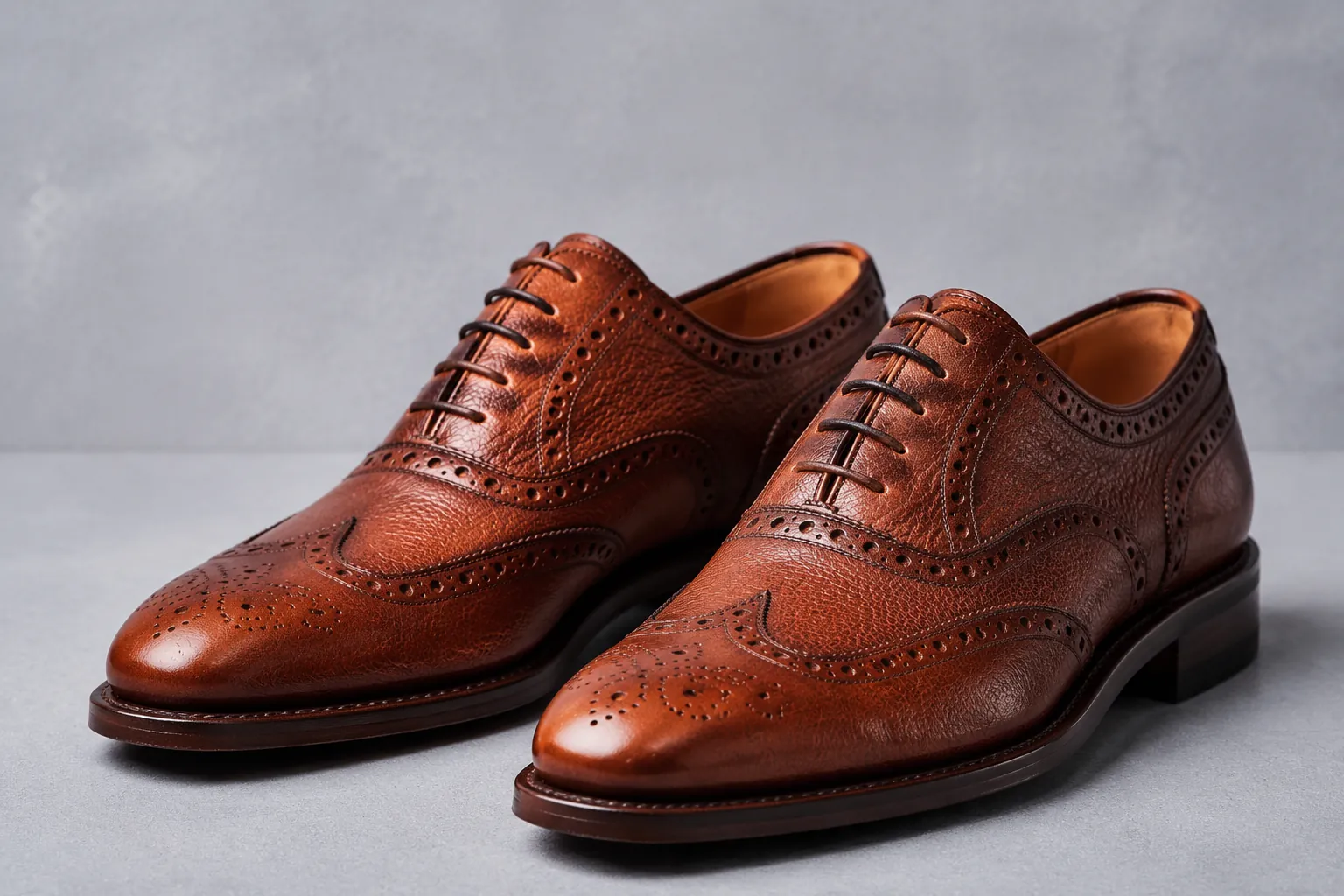
Direct answer
Approve the base last and upper pattern first, then provide controlled artwork for every perforation, pinked edge, wing, seam, and medallion. Review scaling across sizes, leather tear strength, reinforcement, cutting dies, pair alignment, and finishing before bulk.
Buyer terminology and search intent
Buyers often reach the same sourcing problem through different phrases. Use each term to build a controlled product brief rather than a broad supplier promise.
- leather brogue shoesThis guide uses the phrase as a practical buying topic and connects it to the specification, risk, and approval decisions behind brogue shoes manufacturing guide.
- oxford brogue shoesThis product phrase should be qualified by target customer, material, construction, fit, size range, outsole, and intended occasion.
- brogue shoes vs oxfordThis research phrase signals a comparison or classification need. The useful answer is a decision framework rather than a one-line winner.
- mens leather brogue shoesThis product phrase should be qualified by target customer, material, construction, fit, size range, outsole, and intended occasion.
Related buyer searches
These SEMrush variants express closely related product research. They are grouped on this page because the sourcing answer depends on the same fit, material, construction, quality, and order controls.
- womens oxford brogue shoes
- oxford brogue shoes womens
- women's oxford brogue shoes
- oxford brogue shoes women's
- brogue shoes oxford
Specification points to confirm
Use these five controls to make quotations and samples comparable. Name the reference, method, tolerance, owner, and approval status for every point that can change cost or quality.
| Control point | What the buyer should define | Why it matters |
|---|---|---|
| Style definition | Name the lacing construction, toe design, quarter pattern, wing, longwing, semi-brogue, full brogue, or other layout. | Brogue and Oxford are not interchangeable terms, so the pattern must show the exact product. |
| Perforation artwork | Control hole diameters, spacing, rows, curves, medallion geometry, registration points, and size scaling. | Small errors are repeated across the whole upper and become highly visible in paired shoes. |
| Pinking and edges | Define tooth pitch, cut depth, backing, seam allowance, skiving, fold or raw edge, thread, and finish. | Decorative edges must remain clean without weakening narrow leather sections. |
| Material behavior | Select leather thickness, temper, finish, backing, reinforcement, and color around punching and flex requirements. | Brittle coatings can crack around holes, while soft leather can distort under punching. |
| Pair and size QC | Inspect wing height, medallion center, seam curves, perforation cleanliness, symmetry, shade, toe shape, and outsole alignment. | Graded patterns need visual review, not only mechanical enlargement. |
A four-stage buyer workflow
Turn the research into a decision that the factory can quote, sample, manufacture, inspect, and repeat.
Give the style a range role
Define the consumer, occasion, price position, material story, color, channel, and the job this SKU performs. Apply this control: Name the lacing construction, toe design, quarter pattern, wing, longwing, semi-brogue, full brogue, or other layout. Brogue and Oxford are not interchangeable terms, so the pattern must show the exact product.
Approve the fit platform
Set the last, opening, hold, toe allowance, flex, lining, insole, outsole, and wearing conditions before decoration. Apply this control: Control hole diameters, spacing, rows, curves, medallion geometry, registration points, and size scaling. Small errors are repeated across the whole upper and become highly visible in paired shoes.
Engineer visible details
Control pattern geometry, seams, hardware, reinforcement, edge treatment, branding, grading, and component compatibility. Apply this control: Define tooth pitch, cut depth, backing, seam allowance, skiving, fold or raw edge, thread, and finish. Decorative edges must remain clean without weakening narrow leather sections.
Turn the sample into QC
Convert approved fit and appearance into measurements, photos, workmanship points, tests, packing rules, and defect limits. Apply this control: Select leather thickness, temper, finish, backing, reinforcement, and color around punching and flex requirements. Brittle coatings can crack around holes, while soft leather can distort under punching.
Sourcing risks and practical controls
Raise the assumptions most likely to change fit, appearance, cost, quality, or delivery before final sample approval.
Small perforations close after finishing
Control: Test punching, coating, polish, and cleaning on the production leather before tool approval.
Wing tips sit at different heights
Control: Use pattern registration, first-piece templates, and paired inline inspection.
Pinking tears at flex points
Control: Adjust tooth geometry, leather selection, backing, seam position, and reinforcement.
RFQ checklist
Attach images, drawings, a reference pair, or a tech pack, then state the order, market, and approval assumptions the factory must confirm.
- Style definition: Name the lacing construction, toe design, quarter pattern, wing, longwing, semi-brogue, full brogue, or other layout.
- Perforation artwork: Control hole diameters, spacing, rows, curves, medallion geometry, registration points, and size scaling.
- Pinking and edges: Define tooth pitch, cut depth, backing, seam allowance, skiving, fold or raw edge, thread, and finish.
- Material behavior: Select leather thickness, temper, finish, backing, reinforcement, and color around punching and flex requirements.
- Pair and size QC: Inspect wing height, medallion center, seam curves, perforation cleanliness, symmetry, shade, toe shape, and outsole alignment.
- Order architecture: Estimated pairs by style, color, material, and size, plus launch and reorder expectations.
- Market requirements: Destination, channel, labels, testing, packaging, trade term, and customer-specific standards.
- Approval path: Sample purpose, reviewers, comment format, physical references, inspection plan, and release authority.
Frequently asked questions
These answers frame the most common buying decisions for this topic.
Are brogue shoes the same as Oxford shoes?
No. Brogue describes perforated decoration, while Oxford describes closed lacing. An Oxford can be plain or brogued, and brogueing can also appear on Derbies and other styles.
What is a full brogue?
A full brogue commonly uses a wingtip toe, extensive perforation and pinking, and a decorative medallion. Exact panel layouts vary and should be shown in artwork.
Can brogue patterns be customized for a private label?
Yes. Custom artwork, hole sizes, medallions, wings, and edge patterns can create a recognizable design. Confirm tooling, ownership, size scaling, and leather suitability.