
Wholesale Sourcing
Women Leather Shoes Wholesale: Quote Variance Register
Use a quote-variance register to compare women's leather footwear proposals by their stated product and commercial definitions, not price alone.
A variance register gives buyers a structured way to compare women leather shoes wholesale quotations. It places the buyer's current definition beside each quoted response, then records differences, proposed alternatives and unanswered questions. Price remains part of the comparison, but it is read against the definition to which it applies.
The manufacturer's quotation contact page says style, market, quantity, size range, materials, branding, packaging and delivery need are reviewed together rather than priced as isolated line items. This statement supplies the field structure for the register. It does not confirm that every requested combination can be supplied.
Set the comparison baseline
As an editorial recommendation, the buyer should establish one current definition before reviewing proposals. Each response can then be checked against the same revision. The documented quotation frame provides eight headings for that baseline:
- Style: Identify the design and the reference documents submitted with the inquiry. Record their revision or date so the quotation can be connected to the correct definition.
- Market: State the intended market. List any requirements that still need a project-specific response as open questions.
- Quantity: Record the quantity submitted for review. Keep any question about an applicable minimum separate from the buyer's requested quantity.
- Size range: State the requested range and sizing system. Do not infer women's lasts, widths or fit procedures from the available evidence.
- Materials: Enter the current article references or material descriptions. Identify composition questions and acceptable alternatives separately.
- Branding: Specify the requested placement and artwork reference. Treat the request as an input until the quoted response addresses it.
- Packaging: Describe the current packing requirement and record which details the quotation includes, changes or leaves unanswered.
- Delivery need: State the requested destination and timing context. Keep this request distinct from any response or commitment.
For private label women's leather shoes, supporting files may contain artwork instructions and product details while the register records how each proposal responds. Buyers preparing those files can also consult the quote-ready leather shoe RFQ article and the separate women's leather shoe sourcing guide.
Record the reason each quote differs
The following register is an editorial comparison tool built around the published quotation-review fields. It contains no assumed price, tolerance, minimum or timing. The buyer can create a separate response column for each proposal or maintain one register per supplier.
| Field | Buyer's current definition | Quoted response | Recorded variance | Clarification owner | Status |
|---|---|---|---|---|---|
| Style | Current style reference and revision | Wording or document cited in the response | Difference, alternative or omission | Named contact | Open, aligned or superseded |
| Market | Intended market | Market stated in the response | Missing or conflicting context | Named contact | Open, aligned or superseded |
| Quantity | Quantity submitted for review | Quantity basis stated in the quote | Different basis or unanswered point | Named contact | Open, aligned or superseded |
| Size range | Requested range and sizing system | Range stated in the response | Changed, partial or unclear response | Named contact | Open, aligned or superseded |
| Materials | Current references or descriptions | Materials explicitly quoted | Substitution, omission or ambiguity | Named contact | Open, aligned or superseded |
| Branding | Placement and artwork reference | Branding explicitly included | Method, placement or artwork difference | Named contact | Open, aligned or superseded |
| Packaging | Current packing definition | Packaging explicitly included | Alternative, exclusion or open detail | Named contact | Open, aligned or superseded |
| Delivery need | Requested destination and timing context | Response stated in the quotation | Difference or unresolved condition | Named contact | Open, aligned or superseded |
As an editorial control, preserve the earlier baseline when a requirement changes and mark it superseded. This makes clear which definition each quotation addressed. It also prevents an older response from being compared with a revised requirement without noting the change.
Label each register entry
Copied wording can obscure whether an entry came from the buyer or the quoted response. The buyer should assign one classification to each substantive entry and retain the document or message from which it was taken.
- Buyer requirement
The current requirement submitted for consideration. It records the buyer's position, not a supplier commitment.
- Confirmed quotation content
A point explicitly stated in the current quotation. The register should identify the relevant quotation revision.
- Proposed alternative
A different definition offered for consideration. Keep it separate from the baseline unless the buyer revises that baseline.
- Unanswered inquiry topic
A requested point that the response does not settle. As an editorial rule, leave the item open instead of interpreting a blank entry as acceptance.
Development and sampling may be raised when relevant to the project, but the supplied evidence does not document them as guaranteed stages or generally available services. The qualification inquiry should ask which development, sampling or quotation options may apply to the submitted footwear definition.
Keep published controls with their styles
Two published product excerpts illustrate why control points must retain their source context. They concern different named styles and do not document a women's footwear program.
| Published excerpt | Controls named in that excerpt | Limit of the evidence |
|---|---|---|
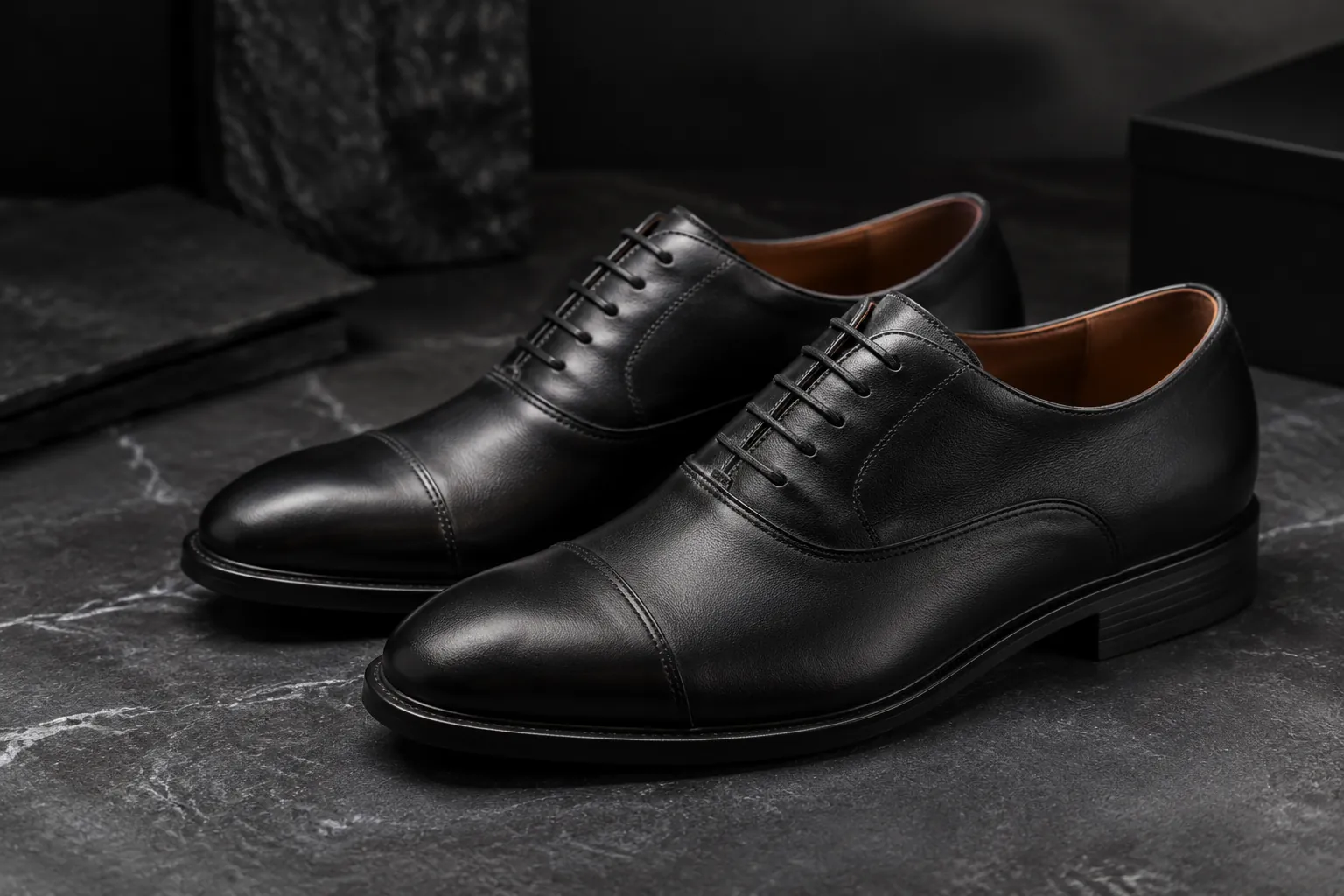
| Black cap-toe Oxford | Facing gap, toe proportion, cap placement, polish and pair symmetry | The excerpt does not establish corresponding controls, availability or capability for women's dress shoes. |
| Tan men's penny loafer | Saddle proportion, apron symmetry, vamp length, opening retention, heel hold and flex | The men's example does not establish a women's loafer program or a women's-specific control definition. |
For a women's inquiry, the buyer can ask which review points apply to the submitted design and record the response against that style. The Oxford list should remain attached to the published black cap-toe Oxford. The penny-loafer list should remain attached to the published tan men's penny loafer.
Use the incoming instruction within its scope
The factory quality page publishes a separate incoming-control instruction. It calls for review of leather article, color, thickness, lining, outsoles, hardware, packaging, artwork and lot identity before mixed or unclear materials enter production.
| Definition retained in the register | Item named in the incoming instruction | What the excerpt does not document |
|---|---|---|
| Leather article, color and thickness definitions | Leather article, color and thickness | Composition, performance or regulatory test results |
| Lining, outsole and hardware definitions | Lining, outsoles and hardware | Approval of every requested option or finished-shoe conformity |
| Packaging and artwork references | Packaging and artwork | Acceptance of the execution described in a quotation |
| Material identity references | Lot identity | A general traceability guarantee |
The register can preserve the revisions used during quotation so the buyer can refer to the same wording in later incoming-stage questions. This is an editorial recommendation for document consistency. The quotation statement and incoming instruction remain separate published points; they do not by themselves document laboratory testing, certification, finished-shoe inspection or an end-to-end quality system.
Send the unresolved variances
A qualification inquiry should include the current women's leather footwear definition and the register entries that still require an answer. The buyer can use the following submission list:
- Identify the current revision of the product definition.
- State the style, market, quantity, size range, materials, branding, packaging and delivery need submitted for review.
- List each unresolved variance as a separate question.
- Ask which development and sampling options may apply to the current project.
- Ask which MOQ, packaging and quotation information applies to the submitted definition.
- Request that proposed alternatives be distinguished from the buyer's baseline.
- Ask which document revision the quotation addresses.
Share the current definition and open register entries through the project contact page. The resulting response can then be entered field by field without treating an inquiry topic as a confirmed capability or promise.
Sources and verification
- Request a Quote | Leather Shoe Manufacturer First-party site source
- Leather Shoe Factory in China | Capability & Export QC First-party site source
- Custom Leather Dress Shoes Manufacturer | OEM & Private Label First-party site source
- Custom Loafers Manufacturer | OEM & Private Label Leather Loafers First-party site source
Share the current leather footwear definition and ask which development, sampling or quotation options may apply to the project.
Send your project brief