
Sourcing
Women Leather Shoes Wholesale Reorder Consistency via Lot Identity
First-run approval does not freeze reorders. Write leather article, components, packaging, artwork, and lot identity into one wholesale definition before the next cut.
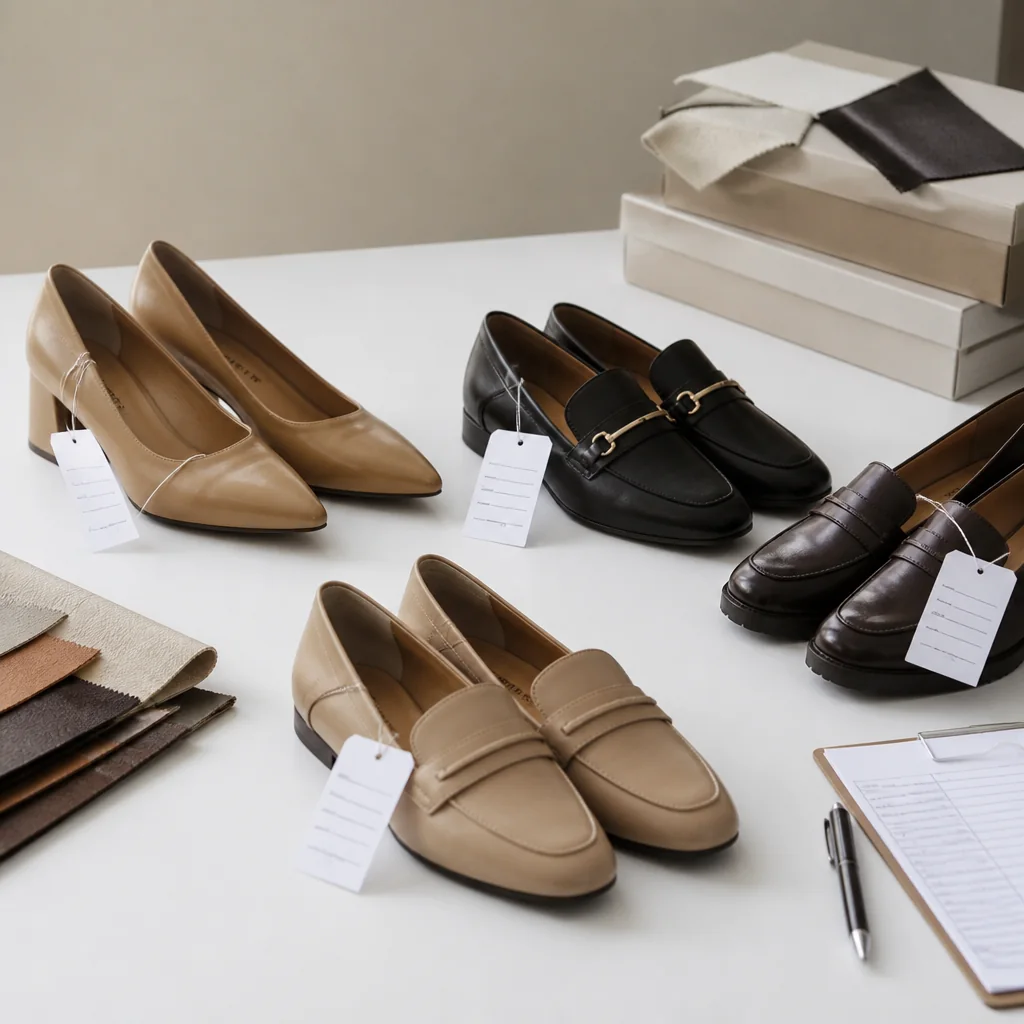
Buyers often approve a sample and a first production run, then open the next shipment to shade shifts, a different hand, substituted lining, hardware that photographs differently, or packaging that no longer matches shelf standards. Women leather shoes wholesale reorder consistency is a procurement problem, not a mystery quality event. The approved pair proved one workable combination. It did not write a durable identity for leather article, components, packaging, artwork, and lot identity that production must reuse.
For private-label and wholesale programs, that gap sits on the buyer side of the brief. Lot identity is not factory housekeeping after the first shipment. It is a pre-production control that belongs on the same page as style, market, quantity, size range, branding, packaging, and delivery need. When those fields stay verbal or live only in a photo of the approved sample, the next cut has nothing durable to enforce.
What still breaks after a clean first wholesale shipment?
Sample acceptance and a clean first PO show that one material-and-process combination produced an acceptable pair. They do not freeze which leather article, which lot, which lining, which outsole tool, which hardware finish, or which packaging and artwork set must reappear next season.
Drift often appears as shade movement under the same color name, hand-feel change when thickness or article is swapped, packaging that no longer meets shelf standards, or hardware that reads differently under retail light. Pair-level finish and symmetry may still pass inspection while the material stack underneath has already moved. Programs that restock core colors feel that erosion faster than a single late delivery, because the brand promise was continuity.
End-of-line photos alone do not close the gap. Identity has to be locked before materials can be mixed or left unclear at the incoming gate, and that identity has to sit inside the commercial frame so pricing and planning do not treat materials as open variables.
Incoming confirmation fields at the material gate
Factory incoming control is described as a confirmation step: controlled materials are reviewed before mixed or unclear materials enter production. The named fields are leather article, color, thickness, lining, outsoles, hardware, packaging, artwork, and lot identity. That boundary is a gate against ambiguous inputs. It is not a full AQL system, a third-party audit claim, or a promise of perfect match forever.
Editorial recommendation for buyers: treat those same fields as the minimum closed set before you plan a reorder. Women leather shoes wholesale lot identity belongs in that set as a first-class field, not a side note after the PO ships.
- Leather article (named construction or tannage reference, not only a marketing color word)
- Color identity tied to that article
- Thickness range or target for the upper leather
- Lining material and color
- Outsole type or tool reference
- Hardware finish and part identity
- Packaging components and copy
- Artwork files and placement rules
- Lot identity for materials held or reordered against the approved set
Write them as buyer-owned fields on the program definition. Do not assume the factory will invent lot continuity from a first PO alone. If a field is still open, it is development work, not a locked reorder input. How that incoming gate is described is on the factory quality page.
Identity fields that make a wholesale definition reorder-ready
A reorder-ready definition gives every identity field a value, a reference, or an explicit open flag. Packaging confirmation belongs in the same record as leather thickness, because packaging and artwork often change between seasons when buyers only re-approve the last. Wholesale women's leather shoe packaging confirmation is part of private label women leather shoes reorder control, not a post-shipment cleanup task.
| Identity field | What to lock for reorders | Buyer risk if left open |
|---|---|---|
| Leather article | Named article or tannage reference used on the approved run | Hand, grain, and dye uptake shift under the same color name |
| Color | Color code or standard tied to that article | Shade drift across pairs and sizes |
| Thickness | Target or range for upper leather | Stiffness, break, and lasting behavior change |
| Lining | Material type and color | Interior contrast and comfort claims fail |
| Outsoles | Tool or construction reference | Wear pattern and silhouette change under the same style code |
| Hardware | Finish and part identity | Retail photos and physical pairs diverge |
| Packaging and artwork | Component list, copy, and file versions | Shelf presentation and compliance labels drift |
| Lot identity | Which material lots map to the approved set | Mixed or unclear lots re-enter production on the next PO |
These are the incoming confirmation fields reframed as a buyer checklist so private-label reorder control can happen before cut, not a separate service package.
When Oxford and loafer control points are not enough
Classic dress and loafer silhouettes still depend on a stable material stack. On the dress shoes page, a black cap-toe Oxford is described with facing gap, toe proportion, cap placement, polish, and pair symmetry as control points. Those checks still matter on reorders, but they cannot recover a different leather article or thickness that changes how the cap sits or how polish reads across a pair.
On the loafers page, a penny loafer is described with control of saddle proportion, apron symmetry, vamp length, opening retention, heel hold, and flex for a repeatable core style. Opening retention and flex depend heavily on leather character and lining. If lot identity and article remain open, the style team can still measure proportions while the product feels and photographs like a different shoe.
Use those pages as construction anchors, not as substitutes for material identity, and not as claims of women-only lasts or gender-exclusive lines. See how Oxford control points are framed on dress shoes and how loafer repeatability is framed on loafers, then complete the materials table before re-approving polish or saddle geometry alone.
One commercial frame, not isolated line items
Quote review is described as reading the product and commercial frame together: style, market, quantity, size range, materials, branding, packaging, and delivery need are reviewed together rather than priced as isolated line items. That framing matters for reorder consistency. If materials and packaging identity are still open while quantity and delivery need are treated as fixed, the commercial conversation is incomplete.
Editorial recommendation: send one definition where locked identity fields and commercial fields sit in the same document. Avoid pricing upper leather as a free-floating line while article, color, thickness, and lot identity remain unresolved. Avoid separating branding and packaging from the material set that will sit next to them on shelf. A single commercial-frame review reduces the chance that a later substitution is treated as a minor cost tweak when it is actually a new identity.
You can still ask which sampling, MOQ, packing, or quotation information may apply to the project. Those remain questions about fit to the program, not pre-promised service bundles.
Locked identity record versus open development work
Separate what you will treat as locked for reorder consistency from what remains open development work so the next PO does not inherit unresolved experiments.
- Build the confirmed identity record. List leather article, color, thickness, lining, outsoles, hardware, packaging, artwork, and lot identity with the values used on the approved first run, or the values you will accept going forward. Mark a field closed only when the reference is written.
- Attach the commercial frame. Add style, market, quantity, size range, branding, packaging presentation, and delivery need so materials are not reviewed alone.
- Flag open development questions separately. New colorways, untried linings, alternate outsoles, or unfinalized artwork stay outside the locked reorder record until you intentionally promote them.
- Treat unclear fields as blocked for planning. If identity is incomplete, do not plan production on the hope that incoming staff will reconstruct the prior lot.
Hypothetical example: a buyer who approved a first brown loafer run without recording lot identity and packaging file versions may later receive a matching style code with a different leather hand and a revised shoe box. Pair symmetry inspection is not the failure mode; the missing written wholesale identity is.
What to send for product-and-commercial assessment
When you are ready for review, send one coherent definition rather than a scattered email thread. Include the locked identity fields named at incoming, the style anchors you care about for dress or loafer programs, and the commercial fields listed for joint review. Keep sampling options, MOQ discussion, packing variants, or quotation paths as questions about what may apply to the project.
A complete definition for assessment typically covers:
- Style references and market positioning
- Quantity and size range intent for the reorder or program
- Materials identity: article, color, thickness, lining, outsoles, hardware
- Lot identity notes for materials that must match the approved set
- Branding, packaging, and artwork versions
- Delivery need stated as a planning input, not a freestanding price line
- Explicit list of fields still open for development
That package shows whether reorder continuity is protected by identity control or still exposed to mixed materials. Share the current leather footwear definition and ask which development, sampling, or quotation options may apply through contact. Continuity claims should stay inside what confirmation before production can support: controlled materials and lot identity reviewed so mixed or unclear inputs do not enter the next run.
Sources and verification
- Leather Shoe Factory in China | Capability & Export QC First-party site source
- Request a Quote | Leather Shoe Manufacturer First-party site source
- Custom Leather Dress Shoes Manufacturer | OEM & Private Label First-party site source
- Custom Loafers Manufacturer | OEM & Private Label Leather Loafers First-party site source
Share the current leather footwear definition and ask which development, sampling or quotation options may apply to the project.
Send your project brief