
Loafer Sourcing
Open Decisions in a Wholesale Men's Penny Loafer Supplier Brief
A practical register for recording the current penny loafer definition, keeping material appearance separate, and carrying open decisions into an inquiry.
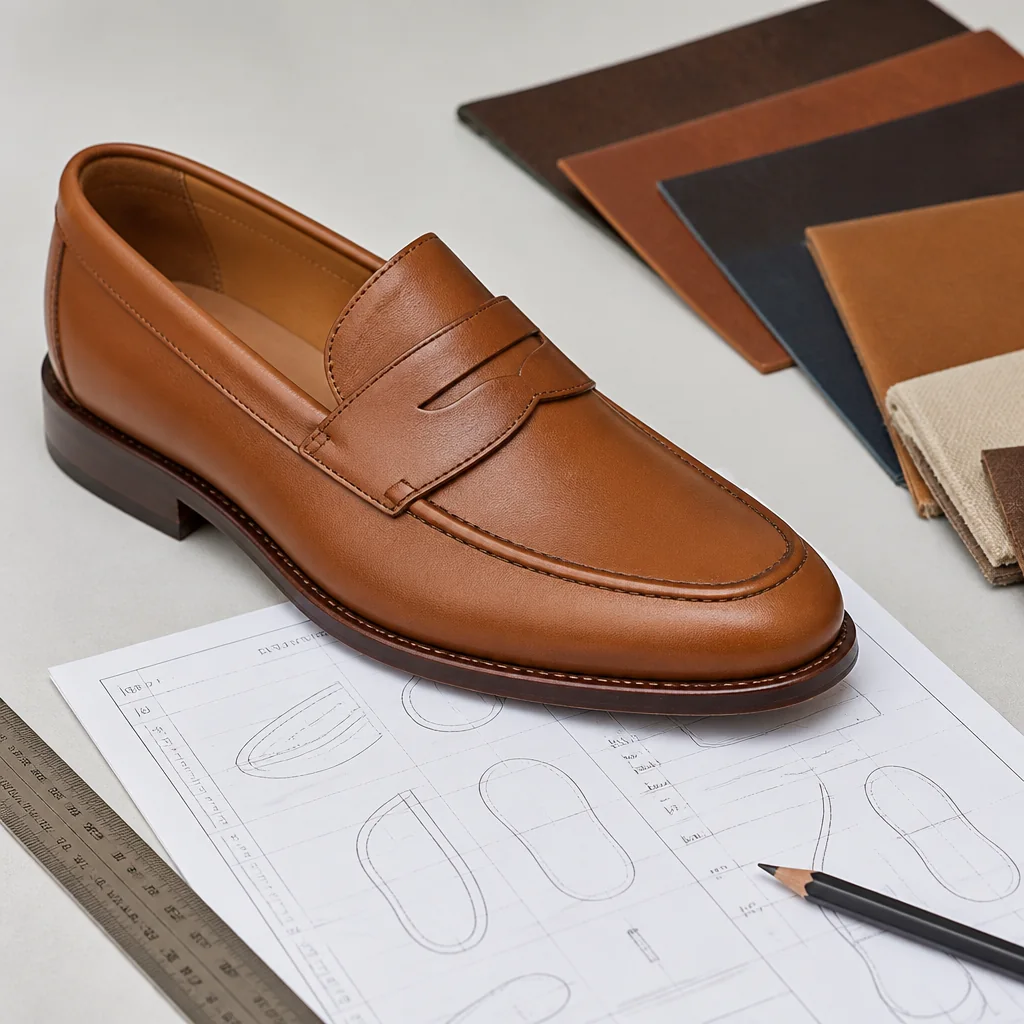
Before sending a product inquiry, put the current penny loafer definition into a working document. The editorial recommendation in this wholesale men's penny loafer supplier brief is to use an uncertainty register: record what the buyer has decided, identify the reference behind each decision, and leave unresolved points visibly open. Treat the register as inquiry preparation rather than a supplier procedure or a finished technical specification.
The suggested output has two parts. The first covers the controls named for the penny loafer. The second holds material-appearance questions. Keeping them apart helps the buyer show the current product direction without filling gaps with assumed measurements, tests, processes, or commercial terms.
What belongs in the working brief?
The company's loafer-page excerpt identifies a tan men's penny loafer as L-01. For a repeatable core style, it names six controls:
- Saddle proportion
- Apron symmetry
- Vamp length
- Opening retention
- Heel hold
- Flex
Within the provided excerpt, those controls have no accompanying tolerances, measurement methods, tests, size-grading rules, or acceptance thresholds. The buyer's register should therefore preserve the terms as written and record only the project definitions that already exist.
The materials-page excerpt addresses a different subject. It asks what variation is natural, what becomes a defect, how colors are approved, and how hides or component lots are paired across the order. These four questions belong in a separate record rather than being added to the six loafer controls.
The six-control register
The following table is an editorial worksheet for the buyer. Use one row for each sourced control. The lane names and the statuses defined below are organizational aids, not documented factory terminology. Each row asks for the governing project reference, the definition currently supported by that reference, and the decision that remains open.
Buyer-owned uncertainty register for the documented loafer controls
| Editorial lane | Documented control | Governing project reference | Current project definition | Unresolved decision | Status: defined, partial, or open |
|---|---|---|---|---|---|
| Visible geometry | Saddle proportion | Identify the drawing, image, annotation, or written direction used for the saddle. | Record the proportion currently shown or described. | Which part of the intended saddle proportion remains undecided? | Buyer to complete |
| Visible geometry | Apron symmetry | Identify the reference used for the apron. | Record the current direction for apron symmetry. | What remains unresolved about the intended apron symmetry? | Buyer to complete |
| Visible geometry | Vamp length | Identify the drawing or written direction used for vamp length. | Record the current length direction without adding an unstated value. | What remains undefined about the intended vamp length? | Buyer to complete |
| Retention | Opening retention | Identify any existing wording or reference for opening retention. | Record the meaning currently assigned by the buyer. | Which part of the opening-retention definition still needs an answer? | Buyer to complete |
| Retention | Heel hold | Identify any existing wording or reference for heel hold. | Record the meaning currently assigned by the buyer. | What part of the heel-hold definition remains open? | Buyer to complete |
| Flex | Flex | Identify any existing descriptive direction or reference. | Record the buyer's current flex direction. | Which flex decision has not yet been defined? | Buyer to complete |
Editorial status key: Defined means the buyer regards the current entry as settled for the purpose of making the inquiry. Partial means a reference or direction exists but leaves part of the control unanswered. Open means the buyer has no settled entry. These labels describe the buyer's document; they are not acceptance levels.
For this worksheet, saddle proportion, apron symmetry, and vamp length sit under visible geometry. Opening retention and heel hold are filed under retention, while flex remains on its own. This grouping is only a way to scan the document. It carries no claim that one control causes a particular fit, comfort, durability, flex, or wear result.
Material appearance: a separate record
The four prompts on the materials page define the scope of this second record. They concern natural variation, the point at which variation becomes a defect, color approval, and the pairing of hides or component lots across the order. They should remain questions until project-specific information supplies an answer.
Use these penny loafer material appearance questions beside the control register, with their own references and open decisions:
Editorial record for material-appearance inquiry topics
| Materials-page topic | Current buyer record | Question to carry into the inquiry |
|---|---|---|
| Natural variation | Identify the current appearance reference, or mark the topic open. | What variation does the buyer intend to treat as natural? |
| Defect boundary | Record any buyer-defined description or examples, or leave the boundary open. | Where does intended variation end and a defect begin for this project? |
| Color approval | Identify the current color reference and its status within the buyer's project. | How are colors to be discussed for approval, and what remains undecided? |
| Hide or component-lot pairing | Record the buyer's current pairing direction, or mark it open. | What needs to be asked about pairing hides or component lots across the order? |
Keep these entries in question form. A color reference records the buyer's current input; it does not establish a company approval procedure. A question about hide or component-lot pairing likewise establishes no particular method, responsibility, or available service.
Defined, partial, or open?
For this editorial method, the status should describe the entry as it exists today. It should not make the document look more complete than the underlying references allow.
- Defined
The buyer has a settled reference or written direction for the row and can state what it currently defines. This status says nothing about supplier acceptance or feasibility.
- Partial
A reference exists, but it does not answer the whole row. Record the part it covers, then write the remaining decision as a direct question. Do not promote a partial field to defined merely because an image or note has been attached.
- Open
No settled reference or wording has been entered. In this register, an intentionally open field communicates the actual stage of the project and identifies a subject for discussion.
Apply the same status language across all six controls. Material appearance remains on its separate record, where the buyer can also distinguish an existing reference from an unresolved question.
The inquiry packet
For a private label men's penny loafer inquiry, the editorial recommendation is to share the register in its current state. Defined fields present the direction already chosen. Partial and open fields show where the buyer needs project-specific information.
- Identify the penny loafer project and list the drawings, images, annotations, color references, or written directions the buyer is using.
- Attach the six-control register with each current definition and status left intact. Keep unresolved wording visible.
- Add the separate material-appearance record. Do not use an answer about appearance to fill a different loafer-control row.
- Name each unresolved product point before asking which development, sampling, or quotation option, if any, may apply to it.
An editorial inquiry can use wording such as:
We are preparing a men's penny loafer project. Attached is our current definition for the six listed controls, with partial and open decisions marked. We have recorded material-appearance questions separately. Please indicate which development, sampling, or quotation option, if any, may apply to the unresolved points.
Place any commercial topics in a separate question list. The register supplies product-definition context, but it does not supply figures, terms, an approval sequence, or a commitment that a particular route will be available.
Questions the excerpts cannot answer
The two linked excerpts do not establish the following project information:
- Numerical tolerances, measurement locations or methods, fit standards, size ranges, size-grading rules, flex tests, opening-retention tests, heel-hold tests, or acceptance thresholds
- Leather grades, linings, outsoles, constructions, component specifications, or material-performance requirements
- Certifications, regulatory compliance, audits, inspections, test results, production capacity, or first-hand factory observations
- Minimum quantities, prices, tooling charges, sample charges, sample terms, payment terms, lead times, delivery schedules, or delivery commitments
Where any of these subjects matter to the project, treat them as questions requiring project-specific answers. Their absence from the excerpts establishes neither availability nor unavailability.
Share the current definition
Send the current leather-footwear definition through the contact page. Include the status of saddle proportion, apron symmetry, vamp length, opening retention, heel hold, and flex. Add the separate appearance questions relevant to the project, then ask which development, sampling, or quotation option, if any, may apply to each unresolved point.
This approach presents the concept at its current stage and leaves the applicable route, commercial terms, and timing open for a project-specific response.
Sources and verification
- Custom Loafers Manufacturer | OEM & Private Label Leather Loafers First-party site source
- Leather Shoe Materials | Full Grain, Suede, Lining & Outsoles First-party site source
Share the current leather footwear definition and ask which development, sampling or quotation options may apply to the project.
Send your project brief