
Wholesale Sourcing
Wholesale Leather Shoes Style Control Points to Lock Early
Material lock alone does not keep wholesale pairs consistent. Name Oxford and penny loafer geometry as buyer-owned brief fields, then bind them to incoming confirmation and the joint commercial frame.
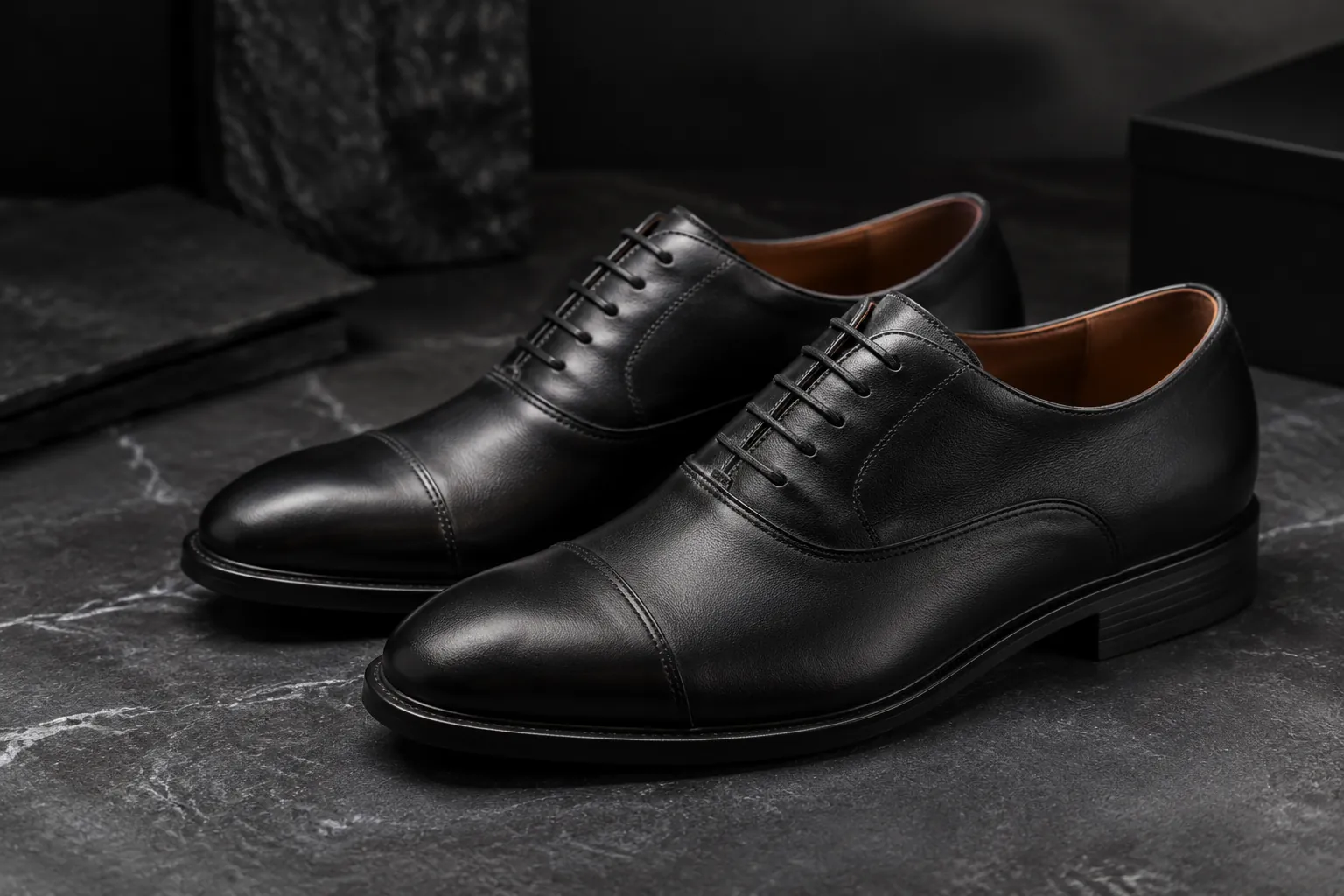
A wholesale program can confirm leather article, color, and commercial terms and still receive uneven pairs once production starts. Facing gap, cap placement, saddle proportion, and pair symmetry never appeared as named buyer fields, so they stayed in informal craft judgment. Wholesale leather shoes style control points close that gap: geometry and finish belong on the brief beside materials, not later as QC complaints.
When a locked leather article still ships uneven pairs
Procurement teams are right to treat leather type, lining, and outsole as hard gates. In the factory quality sequence, controlled materials are reviewed before mixed or unclear inputs enter production: leather article, color, thickness, lining, outsoles, hardware, packaging, artwork, and lot identity. That gate protects the program from mixed lots and unclear components.
It does not decide whether a cap-toe Oxford reads as one disciplined program or a set of near-matches. Style geometry is a separate decision layer. If the brief never names facing gap, toe proportion, cap placement, polish, or pair symmetry for an Oxford, those fields default to workshop interpretation. The same risk applies to a penny loafer when saddle proportion, apron symmetry, vamp length, opening retention, heel hold, and flex remain unnamed. Catalog photos and verbal references rarely survive a size-run program with the consistency wholesale buyers need. Material language can be perfect while the pairs still fail a visual program test.
Convert the core style into named control fields
Turning a style choice into a briefable list is a buyer task, not a late-stage inspection exercise. Treat the style name as a container, then fill it with the geometry and finish fields that decide whether reorders and size runs still look like the same product. As an editorial recommendation for structuring that work:
- Pick the core silhouette that anchors the program, such as a formal cap-toe Oxford or a men's penny loafer.
- List only the geometry and finish fields that decide whether pairs will read as one product across sizes and reorders.
- Place those fields next to material and commercial terms on the same definition you share for assessment.
- Leave open development questions separate so they do not masquerade as already-locked controls.
Factory language on dress shoes and loafers already treats certain fields as control points. Own those names on the wholesale brief rather than assuming uniform application without instruction. Photos help, but photos without field names still leave room for interpretation when last, size, and finish interact in production.
Cap-toe Oxford fields that belong on the wholesale brief
On the dress-shoe program page, the cap-toe Oxford is framed as a disciplined formal anchor, with facing gap, toe proportion, cap placement, polish, and pair symmetry treated as control points. Those five names are the ones worth writing into a wholesale leather oxford control points section of your brief. Formal program context sits on the custom leather dress shoes page.
Field glosses in this article are editorial recommendations for how a buyer can interpret each named control on a brief. They are not factory-published acceptance criteria, millimetre tolerances, or scoring rules. If a buyer later needs numeric limits, that is a development conversation, not a fact already present in the public control language.
- Facing gap
- How the facings meet or open along the vamp and lace line, and whether that relationship holds across the pair.
- Toe proportion
- The relative length and shape of the toe against the rest of the last silhouette.
- Cap placement
- Where the cap seam sits and how that placement reads left to right.
- Polish
- The finish expectation that must hold across the size run, not only on a show sample.
- Pair symmetry
- Left-right consistency wholesale buyers use to judge whether a shipment is program-ready.
Name the fields, attach reference photos or approved samples when you hold them, and treat the list as buyer-owned language.
Penny loafer fields that belong on the wholesale brief
Where the Oxford list is about formal seam discipline, the loafer brief is about proportion and hold. The loafer page frames the men's penny loafer as a repeatable core style when saddle proportion, apron symmetry, vamp length, opening retention, heel hold, and flex are controlled. Those six names form the parallel list for penny loafer wholesale specifications. The custom loafers page is the style home for this control set; use it for field names, not as a substitute for writing those names into your own brief.
Apply the same editorial boundary already stated for Oxford glosses: the notes below help a buyer phrase the brief. They do not publish factory acceptance metrics.
- Saddle proportion: width and placement of the saddle relative to the vamp and apron.
- Apron symmetry: balanced apron stitching and shape from left to right.
- Vamp length: how much vamp shows and how that length holds across sizes.
- Opening retention: whether the throat opening holds its intended shape in handling and wear.
- Heel hold: rear fit and structure that keep the shoe seated without collapse.
- Flex: break and flex behaviour expected for the construction and intended use.
A wholesale program that only specifies leather color and hardware for a loafer still leaves the visual identity of the shoe open. Keep the list to the named fields.
Bind style controls to the incoming confirmation gate
Style geometry and material gates should not travel on separate calendars. Incoming confirmation reviews leather article, color, thickness, lining, outsoles, hardware, packaging, artwork, and lot identity so mixed or unclear materials do not enter production. If the style definition is still incomplete when that review happens, production can begin with clear materials and unclear geometry.
As an editorial recommendation for the buyer: attach the Oxford or loafer control list to the same package that confirms articles and lot identity. That practice does not expand the factory's published incoming list. It keeps style language from arriving later as a complaint about craft judgment. When hardware, packaging, or artwork are still open, mark them open. When facing gap or saddle proportion are already decided, mark them locked. Incomplete definitions become expensive at this gate because mixed material risk and style ambiguity can compound in the same production window.
Factory quality framing for that material review sits on the leather shoe factory quality page. Use it to align material identity with the style fields you have already named, not as a place to discover geometry after cutting has started.
Keep style controls inside the commercial-frame review
Quote and program assessment is not a stack of isolated line items. The contact process describes reading the product and commercial frame together: style, market, quantity, size range, materials, branding, packaging, and delivery need are reviewed jointly rather than priced as disconnected pieces.
Wholesale leather shoes production controls only work if style control points ride inside that same frame. Naming facing gap or apron symmetry after commercial terms are already assumed to be fixed invites rework and mismatched expectations. Bring style, materials, branding, packaging, and delivery need into one definition so the review can see how they interact. Quantity and size range still matter, but they do not replace geometry language. A brief that is rich on delivery need and thin on pair symmetry is still an incomplete wholesale definition.
Locked style controls versus open development questions
Not every field on a brief is ready to lock. Separating locked controls from open questions keeps the inquiry honest and avoids over-claiming what has already been agreed. The table below is editorial guidance for how you structure the handoff, not a factory process map.
| Status | What belongs here | Buyer action |
|---|---|---|
| Locked style controls | Named Oxford or loafer fields you can already specify (facing gap, cap placement, saddle proportion, and the parallel lists above) | Write them into the shared definition with any approved references you hold |
| Locked materials and identity | Leather article, color, thickness, lining, outsoles, hardware, packaging, artwork, and lot identity when already confirmed | Keep them aligned with the incoming confirmation list so mixed inputs stay out |
| Commercial frame | Style, market, quantity, size range, materials, branding, packaging, and delivery need as a joint set | Present them together for review rather than as isolated asks |
| Open development questions | Sampling path, quantitative tolerances not yet agreed, unconfirmed branding or packing details, anything still exploratory | Ask which development, sampling, or quotation options may apply; do not treat those topics as promised services |
This separation does not invent commercial quantities, MOQs, or lead times, and it does not convert an invitation to discuss options into a documented factory guarantee. If only half the Oxford fields are firm, lock those half and label the rest as questions. Partial honesty beats a brief that looks complete and fails in production.
Share one style-controlled footwear definition for assessment
The practical close is a single definition, not a trail of partial emails. Include the core style, the named control points for that silhouette, the material and lot identity status, and the commercial frame elements that are known. Then ask which development, sampling, or quotation options may apply to the project.
That invitation keeps the next step proportional to what you have actually locked. If Oxford pair symmetry and polish are firm but packaging artwork is not, say so. If the penny loafer saddle and flex are decided but size-range quantity is still being modelled, leave the open items open. A shared definition is easier to review than a stack of disconnected style notes and material swatches. When you are ready, share the current leather footwear definition and request assessment of the options that fit the program you actually have on paper.
Sources and verification
- Leather Shoe Factory in China | Capability & Export QC First-party site source
- Request a Quote | Leather Shoe Manufacturer First-party site source
- Custom Leather Dress Shoes Manufacturer | OEM & Private Label First-party site source
- Custom Loafers Manufacturer | OEM & Private Label Leather Loafers First-party site source
Share the current leather footwear definition and ask which development, sampling or quotation options may apply to the project.
Send your project brief