
Footwear Sourcing
Wholesale Leather Shoes RFQ Template by Decision State
Use a buyer-owned three-state wholesale leather shoes RFQ template to record fixed decisions, preferred directions, and open questions across quotation-review fields, preparation prompts, and silhouette-specific control points.
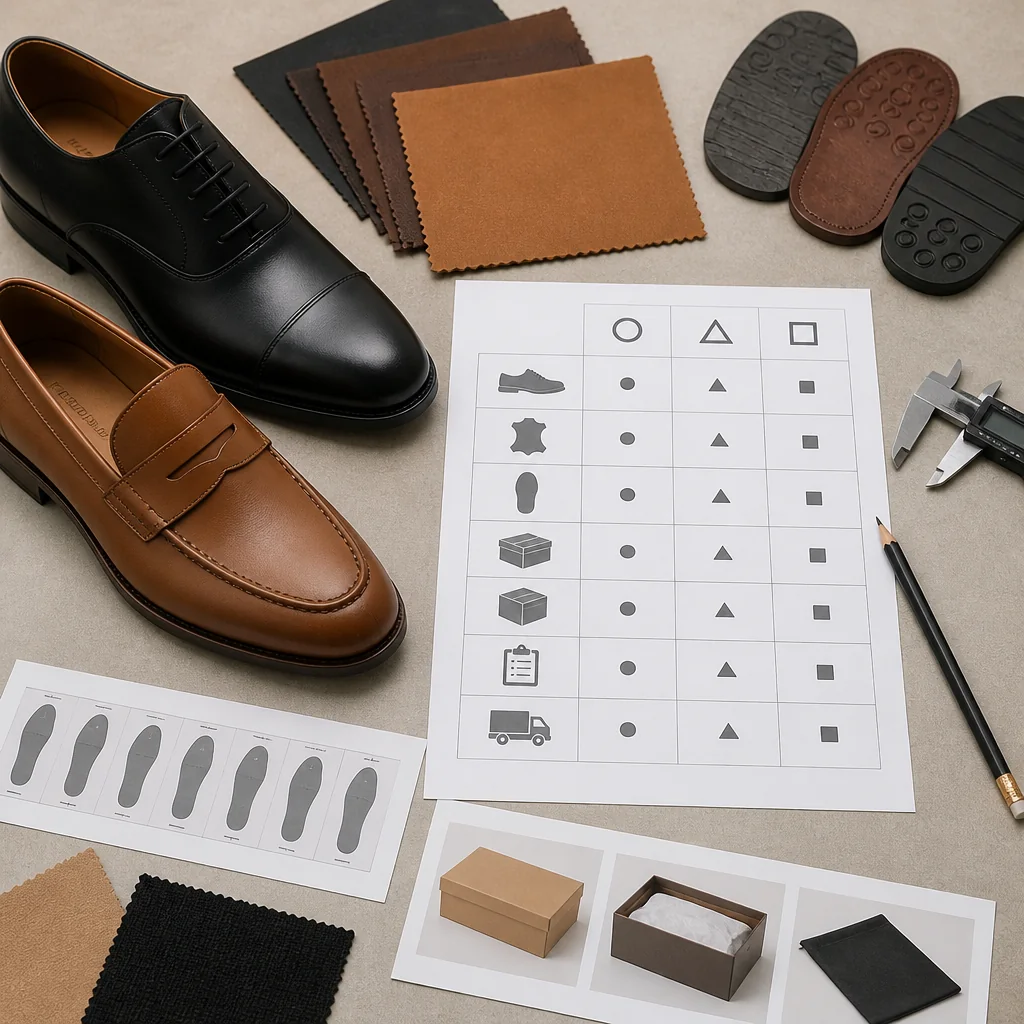
When a product direction is clear enough to contact a factory but several materials, branding, packaging, size-range, or delivery choices remain unsettled, the handoff fails if every field looks final—or if open items vanish into a vague note. A wholesale leather shoes RFQ template works better as a decision-state matrix: each field carries a status (fixed, preferred, or open for inquiry), a current definition or reference, and an unresolved question. The matrix is editorial procurement guidance for the buyer, not the manufacturer's required form, workflow, or service.
Hypothetical partial row (buyer-owned example only): Field = packaging; Decision state = open for inquiry; Current definition = none selected; Unresolved question = what packing information applies to this project? That single pattern can be repeated across the product and commercial frame the manufacturer says it reviews together.
What belongs in a wholesale leather shoes RFQ template?
On the manufacturer's quotation page, style, market, quantity, size range, materials, branding, packaging, and delivery need are reviewed together rather than priced as isolated line items. That joint frame is the core of leather shoe quotation requirements in this article. Blank cells without a status leave the recipient guessing whether a detail was overlooked, deferred, or never relevant. Labels that force tentative choices into “final” status create the opposite distortion.
Scope note for this section: the source supports joint review of those eight fields. It does not document minimum quantities, lead times, price rules, size-grading methods, packing menus, delivery arrangements, sampling paths, or development option sets. Anything outside the published frame stays a buyer definition or an explicit question.
Three decision states for each RFQ field
Status attaches to the field, not the whole project. One inquiry can hold a fixed style, a preferred material direction, and an open delivery question at once. The definitions below are editorial recommendations for structuring the record.
| Status | Buyer meaning | What to enter |
|---|---|---|
| Fixed | The buyer has made a current project decision. | Record the specification, reference, or commercial requirement. Fixed is a buyer decision, not manufacturer acceptance. |
| Preferred | The buyer has a direction and may still consider alternatives. | State the preferred definition and the characteristics that should survive if another route is discussed. |
| Open for inquiry | The buyer has not selected or validated a direction. | Write a direct question. Do not invent a specification only to fill the cell. |
Every working row should hold four parts: field name, decision state, current definition or reference, and unresolved question. That layout separates a missing decision from missing data and keeps preferred from reading as fixed.
Start with the quotation-review fields only
Use this copy-ready matrix for the exact fields named in the quotation review. Complete the blank cells with project data; do not treat empty cells as implied factory options.
| Field | Decision state | Current definition or reference | Unresolved question |
|---|---|---|---|
| Style | |||
| Market | |||
| Quantity | |||
| Size range | |||
| Materials | |||
| Branding | |||
| Packaging | |||
| Delivery need |
Editorial recommendation: if the buyer uses “silhouette” language internally, keep it as a note under Style rather than renaming the source field. A private label footwear RFQ can still sit inside this same eight-field frame; the editorial purpose of the format is to keep each field's decision state visible beside the product definition in one buyer-owned record.
Incoming categories as preparation prompts
The factory-quality page documents a separate stage: before mixed or unclear materials enter production, it reviews leather article, color, thickness, lining, outsoles, hardware, packaging, artwork, and lot identity. Those names can sharpen buyer preparation questions, but they are not a second quotation form and not proof of quote-stage inspection, laboratory testing, independent approval, certification, or a quality guarantee.
Use the following table only as an editorial preparation aid. Assign decision states the same way, and leave open items as questions rather than assumed controls.
| Preparation prompt | Decision state | Current definition or reference | Unresolved question |
|---|---|---|---|
| Leather article | |||
| Color | |||
| Thickness | |||
| Lining | |||
| Outsoles | |||
| Hardware | |||
| Packaging | |||
| Artwork | |||
| Lot identity |
Packaging appears in both published excerpts. At quotation it is part of the product and commercial frame; in the factory-quality excerpt it is one incoming-review item. Do not merge the stages because the word repeats.
Where commercial context stays visible
Market, quantity, size range, branding, packaging, and delivery need belong in the same project record as style and materials because the quotation source reviews them together. Practical buyer prompts for those rows:
- Market: record the known market context; mark unresolved destination or channel points as open.
- Quantity and size range: enter the current requirement or leave the status open and ask what information applies to the project.
- Branding and packaging: separate supplied artwork or fixed presentation rules from preferred directions and open packing questions.
- Delivery need: state the current need without converting it into a schedule, shipping method, or performance commitment.
Statuses need not match across rows. The matrix should preserve the actual level of closure field by field.
Cap-toe Oxford control points
When the inquiry concerns the named cap-toe Oxford on the manufacturer's dress-shoe page, add a style-specific record using only the published control points: facing gap, toe proportion, cap placement, polish, and pair symmetry. The source does not supply tolerances, measurement procedures, test methods, or acceptance thresholds for those points.
- Create a separate Oxford sheet; do not bury the five fields inside the generic Style row.
- For each control point, enter decision state, current definition or reference, and unresolved question.
- Treat a reference image as appearance guidance only unless the buyer has separately defined a measurable standard.
- Do not extend these Oxford labels to other dress-shoe constructions without supporting product information.
| Oxford control point | Decision state | Current definition or reference | Unresolved question |
|---|---|---|---|
| Facing gap | |||
| Toe proportion | |||
| Cap placement | |||
| Polish | |||
| Pair symmetry |
Penny loafer control vocabulary
The manufacturer's loafer page publishes a different set for its named penny loafer: saddle proportion, apron symmetry, vamp length, opening retention, heel hold, and flex. Those labels are style-specific to that page, not a guaranteed result for every loafer or footwear program.
| Style record | Published control vocabulary |
|---|---|
| Cap-toe Oxford | Facing gap, toe proportion, cap placement, polish, pair symmetry |
| Penny loafer | Saddle proportion, apron symmetry, vamp length, opening retention, heel hold, flex |
Keep shared RFQ fields in the main matrix. Attach only the style record that matches the inquiry. Do not transfer Oxford controls onto a loafer, and do not expand the penny-loafer list to other loafer constructions without supporting product information. Use the same four-column pattern for the loafer points when that silhouette is in scope.
| Penny loafer control point | Decision state | Current definition or reference | Unresolved question |
|---|---|---|---|
| Saddle proportion | |||
| Apron symmetry | |||
| Vamp length | |||
| Opening retention | |||
| Heel hold | |||
| Flex |
Quotation review versus incoming confirmation
The two published stages answer different questions and should stay separate inside the RFQ record.
| Published stage | Documented scope | Buyer-side use |
|---|---|---|
| Quotation review | Style, market, quantity, size range, materials, branding, packaging, and delivery need are considered together. | Present the current product and commercial frame, including unresolved statuses. |
| Incoming checkpoint | Leather article, color, thickness, lining, outsoles, hardware, packaging, artwork, and lot identity are reviewed before mixed or unclear materials enter production. | Keep that timing visible; do not describe an open quote-stage field as if it had already passed incoming confirmation. |
Neither excerpt establishes laboratory testing, independent approval, certification, inspection rates, or a quality guarantee. An OEM leather shoe quote request that blurs the stages can overstate what has been decided and what has only been listed for later production control.
Convert open cells into inquiry topics
Before sending the matrix, turn every open cell into a question assessed against the current footwear definition. Editorial examples of direct questions:
- Which development or sampling options, if any, may apply to the product as currently defined?
- What MOQ information applies to this style, material direction, size range, and branding context?
- Which material details are needed before the quotation request can be assessed?
- What packing or quotation information applies to the project?
- Which delivery details should the buyer define at this stage?
Those questions request assessment. They do not document that a particular option, timing, price, packing service, or eligibility exists.
Share the completed decision-state matrix through the contact page, keep fixed, preferred, and open statuses intact, attach the Oxford or penny-loafer control record only when it matches the style under discussion, and ask which development, sampling, MOQ, packing, or quotation information may apply to the project.
Sources and verification
- Request a Quote | Leather Shoe Manufacturer First-party site source
- Leather Shoe Factory in China | Capability & Export QC First-party site source
- Custom Leather Dress Shoes Manufacturer | OEM & Private Label First-party site source
- Custom Loafers Manufacturer | OEM & Private Label Leather Loafers First-party site source
Share the current leather footwear definition and ask which development, sampling or quotation options may apply to the project.
Send your project brief