
Leather Shoe Sourcing
Wholesale Leather Shoes: Define Before You Quote
A practical guide to defining a wholesale leather shoe project before requesting development, sampling or quotation options.
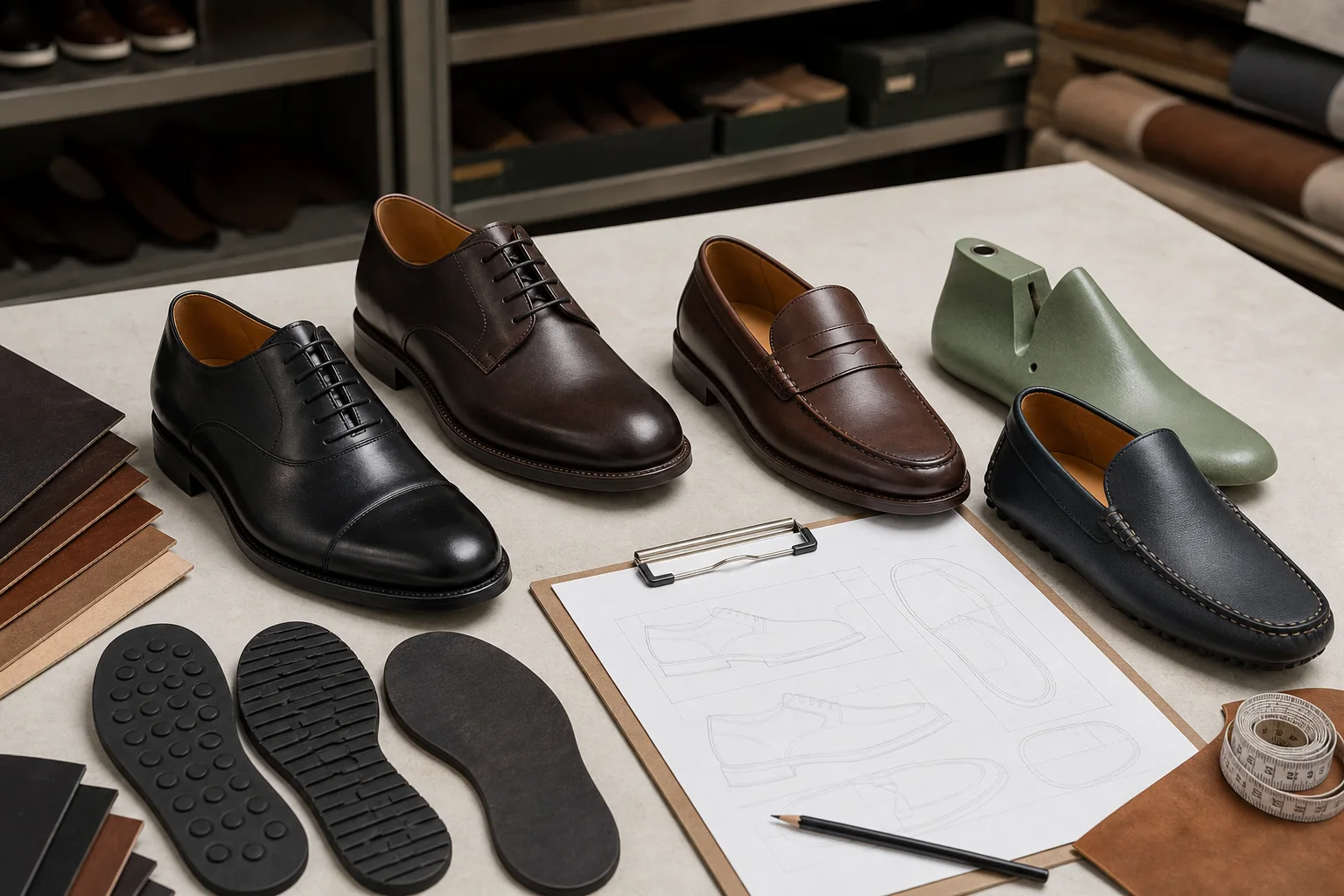
A search for wholesale leather shoes can lead to two different sourcing models: buying available inventory or developing footwear to a specification. The manufacturer pages supplied for this guide address private-label, OEM, wholesale and retail buyer inquiries. They describe product programs and the information used to begin an inquiry, but they do not document ready-stock availability or immediate shipment.
That distinction changes what a buyer should send. A made-to-spec request needs enough product definition to identify the relevant shoe family and expose the decisions that remain open. It does not need to present every detail as final. The useful starting point is a brief that separates fixed requirements, preferences and questions for the manufacturer.
Define the footwear before discussing terms
The contact page asks for a style photo or reference pair, target market and price point, quantity and size range, plus logo and packaging needs. It also asks buyers to state the style, material preference and target market. Together, those inputs provide a practical outline for the first inquiry.
As an editorial recommendation, organize the current definition under the following headings:
- Style and reference
Identify the intended shoe family and provide a style photo or reference pair. For the men's leather shoe and loafer programs, the respective pages also invite a sketch or tech pack. Note which visual features must be retained and which are open to development.
- Market and price position
State the target market and price point. If the project falls within the men's leather shoe program, also define the intended consumer and wearing occasion because that page connects those decisions with last shape, width strategy and construction.
- Quantity and size range
Provide the intended quantity and size range. For a men's program, the page also requests the expected pairs by style and color, intended size curve and any existing fit feedback.
- Materials and construction
Describe the preferred upper material, sole direction and construction where these are already known. Treat alternatives as preferences until the proposed combination has been discussed for the specific product.
- Branding and packaging
List the logo and packaging needs requested by the contact page. Where relevant to the men's program, its page names insole print, outsole logo, embossing, debossing and box sleeves as branding directions. The same page separately lists retail boxes, master cartons, inserts and an export packing setup.
A short brief can mark unresolved items as “open” or “to be confirmed.” This makes the inquiry usable without implying that a material, fit direction or packaging treatment has already been approved.
Match the brief to a documented product family
The dress shoe program identifies Oxfords, Derbies, monk straps and dress loafers. It also presents cap-toe, wholecut, wedding and formal directions. Construction options listed on that page are cemented, stitched and Goodyear-welted.
The loafer program covers penny, tassel, bit, driving, Belgian and suede loafers. Its listed upper directions are full-grain or corrected-grain leather, suede and mixed builds. Its sole directions are leather-look TPR, rubber driver studs and stitched leather soles.
The broader men's leather shoe program identifies Oxford shoes, Derby and dress styles, loafers and monk straps. The page asks buyers to define the consumer, wearing occasion, price position, last shape, width strategy and target construction before choosing decorative details or hardware.
Choose the closest family and describe any crossover rather than combining every published option into one assumed specification. A sole shown for loafers, for example, should remain attached to the loafer program unless its use elsewhere is confirmed for the project.
Keep facts, buyer inputs and questions separate
The table below is an editorial scope-control tool. Each documented example remains tied to the page on which it appears; the final column contains questions for the inquiry rather than confirmed project terms.
| Documented for a named program | Information from the buyer | Points to confirm |
|---|---|---|
| Dress shoes: Oxford, Derby, monk strap and dress loafer styles; cemented, stitched and Goodyear-welted construction options. | Dress shoe reference, target market, price point, quantity, size range and preferred construction. | Whether the proposed leather, sole and construction combination can be considered for that design. |
| Loafers: penny, tassel, bit, driving, Belgian and suede styles. The loafer page separately lists its upper and sole directions. | Loafer reference, intended use, quantity, sizing, material preference and branding direction. | Which development or sampling route may apply and whether the page-specific commercial terms fit the proposed specification. |
| Men's leather shoes: listed branding directions, packaging elements and inputs used to assess a product platform. | References for each style, consumer, wearing occasion, last and width direction, size curve and fit feedback where available. | Which elements may share a platform and which need a dedicated pattern or component. |
| Contact page: the requested inquiry inputs and the stated use for private-label, OEM, wholesale and retail buyer inquiries. | Fixed requirements, acceptable alternatives and a clear list of unresolved decisions. | Which development, sampling or quotation options may apply to the current definition. |
Read minimums and timing at page level
The dress shoe page publishes a starting minimum of 300 pairs per style and color. On that page, samples are stated at 10-15 days and bulk production at 35-50 days.
The loafer page also publishes a starting minimum of 300 pairs per style and color, samples in 10-15 days and bulk production in 35-50 days. These are separate product-page statements, not evidence of one universal policy for every leather footwear inquiry.
The loafer page says lower trial quantities can be discussed on a development order. Buyers should therefore present a proposed quantity as a discussion point rather than treating a lower minimum as available in advance.
In the inquiry, name the relevant page and ask whether its published minimum and timing fit the proposed style, materials and construction. It is also useful to ask what project information or approval stage is needed before timing can be assessed. The latter is buyer-preparation guidance, not a documented company-wide rule.
Assess platform sharing after the styles are clear
A multi-style program may raise questions about shared components. The men's leather shoe page states that, after receiving references and project inputs, the manufacturer can separate elements that may be shared from those requiring a dedicated pattern or component. It names the last, outsole, lining, packaging and leather article as potential shared elements.
The assessment depends on the proposed styles; the page does not establish that any particular pair of designs can use common parts. For a useful review, present the references together and identify the features believed to be common. Also call out any style-specific fit, construction or appearance requirements.
- Define the intended consumer and wearing occasion for each style.
- Record the proposed last shape, width strategy and fit direction.
- Show preferred leather, lining and outsole directions separately.
- Identify branding or packaging requirements that appear common.
- Mark the features that must remain specific to one style.
Keep component sharing separate from assumptions about price, minimums or development time. The published evidence supports a review of possible shared elements, not a predetermined commercial result.
Send a qualification inquiry
The final message should describe the project as it stands today. Include the style photo or reference pair requested by the contact page. A sketch or tech pack can also be included when using the formats named on the men's leather shoe or loafer page.
State the target market and price point, intended quantity and size range, material preference, logo needs and packaging direction. Separate requirements from preferences, then list the questions that must be answered before the project can move forward.
This approach is relevant to brands, importers, wholesalers, retailers and product teams evaluating an OEM leather shoe supplier or a private-label program. The search term “wholesale” does not settle whether the project fits an inventory purchase or made-to-spec development. That can only be clarified against the current footwear definition and the response to the inquiry.
Share the definition through the contact page and ask which development, sampling or quotation options may apply to the proposed program.
Sources and verification
- Request a Quote | Leather Shoe Manufacturer First-party site source
- Custom Leather Dress Shoes Manufacturer | OEM & Private Label First-party site source
- Men's Leather Shoes Manufacturer | Custom Oxfords & Loafers First-party site source
- Custom Loafers Manufacturer | OEM & Private Label Leather Loafers First-party site source
Share the current leather footwear definition and ask which development, sampling or quotation options may apply to the project.
Send your project brief