
Sourcing Guides
Wholesale Leather Boots: Audit Supplier Fit First
A buyer-side framework for separating documented leather shoe information from the questions that still need direct answers for a boot project.
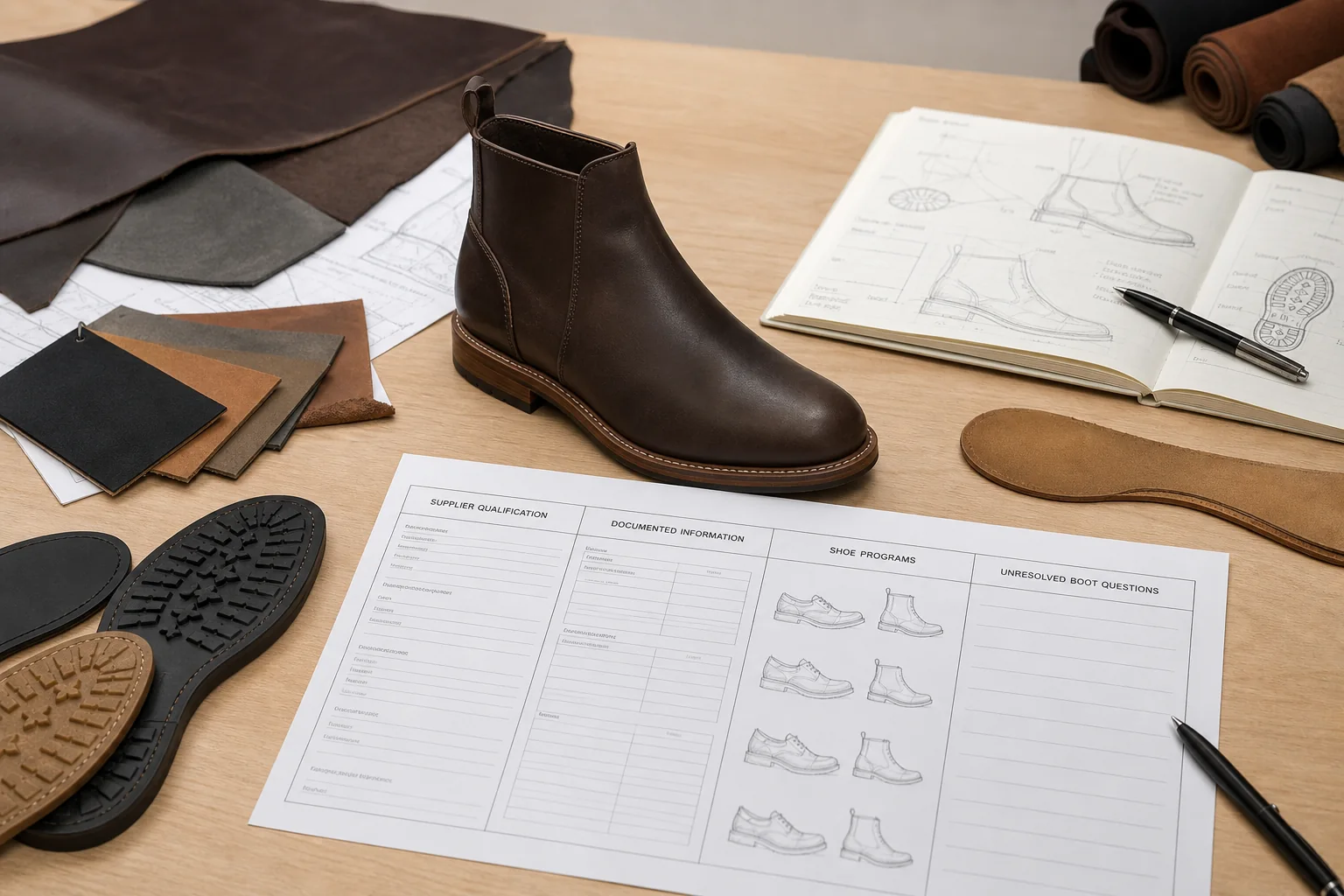
Buyers sourcing wholesale leather boots can use this manufacturer's published information to decide whether an inquiry is worthwhile. They cannot use it to confirm a boot program. The first-party pages identify an inquiry channel in Zhejiang, China and describe named men's leather shoe and dress shoe ranges, but none of the supplied pages identifies boots as a current product category.
The immediate decision is therefore whether to request a project assessment, not whether to accept a price, minimum order, sample schedule, or production plan. Those boot-specific points remain open until the company responds to a defined product request.
Make category fit the first decision
A useful first message gives the recipient enough information to determine whether the proposed product can be reviewed. The contact page asks buyers to include a style photo or reference pair, target market and price point, quantity and size range, material preference, and logo or packaging needs. It identifies private-label, OEM, wholesale, and retail buyer inquiries as the best use of the channel.
That invitation supports opening a conversation. It does not, by itself, document the company as a wholesale boot supplier or establish that a particular boot can be developed, sampled, quoted, or produced. Treat the reply as the point at which category fit begins to be established.
Separate the available information into three states
The following audit keeps company-level facts apart from specifications published for named shoe ranges. It also prevents unresolved boot questions from appearing as assumed capabilities.
| Evidence state | What is available | How the buyer can use it |
|---|---|---|
| Company-level facts | The contact page gives a Zhejiang, China location, identifies the intended inquiry types, lists requested brief inputs, and says the company replies with a practical production direction. | Use the published channel to request an assessment of the defined product. |
| Named shoe-range facts | The men's leather shoe page describes Oxford, derby, loafer, and monk strap styles. The dress shoe page describes its own formal footwear range and specifications. | Keep every listed material, construction, size, branding, packaging, minimum, and timing statement within the range where it appears. |
| Boot-specific unknowns | The supplied pages do not identify boot patterns, shafts, lasts, closures, constructions, outsole options, size coverage, testing, minimums, sampling periods, production timing, or quotation conditions. | Ask which parts of the submitted definition can be assessed and what information is still required. |
Prepare a buyer qualification brief
The next step is an editorial recommendation for the buyer: describe the proposed boot without presenting any feature as an existing factory option. This is qualification information prepared by the buyer, not a list of documented company services.
- Product position
- Identify the intended wearer, use context, sales market, and target price point.
- Visual reference
- Attach a clear image, reference pair, sketch, or technical file. Mark the features that must be retained and those that can change.
- Boot structure
- Describe the requested shaft height and opening. Note any preferred lining, reinforcement, stretch panel, or other structural requirement for assessment.
- Closure and hardware
- List requested laces, zips, elastic sections, buckles, hooks, pull tabs, or other components. Ask which can be reviewed for the design.
- Material direction
- State the preferred upper material and any appearance, feel, durability, or price objective. Do not assume that materials named for another shoe range apply to the boot.
- Outsole and use conditions
- Describe the desired appearance, tread, flexibility, weight, and intended environment. Leave the applicable construction and component options open for confirmation.
- Fit and size request
- Provide the intended size range, fit objective, width assumptions, and any approved reference pair. Ask what last and sizing directions, if any, can be considered.
- Brand presentation
- List desired logo positions, retail packaging, inserts, cartons, and presentation requirements as project requests.
This brief is not yet a complete request for firm commercial terms. Its purpose is to let the recipient identify whether the category is reviewable and which parts require more definition.
Keep shoe specifications inside their named ranges
The men's leather shoe page lists full-grain leather, corrected grain, suede, and mixed-material builds for the men's styles described there. It also lists insole print, outsole logo, embossing, debossing, and box sleeves as branding options for that range. Packaging references on the same page include retail boxes, master cartons, inserts, and an export packing setup.
These details can help a buyer formulate questions for private label leather boots. They do not confirm that the same materials, branding applications, or packaging arrangements are available for a boot project.
The dress shoe page has a different and equally bounded specification. It lists full-grain calf, Italian-style leather, and patent leather for dress shoes. Its sole directions are cemented TPR, stitched rubber, and Goodyear-welted leather.
That page also publishes dress-shoe sizes, a minimum from 300 pairs per style and color, sample timing of 10-15 days, and bulk timing of 35-50 days. None of those figures should be transferred into a boot sourcing record, even as provisional terms. The buyer needs a direct response stating what, if anything, applies to the proposed boot.
The factory and quality page presents leather and suede as material-board choices connected with surface feel, visual depth, and price position. This may help frame the intended material direction, but it does not document either material for a specific boot.
Ask for decisions in the right order
Rather than opening with a demand for a complete quotation, the editorial recommendation is to ask questions in go-or-no-go order:
- Can the specific boot category shown in the attached reference be reviewed?
- What drawings, measurements, fit information, physical references, or other inputs are needed before further assessment?
- Which requested upper, shaft, lining, closure, hardware, outsole, and construction directions can be assessed?
- Which requested logo applications and packaging elements can be considered?
- If the category can be reviewed, which development or sampling options may apply?
- At what stage can project-specific information about minimums, timing, testing, and quotation conditions be documented?
- Which requested elements are outside scope or still conditional?
These are buyer questions, not representations that the company offers each listed option for boots. Keeping that distinction visible is especially important when evaluating a potential leather boot manufacturer in China through pages written for adjacent footwear categories.
Read the response for conditions and exclusions
The contact page says the company replies with a practical production direction. That wording supports expecting a response to the inquiry, but it does not promise a boot quotation, an approved sample, or a production commitment.
Review the reply against the submitted product definition. A useful response should make clear whether the boot category can be considered, which requested elements can be assessed, what information is missing, and what remains conditional. This is an editorial evaluation framework for the buyer, not a description of the company's response process.
- Record any direct statement about the proposed boot category.
- Separate confirmed project information from possibilities that depend on further review.
- Note every requested feature or commercial point that was not addressed.
- Request clarification of ambiguous conditions, exclusions, or required inputs.
- Do not import terms from the men's or dress shoe pages unless the reply expressly applies them to the defined project.
A conditional response may still support the next sourcing decision if it identifies what the buyer must provide. A general invitation to continue the conversation provides less evidence of category fit until the actual boot definition is addressed.
Send the current definition for assessment
Use the inquiry page to share the style image or reference pair, target market and price point, intended quantity and size range, material preference, and logo or packaging needs. Those are the inputs requested on the published contact page.
Ask whether the defined boot can be reviewed, which requested items can be assessed, and what project-specific development, sampling, commercial, or quotation information can be documented at the next stage. The answer can then be evaluated on its own terms without treating the published shoe ranges as proof of boot production capability.
Sources and verification
- Request a Quote | Leather Shoe Manufacturer First-party site source
- Leather Shoe Factory in China | Capability & Export QC First-party site source
- Men's Leather Shoes Manufacturer | Custom Oxfords & Loafers First-party site source
- Custom Leather Dress Shoes Manufacturer | OEM & Private Label First-party site source
Share the current leather footwear definition and ask which development, sampling or quotation options may apply to the project.
Send your project brief