
Private Label Sourcing
Wholesale Genuine Leather Shoes Private Label Packaging Brief
For private-label wholesale pairs, branding and packaging belong on the same commercial-frame review and incoming materials pass as style and leather identity—not after a materials-only quote.
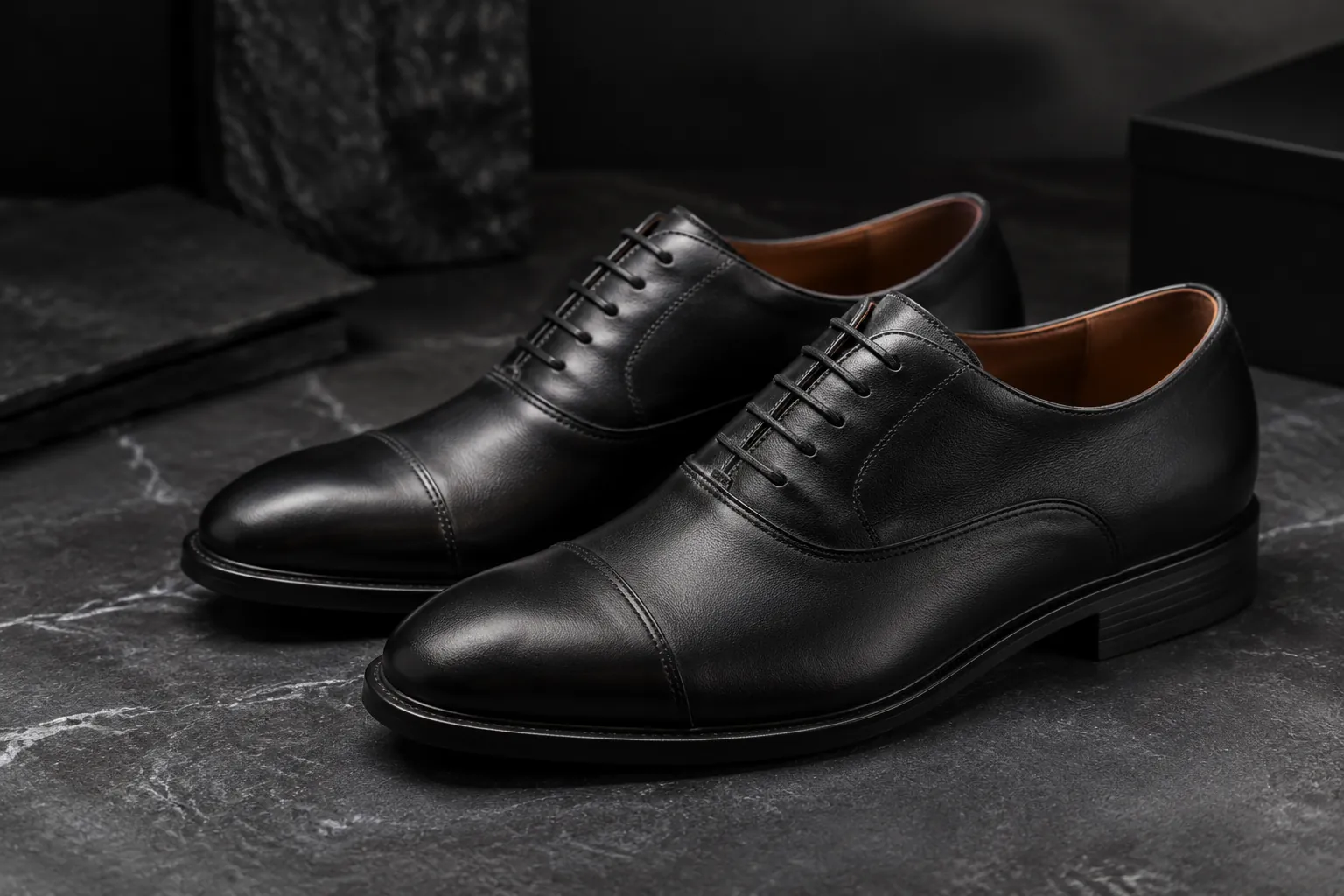
Wholesale genuine leather shoes private label packaging often enters the file after upper leather, lining, and silhouette already have a price conversation. Importers, wholesalers, and product teams lock materials and style first, then send logo files, box marks, and hangtags in a later wave. The contact path reviews branding and packaging with the product and commercial frame; the factory-quality path lists packaging and artwork with controlled materials before production entry. When those fields stay open, the private-label record is incomplete even if leather and last look settled.
Branding and packaging are peer inputs, not decorations attached after a unit figure lands. Closing them with style and materials is buyer-side brief discipline so development, sampling, or quotation options can be assessed against one definition.
When packaging is still open after materials are priced
A common sequence prices upper leather, lining, outsole, and a named silhouette first. Logo placement, box artwork, and carton presentation arrive only after a number is on the table. By then the commercial conversation has already treated materials and style as the full scope of the request.
On the quote path, the product and commercial frame are reviewed together rather than priced as isolated line items. Style, market, quantity, size range, materials, branding, packaging, and delivery need form one reading. Leaving branding and packaging off that reading does not erase them from the program; it only delays the moment they rejoin the same assessment.
For buyers, treat a materials-only figure as incomplete until branding and packaging status sit in the same file. Late packaging is rarely only a carton upgrade once the goods are meant to ship as branded pairs. That timing risk is buyer reasoning about incomplete briefs, not a factory claim that open packaging automatically reopens every cost or sampling line.
Private-label fields that belong in the commercial frame
The commercial-frame review on the contact path treats branding and packaging as peers of style and materials. Buyers who want one assessable definition should put those inputs in the same brief rather than in a second wave of emails.
- Style
- Market
- Quantity
- Size range
- Materials
- Branding
- Packaging
- Delivery need
That list is the documented review scope for the quote request. It is not a promise that the factory designs logos or creates box graphics. Buyers still supply or approve brand assets.
Optional buyer prep (not a manufacturer field inventory): under branding, many teams assemble logo type, placement on the shoe, and any insole or heel-mark artwork so those assets can be read with the style file. Under packaging, teams often decide unit presentation expectations such as box style, tissue, hangtags, labels, poly bags, and outer carton marks so those choices sit beside materials and delivery need. Those component choices are buyer-owned brief contents; the source only confirms that branding and packaging are reviewed with the commercial frame.
Private label genuine leather shoes branding is therefore a brief discipline: put brand assets inside the commercial frame so development, sampling, or quotation options can be assessed against one definition instead of a materials quote plus a dangling branding request.
Incoming confirmation for packaging, artwork, and lot identity
When materials move toward production, the factory-quality path describes an incoming confirmation step. Controlled materials are reviewed before mixed or unclear lots enter production. The reviewed set is leather article, color, thickness, lining, outsoles, hardware, packaging, artwork, and lot identity.
Packaging and artwork appear on that same pass as leather article and lot identity. The excerpt states a single flat review list, not a multi-step factory SOP and not a requirement that each line be checked “against a locked brief” as internal procedure language. What the source does establish is that packaging and artwork are in scope before mixed or unclear materials enter production.
Buyer discipline that supports that gate: resolve open logo files, language proofs on box art, and hangtag rules before you treat lots as production-ready. Wholesale leather shoes packaging confirmation is alignment with how the incoming list is written, not an extra design service claim. Genuine leather shoes wholesale artwork that remains unsigned still sits on the same confirmation pass as leather article and hardware.
Why Oxford and loafer programs still need packaging bound
Core dress and casual programs already treat style geometry as control points. Packaging and branding should travel with those locks if the wholesale pair is meant to remain repeatable as a branded unit.
On the dress-shoes path, the black cap-toe Oxford is described as a disciplined anchor of a formal program. Facing gap, toe proportion, cap placement, polish, and pair symmetry are treated as control points.
On the loafers path, the tan men's penny loafer is described for a repeatable core style. The controlled fields are saddle proportion, apron symmetry, vamp length, opening retention, heel hold, and flex.
Those field sets lock pair geometry. They do not replace packaging locks.
| Program focus | Documented style control points | Why packaging stays bound (buyer guidance) |
|---|---|---|
| Cap-toe Oxford | Facing gap, toe proportion, cap placement, polish, pair symmetry | Brand marks and formal box presentation should travel with the same formal program lock so the branded unit does not diverge from the style record. |
| Penny loafer | Saddle proportion, apron symmetry, vamp length, opening retention, heel hold, flex | Saddle branding, hangtags, and casual packaging should not reopen a core style locked for repeatable wholesale pairs. |
Keep the packaging record in the same program file as Oxford facing rules or loafer saddle rules. Explore locked Oxford programs on the dress shoes path and locked loafer geometry on the loafers path, then attach branding and packaging so the private-label unit inherits both the style lock and the presentation lock. Late brand presentation can raise rework risk against geometry that was already frozen; that is buyer guidance on repeatability, not an extra factory control-point list.
Closed packaging record versus open branding questions
A closed private-label definition supports assessment. An open branding question does not. The difference is what the commercial frame and the incoming list can actually read.
| Closed in the private-label record | Still an open assessment question |
|---|---|
| Style, market, quantity, size range, materials, branding, packaging, and delivery need reviewed as one commercial frame | Whether a specific sampling path or quotation format applies until the buyer asks and receives a scoped answer |
| Packaging and artwork listed with leather article, color, thickness, lining, outsoles, hardware, and lot identity on the incoming confirmation pass | Any artwork revision, language proof, or carton mark change not yet written into the buyer’s brief |
| Oxford or loafer style control points held as the pair geometry file | Brand assets the buyer has not yet supplied or approved for placement on that geometry |
No MOQ, unit price, lead time, or certification is stated here for these fields. A buyer may ask which development, sampling, or quotation information applies to the project. That invitation is a request for assessment against the definition the buyer provides. It is not a documented packing-method service menu beyond the commercial-frame and incoming-confirmation language already cited.
Close packaging and artwork before materials are treated as fully priced and before lots are treated as production-ready. Open questions remain legitimate when they are framed as open, not as assumed inclusions in a materials-only quote.
Share one private-label definition for assessment
Send one definition that already holds style, materials, branding, packaging, and delivery need together. That matches how the commercial frame is reviewed on the contact path and how packaging and artwork appear on the factory quality incoming list. Split briefs recreate the late-packaging gap described above.
As a hypothetical only, a buyer preparing a core black cap-toe Oxford private-label run for a North American wholesale calendar could name the Oxford control points, the leather article and color, the logo and box artwork status, and the delivery need in the same file, then ask which development, sampling, or quotation options may apply. That sketch invents no quantities or dates and is not a case study.
Use the contact path to share the current leather footwear definition and to ask which development, sampling, or quotation options may apply to the project. Keep branding and packaging inside that definition so wholesale genuine leather shoes private label packaging is assessed as production-bound scope, not as decoration added after materials were already priced.
Sources and verification
- Request a Quote | Leather Shoe Manufacturer First-party site source
- Leather Shoe Factory in China | Capability & Export QC First-party site source
- Custom Leather Dress Shoes Manufacturer | OEM & Private Label First-party site source
- Custom Loafers Manufacturer | OEM & Private Label Leather Loafers First-party site source
Share the current leather footwear definition and ask which development, sampling or quotation options may apply to the project.
Send your project brief