
Sourcing Guides
Specify Genuine Leather for Wholesale Shoes
Wholesale briefs that only say “genuine leather” leave article, thickness, color, lining, and lot identity open. Lock those fields with outsoles, hardware, packaging, and style controls before materials enter production.
When buyers specify genuine leather for wholesale shoes, the RFQ often stops at a category label as if that finished the material decision. It does not. Pair shade, hand, thickness, lining behavior, and lot continuity stay unsettled until the leather article and the fields that travel with it are named. When those fields arrive late, mixed or unclear materials can already sit at production intake, and style controls that depend on a stable upper become harder to hold.
This guide treats factory incoming confirmation fields as buyer-side specification gates. The aim is a wholesale leather shoe material record complete enough for development, sampling, or quotation assessment—not a proprietary tracking system, and not an open leather category label.
Why “genuine leather” is incomplete on a wholesale brief
“Genuine leather” is a category tag, not a production identity. Two hides can both qualify under that label and still differ in article, grain character, dye depth, finish, and usable thickness. A brief that stops at the category leaves substitution boundaries open for later interpretation, when commercial pressure is higher and visual acceptance is already contested.
On the factory quality page, incoming confirmation is framed around controlled materials: leather article, color, thickness, lining, outsoles, hardware, packaging, artwork, and lot identity are reviewed before mixed or unclear materials enter production. For a buyer, that list is the practical message. If those items are still open on the RFQ, the wholesale order is not yet material-ready, even when the style sketch and target price look finished.
The failure mode is consistency across pairs and reorders, not a single pretty sample. Color drift between lots, lining that changes foot feel, or thickness that alters lasting behavior usually traces back to an incomplete material record rather than a late visual check alone.
Fields that convert genuine leather into a controlled material record
Treat the following as gates you lock before you expect production intake to treat materials as controlled. Frame them as confirmation fields on your side of the handoff, not as a promise of any particular factory process beyond what the incoming language states.
- Leather article: a genuine leather article wholesale choice means naming the hide or leather type, not only writing the word “genuine.”
- Color: approved shade reference and any finish or polish expectation that affects appearance.
- Thickness: the thickness band intended for the upper and related components that share that leather.
- Lining: lining material identity where it affects comfort, structure, or visible openings.
- Lot identity: leather lot identity footwear programs need a way to refer to the same material stream on reorders and multi-shipment runs, rather than a vague category.
Editorial recommendation for buyers: refuse a production-ready status until article and lot identity are named together. Color and thickness without lot identity still allow silent lot changes. Lot identity without a named article still allows category-level substitution.
Components that must stay on the same confirmation pass
Leather is not the only field that belongs in the first material pass. The same incoming confirmation language groups outsoles, hardware, packaging, and artwork with the leather fields. Pricing or approving those items as isolated line items after the leather is “assumed” breaks the wholesale definition into pieces that no longer share one acceptance frame.
- Outsoles: construction and appearance references that must match the upper program you are locking.
- Hardware: metal or other trim items whose finish and scale interact with leather color and polish.
- Packaging: boxes, tissue, bags, or inserts that carry brand presentation and must align with the approved product identity.
- Artwork: logos, stamps, labels, or print that should not be negotiated after materials are already mixed in intake.
The quote request language reinforces the same idea from the commercial side: style, market, quantity, size range, materials, branding, packaging, and delivery need are reviewed together rather than priced as isolated line items. Keep components on one confirmation pass so the material record and the commercial frame describe the same shoe.
Style control points that depend on a locked leather article
Style pages only become useful after the leather article and related fields are named. Documented control points for formal and casual cores assume a stable upper. If article, thickness, color, or lining remain open, those controls have no stable upper to measure against.
Cap-toe Oxford
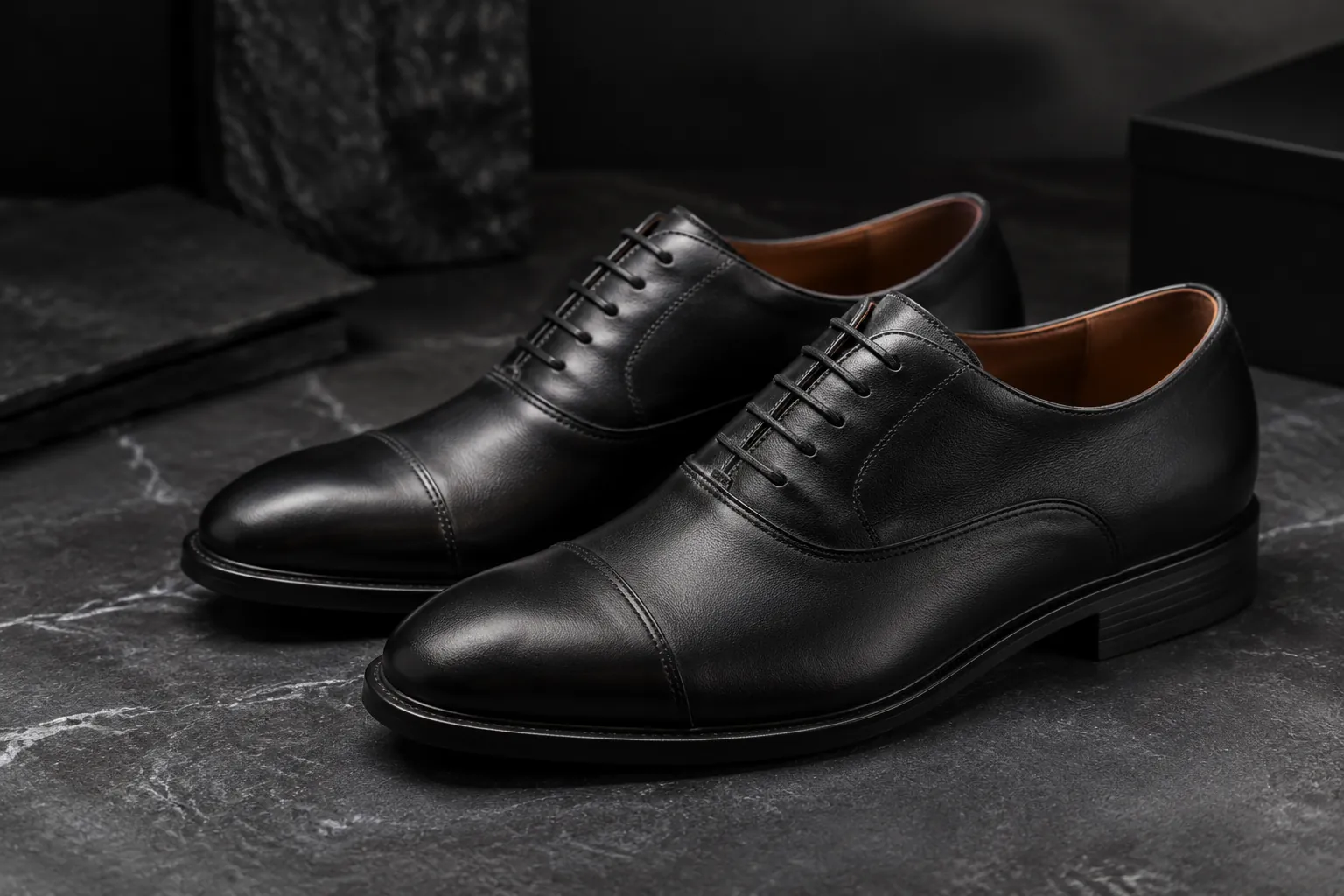
On the dress shoes program page, the black cap-toe Oxford is described as a disciplined formal anchor. Control points listed there are facing gap, toe proportion, cap placement, polish, and pair symmetry. Those points depend on a named leather article that remains consistent across pairs. An unnamed “genuine leather” substitute leaves those geometry and finish checks without a stable reference.
Penny loafer
On the loafers program page, the men’s penny loafer lists saddle proportion, apron symmetry, vamp length, opening retention, heel hold, and flex as control points for a repeatable core style. Softness, thickness, and finish of the leather article affect how those points read on finished pairs. Lock the article before you treat those points as enforceable acceptance language.
Write the material record first, then attach the style control list that belongs to that family. Reversing the order leaves Oxford or loafer geometry resting on an open leather category.
Review materials with the commercial frame, not after the quote
Material locks and commercial needs belong in one review. Separating them invites a quote that looks complete on paper while materials remain interpretative. Use a single joint pass that covers the product and commercial frame together.
- State the style family and any core reference (for example, cap-toe Oxford or penny loafer) with the control points you intend to enforce.
- Name the market positioning and the quantity and size range you expect the program to support, without treating those figures as factory guarantees until they are assessed.
- Attach the material record: leather article, color, thickness, lining, lot identity, plus outsoles, hardware, packaging, and artwork.
- Add branding and packaging expectations so presentation is not priced later as an orphan line.
- State delivery need as a planning input for assessment, not as a fixed lead-time claim unless it has been confirmed for that project.
That sequence mirrors the review language on the contact page: the product and commercial frame are read together. Your job as buyer is to supply a definition complete enough that materials are not stripped out and repriced in isolation.
Confirmed material record versus open factory questions
Buyers often blur locked fields with open assessment questions. Keep them separate so inquiry language stays precise.
| Locked on the buyer brief (material record) | Still open for factory assessment |
|---|---|
| Named leather article, color, thickness, lining, and lot identity language you require | Whether a given article and lot plan fit the style, market, and volume you described |
| Outsoles, hardware, packaging, and artwork tied to that material pass | How those components integrate under the commercial frame you submitted |
| Style control points for the chosen family (Oxford or penny loafer as documented) | Development, sampling, or quotation options that may apply after the definition is read |
| Market, quantity, size range, branding, packaging, and delivery need as stated needs | Feasibility, timing, and commercial terms once materials and style are reviewed together |
Do not invent certifications, test results, MOQs, or process guarantees to fill the open column. Those answers, if any, come from assessment of a specific definition. The table only separates what you can lock as buyer language from what still requires a factory response.
Share a material-locked wholesale definition for assessment
A workable wholesale definition for genuine leather shoes is short and complete: named leather article with color, thickness, lining, and lot identity; outsoles, hardware, packaging, and artwork on the same pass; style family with its documented control points; and the commercial frame of market, quantity, size range, branding, packaging, and delivery need. That package replaces a category label with a material record a factory can actually review before mixed materials enter production.
When the definition is ready, share it and ask which development, sampling, or quotation options may apply to the project. Treat those topics as inquiry subjects for assessment, not as pre-documented service promises. A material-locked brief gives both sides a cleaner starting point than another RFQ that only says “genuine leather” and hopes pair consistency will appear later.
Sources and verification
- Leather Shoe Factory in China | Capability & Export QC First-party site source
- Request a Quote | Leather Shoe Manufacturer First-party site source
- Custom Leather Dress Shoes Manufacturer | OEM & Private Label First-party site source
- Custom Loafers Manufacturer | OEM & Private Label Leather Loafers First-party site source
Share the current leather footwear definition and ask which development, sampling or quotation options may apply to the project.
Send your project brief