
Sourcing and Product Development
Private Label Men's Dress Shoe RFQ Checklist: Oxford vs Loafer
A buyer worksheet for separating collection-level component information from cap-toe Oxford and penny loafer control points.
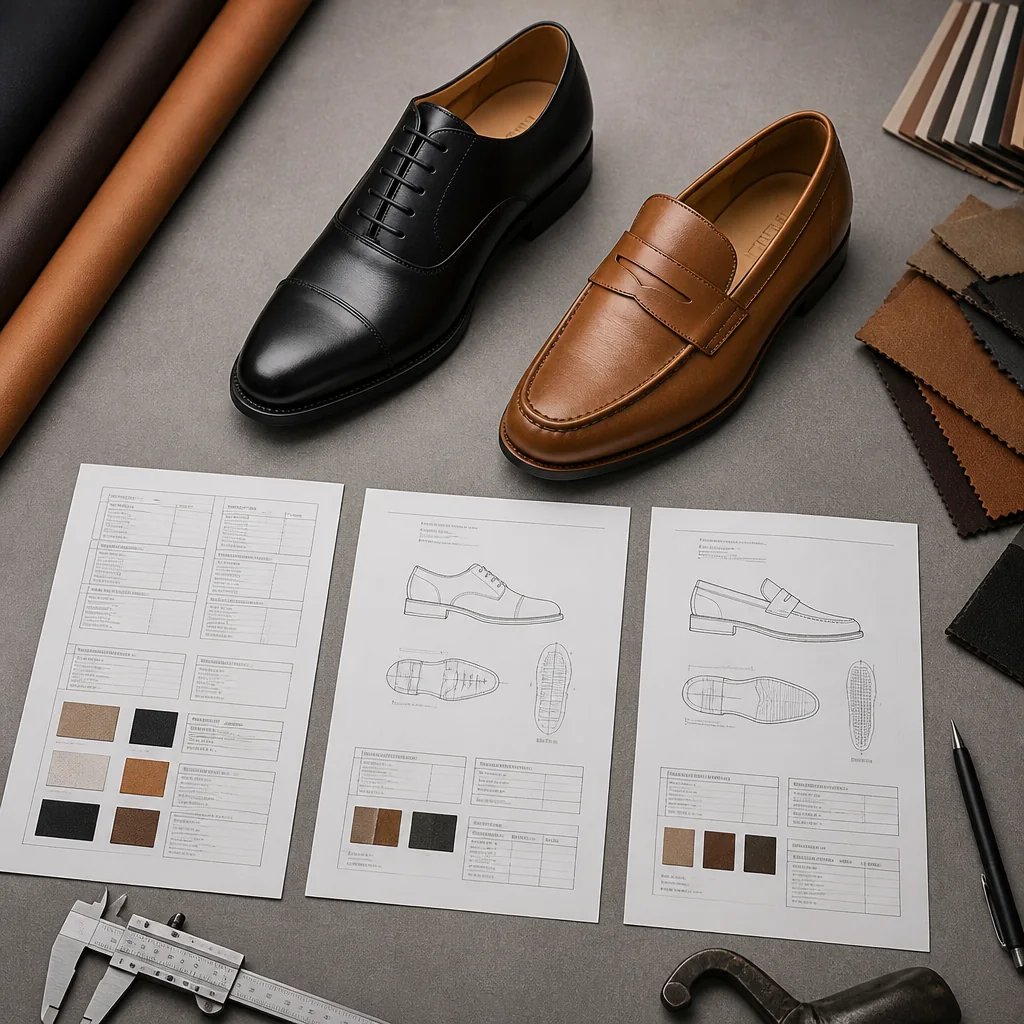
A useful private label men's dress shoe RFQ checklist should separate decisions that can be recorded once from decisions that belong to one style. For a collection containing the named cap-toe Oxford and penny loafer examples, the buyer can start with a common component record, then create one control block for each style. This is an editorial structure for preparing an inquiry, not a description of the supplier's RFQ procedure.
The practical test is simple: a shared entry should identify something intended for both products. If the requirement, reference, or unresolved question differs, it belongs in the relevant style record. That distinction keeps a collection-level label from standing in for a product definition.
The RFQ's Working Structure
The editorial recommendation is to give every buyer-owned entry one of four statuses. Use the same status language in the collection, Oxford, and loafer records so open decisions remain visible.
- Defined
- The buyer has entered a requirement or criterion in the RFQ.
- Reference supplied
- The buyer has identified a file, image, drawing, swatch, or other reference and stated what it governs.
- Open
- The buyer has retained the point as a question instead of supplying an assumed answer.
- Not applicable
- The buyer has determined that the field does not apply to the relevant style.
Scope note: The cited incoming-material excerpt places its review before mixed or unclear materials enter production; it does not place that review at the RFQ, development, sampling, or quotation stage. The materials excerpt frames leather appearance, color approval, and hide or component-lot pairing as questions buyers should ask. The worksheet below therefore treats these subjects as buyer-owned fields and open questions, not documented factory services, promises, or acceptance rules.
What Can Stay at Collection Level?
The factory-quality page identifies leather article, color, thickness, lining, outsoles, hardware, packaging, artwork, and lot identity in its incoming-material review. As an editorial buyer tool, the following worksheet reuses those exact field names to organize the common component record.
| Collection field | Buyer requirement | Governing reference | Status | Open question |
|---|---|---|---|---|
| Leather article | Enter the buyer's current article designation. | Identify the relevant leather reference. | Defined, reference supplied, or open. | Record what remains undecided. |
| Color | Enter the requested color designation. | Name the buyer's current color reference. | Defined, reference supplied, or open. | Move any approval question to the question register. |
| Thickness | Enter a buyer-defined requirement or leave it open. | Identify the specification that governs the entry. | Defined, reference supplied, or open. | Record the missing definition without supplying an assumed value. |
| Lining | Name the requested lining for both styles when it is shared. | Identify the buyer's material reference. | Defined, reference supplied, open, or not applicable. | Note whether the answer differs by style. |
| Outsoles | State whether the buyer's outsole definition applies to both products. | Identify the governing specification or drawing. | Defined, reference supplied, or open. | Record any style-specific difference. |
| Hardware | Enter the applicable buyer requirement. | Identify the relevant component or artwork reference. | Defined, reference supplied, open, or not applicable. | Keep an unresolved selection open. |
| Packaging | Point to the buyer's current packaging requirement. | Enter the file name or revision identifier. | Defined, reference supplied, or open. | List any unresolved packaging point. |
| Artwork | Identify the requested artwork and placement. | Name the governing buyer file. | Defined, reference supplied, open, or not applicable. | Record missing placement or file information. |
| Lot identity | Reserve an entry for the relevant identifier. | Identify the buyer document that uses it. | Defined, reference supplied, or open. | Keep pairing questions separate from the identifier itself. |
Where one of these fields has different answers for the Oxford and loafer, the buyer should repeat the field in both style records. The collection row can then point to those entries instead of forcing a shared value. Adding a revision identifier to each buyer-supplied requirement is also recommended so the inquiry shows which version is current.
Where the Oxford Record Diverges
For the named cap-toe Oxford, the dress-shoes page treats facing gap, toe proportion, cap placement, polish, and pair symmetry as control points. A private label Oxford shoe RFQ can give each point its own row so references and unanswered questions are not applied to the entire shoe by implication. The cited excerpt does not provide a tolerance, inspection method, acceptance threshold, or pass-and-fail value.
| Oxford control | Buyer requirement | Governing reference | Status | Open question |
|---|---|---|---|---|
| Facing gap | Describe the intended relationship in buyer-defined terms. | Identify the view, drawing, or file that governs it. | Defined, reference supplied, or open. | State what still requires definition. |
| Toe proportion | Describe the intended profile or proportion. | Identify the relevant profile or top-view reference. | Defined, reference supplied, or open. | Record any unresolved aspect of the intended shape. |
| Cap placement | Enter the intended placement using the buyer's own definition. | Point to the relevant marking or drawing. | Defined, reference supplied, or open. | Keep the placement question open if no definition exists. |
| Polish | Describe the requested appearance. | Name the appearance reference and what it governs. | Defined, reference supplied, or open. | Record any aspect not established by the reference. |
| Pair symmetry | Identify the elements the buyer wants compared. | Point to the relevant buyer reference. | Defined, reference supplied, or open. | Do not add an unsupported tolerance. |
A reference should be assigned to a specific row. For example, a cap-placement drawing should not also govern polish or toe proportion unless the buyer expressly gives it those roles. This recommendation makes the purpose of each supplied file visible without turning the reference into an undocumented acceptance rule.
Why the Loafer Needs Its Own Record
The penny loafer example identifies saddle proportion, apron symmetry, vamp length, opening retention, heel hold, and flex as controls for that named core style. These terms should remain separate from the Oxford list.
| Loafer control | Buyer requirement | Governing reference | Status | Open question |
|---|---|---|---|---|
| Saddle proportion | Describe the intended relationship between the saddle and surrounding upper. | Identify the buyer's relevant view or drawing. | Defined, reference supplied, or open. | Record which part of the relationship remains undecided. |
| Apron symmetry | Identify the elements the buyer intends to compare. | Name the relevant views or markings. | Defined, reference supplied, or open. | Leave any unstated criterion open. |
| Vamp length | Enter a buyer-defined length criterion or mark the field open. | Use a dimensional reference or clearly identified visual reference. | Defined, reference supplied, or open. | State which length decision still needs an answer. |
| Opening retention | Enter the buyer's criterion when one exists. | Identify the file or definition that governs it. | Defined, reference supplied, or open. | Retain the required assessment as a question when undefined. |
| Heel hold | State the buyer's intended objective without claiming a quantified result. | Identify any buyer-provided criterion or reference. | Defined, reference supplied, or open. | Record what remains to be assessed. |
| Flex | Enter a buyer-supplied criterion or leave the point open. | Identify the reference intended to govern the entry. | Defined, reference supplied, or open. | Do not infer a durability or comfort result. |
The buyer should keep the control name, its requirement, and its open question in separate cells. In particular, retain vamp length as the field name even when a visual reference is supplied. That reference should state whether it defines the length or merely shows the intended appearance.
Leather Appearance: Questions, Not Assumptions
The materials page tells buyers to ask what appearance variation is natural, what becomes a defect, how colors are approved, and how hides or component lots are paired across the order. The recommended RFQ treatment is an open-question register with buyer references attached where available.
| Topic | Buyer reference | Question to retain | Status |
|---|---|---|---|
| Natural appearance variation | Identify the proposed leather and current appearance reference. | What variation would be considered natural for this project? | Open until a project-specific response is recorded. |
| Defect boundary | Point to any buyer-provided appearance definition. | What would become a defect for the proposed definition? | Open until a project-specific response is recorded. |
| Color approval | Name the buyer's current color reference. | How would color approval be addressed for this project? | Open until a project-specific response is recorded. |
| Hide or component-lot pairing | Identify the styles and materials covered by the question. | How would hides or component lots be paired across the contemplated order? | Open until a project-specific response is recorded. |
Lot identity and lot pairing should remain distinct entries. The first records an identifier in the collection worksheet. The second preserves a question about pairing. If the appearance question differs between the cap-toe Oxford and penny loafer, the buyer should point the register entry to the relevant style record.
A Cross-Record Review
Before issuing the RFQ, the buyer can review the three records with the following editorial checks:
- Confirm that every collection field contains a buyer requirement, a governing reference, an open question, or an explicit not-applicable status.
- Keep all five named Oxford controls inside the Oxford record.
- Keep all six named penny loafer controls inside the loafer record.
- Check that every supplied reference states which field or control it governs.
- Repeat a collection field at style level when the two products have different answers.
- Leave leather variation, defect boundaries, color approval, and lot-pairing topics as questions when no project-specific answer has been recorded.
- Remove any tolerance, method, threshold, performance result, or responsibility that the buyer has not actually defined.
This review is meant to expose missing buyer decisions. It should not be presented as a factory inspection plan or as confirmation that an open item will be handled in a particular project stage.
Send the Current Definition
The final buyer file should identify its current revision and include the collection worksheet, the cap-toe Oxford block, the penny loafer block, and the leather-appearance question register. Supporting references should use the same names or identifiers shown in the worksheet.
Share the current leather footwear definition through the project inquiry page. Identify which requirements are defined and which questions remain open, then ask which development, sampling, or quotation options may apply to the project.
Sources and verification
- Custom Leather Dress Shoes Manufacturer | OEM & Private Label First-party site source
- Custom Loafers Manufacturer | OEM & Private Label Leather Loafers First-party site source
- Leather Shoe Materials | Full Grain, Suede, Lining & Outsoles First-party site source
- Leather Shoe Factory in China | Capability & Export QC First-party site source
Share the current leather footwear definition and ask which development, sampling or quotation options may apply to the project.
Send your project brief