
Dress Shoes
Private Label Men's Designer Dress Shoe Sample Approval
Use a dress shoe sample to record what has actually been approved. This brief helps buyers separate cap-toe Oxford appearance, leather variation, and material identity from open development, sampling, or quotation questions.
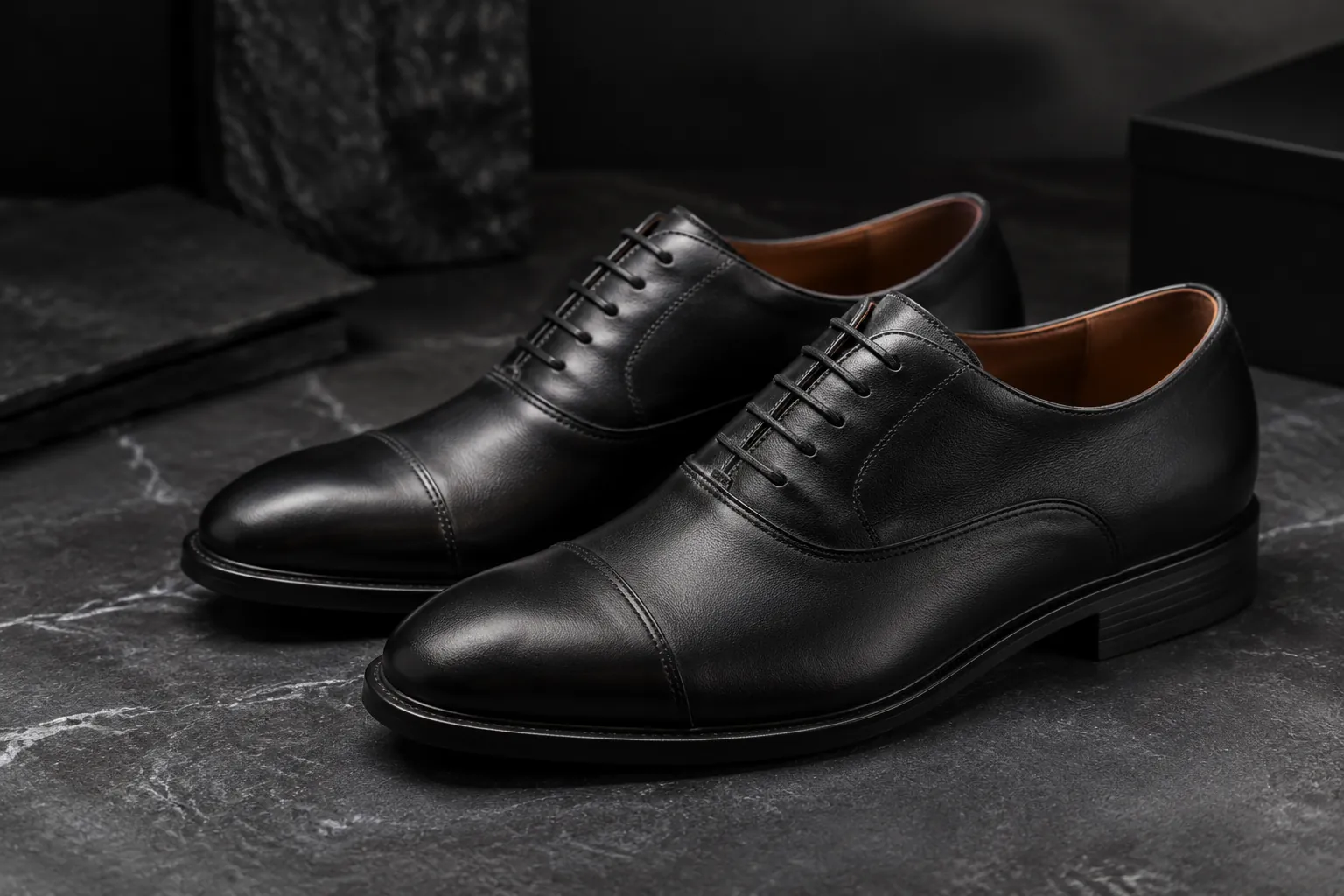
Two people can approve the same Oxford sample and mean different things. One may be approving the toe shape. Another may be approving the polish. A third may only be saying the shoe is close enough to keep talking. Private label men's designer dress shoe sample approval needs a tighter record than that.
For a buyer moving from the broad idea of mens designer dress shoes wholesale into a specific private-label program, the word designer is not a measurable specification by itself. It becomes useful only when the buyer turns the intended look into visible approval points, material boundaries, and open questions that can be discussed before any next step.
Leather Shoe Manufacturer's dress-shoe page gives the sample review a defined product anchor. It describes a black cap-toe Oxford as the disciplined anchor of a formal program, with facing gap, toe proportion, cap placement, polish, and pair symmetry treated as control points. This article stays within that documented scope for the Oxford form and presents the rest as an editorial approval method for buyers preparing a clearer inquiry.
Decide What The Sample Has Approved
A sample should not carry more authority than the buyer has actually given it. Before discussing refinements, assign the sample one of three approval meanings: not accepted, accepted as a visual direction, or accepted as a reference for named points.
- Not accepted
- The sample should not guide the next discussion because the buyer does not accept the visible direction or material basis.
- Accepted as visual direction
- The buyer likes the general idea but still has unresolved points. This status is useful when the shoe feels close but cannot yet serve as a production reference.
- Accepted as reference for named points
- The buyer has identified which parts of the sample are approved. The approval should name those parts instead of relying on a broad note such as approved or designer look confirmed.
For a custom leather dress shoe sample, the editorial recommendation is to keep the approval note narrow. A useful note might say: "Toe proportion and cap placement accepted for the current cap-toe Oxford direction; color depth and leather variation remain open for material review." That wording prevents a partial approval from becoming a full approval by accident.
Review The Oxford Form First
The supported cap-toe Oxford control points are facing gap, toe proportion, cap placement, polish, and pair symmetry. Review those points before adding broader retail language or adjacent product-family concerns.
- Facing gap: Look at the spacing between the facings when the shoe is laced for review. Record whether the gap supports the intended formal appearance or needs adjustment.
- Toe proportion: Decide whether the toe appears balanced for the private-label position. Replace broad words such as sleek or premium with a direct approval or change note.
- Cap placement: Check where the cap line sits in relation to the toe and vamp. If the cap looks too short, too long, too far forward, or too visually heavy, write that plainly.
- Polish: Treat polish as one part of the formal look. Record the accepted direction for shine, depth, and finish, while keeping color approval as a separate material question.
- Pair symmetry: Compare the left and right shoes together. The sample should be reviewed as a pair, not as one attractive shoe viewed alone.
Photographs can support the buyer's internal record when the same angles and lighting are used across review rounds. That is an editorial documentation recommendation for the buyer, not a claim about a fixed manufacturer photo-review process.
Put Leather Appearance In Its Own Decision
The materials page frames appearance range as questions: what variation is natural, what becomes a defect, how colors are approved, and how hides or component lots are paired across the order. That source supports asking and defining those points. It does not support an assumption that all visible leather variation can be eliminated.
For dress shoe material approval, separate the material decision from the shoe-form decision. The Oxford shape may be accepted while the leather boundary remains open. The buyer can record which grain movement, finish variation, or color movement still fits the intended shoe, and which visible difference would be treated as a mismatch or defect for the project.
Color also needs its own approval reference when the visual target matters. A photograph may show direction, but lighting, polish, and leather surface can affect how a shade appears. If the buyer expects a formal black, a brown tone, or a particular finish depth, the safer brief asks how that color should be approved for the project and which physical or written reference should control the decision.
Hide or component-lot pairing should remain a question unless it has been confirmed for the project. The documented materials scope says buyers can ask how hides or component lots are paired across the order. It does not define one universal pairing method.
Record The Material Identity
The factory-quality page lists an incoming controlled-material review. It says to review leather article, color, thickness, lining, outsoles, hardware, packaging, artwork, and lot identity before mixed or unclear materials enter production. For a buyer, those fields are useful prompts for a sample approval record.
| Record field | Approval use | Buyer question |
|---|---|---|
| Leather article | Identifies the upper material reference. | Which leather article is tied to this sample? |
| Color | Keeps color approval separate from general style approval. | Which physical or written color reference applies? |
| Thickness | Records a material attribute named in the incoming controlled-material review. | Is the approved sample linked to a thickness expectation? |
| Lining | Separates interior material identity from upper leather approval. | Has the lining reference been confirmed or left open? |
| Outsoles | Identifies the outsole reference connected to the sample. | Which outsole reference belongs with this approval? |
| Hardware | Tracks any hardware included in the shoe definition. | Are hardware items part of the approved reference or still undecided? |
| Packaging | Records the supported packaging field without turning it into a broader packing service claim. | Which packaging input, if any, has been confirmed? |
| Artwork | Keeps artwork identity visible as its own field. | Which artwork input, if any, has been confirmed? |
| Lot identity | Helps avoid unclear material identity in later discussion. | What lot information should travel with the sample record? |
This table is a buyer-side record tool. It does not mean every field is finalized, available, or required for every project. Its purpose is to show which parts of the shoe definition are known and which parts still need a question.
Do Not Apply Loafer Criteria To An Oxford
A private label cap toe Oxford manufacturer discussion should keep Oxford approval criteria separate from loafer criteria unless the buyer is deliberately comparing product families. The dress-shoe evidence identifies the Oxford control points as facing gap, toe proportion, cap placement, polish, and pair symmetry.
The loafer page identifies penny loafer control areas separately: saddle proportion, apron symmetry, vamp length, opening retention, heel hold, and flex. Those points belong to loafer programs. They are not the documented control-point list for a cap-toe Oxford.
Separating the lists keeps the approval file usable. An Oxford review can focus on the formal shape and pair presentation. A loafer review has its own shape and fit concerns. When a private-label range includes both product families, the editorial recommendation is to give each family its own approval page instead of merging all footwear notes into one checklist.
Send Confirmed Points And Open Questions
The final brief should show what the buyer has already decided and what still needs an answer. Avoid turning unanswered topics into factory commitments. The evidence used here supports the cap-toe Oxford control points, the leather appearance questions, the incoming controlled-material review fields, and the separate loafer control areas. It does not document fixed quantities, lead times, prices, certifications, or guaranteed commercial terms.
A concise buyer brief can include:
- Current definition: men's cap-toe Oxford private-label dress shoe.
- Oxford form notes: facing gap, toe proportion, cap placement, polish, and pair symmetry.
- Leather appearance questions: natural variation, defect boundary, color approval, and hide or component-lot pairing.
- Material identity record: leather article, color, thickness, lining, outsoles, hardware, packaging, artwork, and lot identity, separated into confirmed and open fields.
- Next question: which development, sampling, or quotation options may apply to the project as described?
That last line is a buyer inquiry, not a claim that every option applies to every project. The value of the sample file is that it gives the manufacturer a clearer starting point: the accepted Oxford form is visible, the leather questions are named, and the material identity fields are not hidden inside a general style approval.
To continue, share the current shoe definition and approval record through the contact page, then ask which development, sampling, or quotation options may apply to the project as described.
Sources and verification
- Custom Leather Dress Shoes Manufacturer | OEM & Private Label First-party site source
- Leather Shoe Materials | Full Grain, Suede, Lining & Outsoles First-party site source
- Leather Shoe Factory in China | Capability & Export QC First-party site source
- Custom Loafers Manufacturer | OEM & Private Label Leather Loafers First-party site source
Share the current leather footwear definition and ask which development, sampling or quotation options may apply to the project.
Send your project brief