
Sourcing Guides
Private Label Leather Shoe Quote Comparison Checklist
A scope-parity matrix for checking what each leather shoe quotation states, leaves open, or does not address before evaluating the offers.
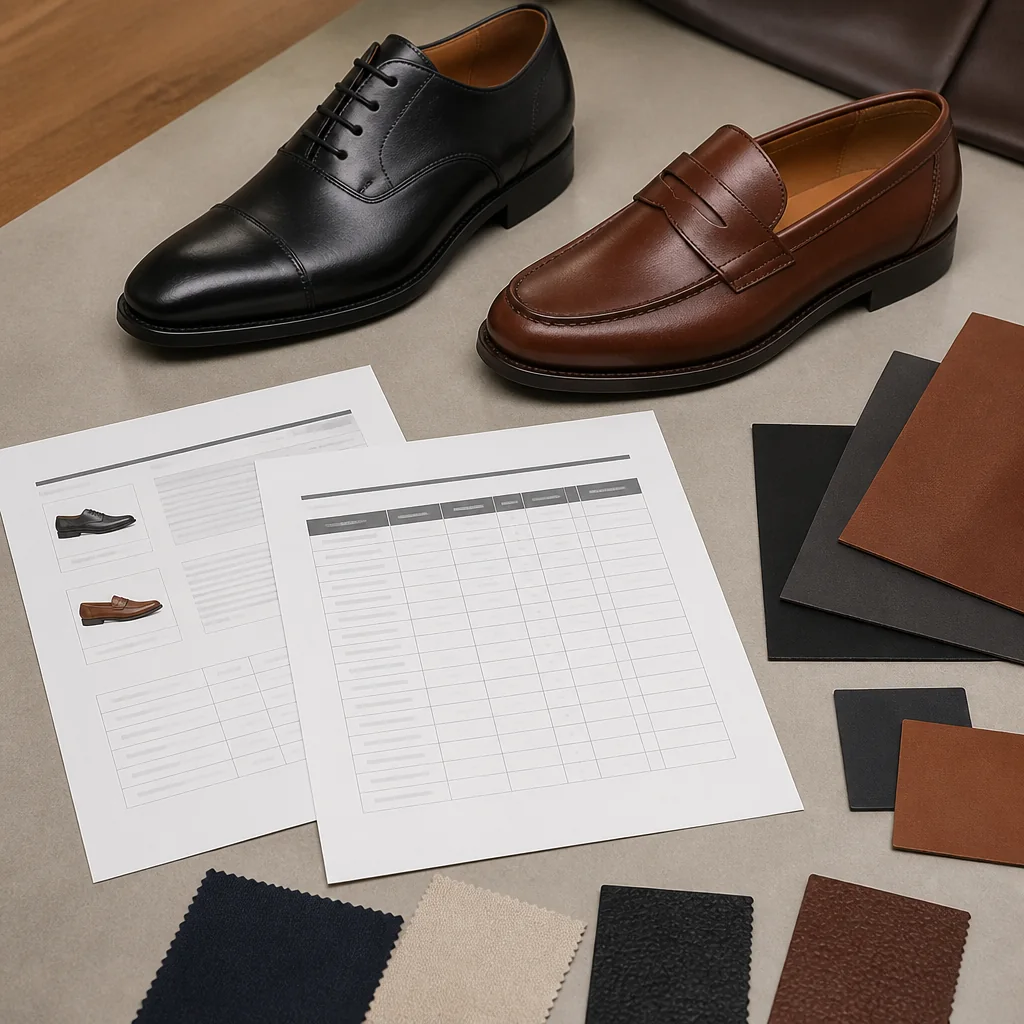
Start with comparability. A private label leather shoe quote comparison checklist helps the buyer decide whether each response addresses the same footwear definition and commercial frame. Price evaluation can follow once the compared scope is visible. Until then, the working task is to record what each quotation states, where it differs from the buyer's definition, and which fields still need an answer.
The method below is an editorial recommendation for buyers. It uses a single scope-parity matrix, three buyer-side status labels, and a recorded comparison disposition. It is not a documented quotation format or company workflow.
Can the quotations be compared?
Leather Shoe Manufacturer states on its contact page that style, market, quantity, size range, materials, branding, packaging, and delivery need are reviewed together rather than priced as isolated line items. That statement provides a useful set of headings for comparison. It does not establish that every heading appears in a quotation, has its own price, or is included in a quoted total.
Use the buyer's current definition as the fixed reference. Comparing one supplier's wording only with another supplier's wording can hide a shared omission. Comparing both responses with the same definition shows whether each field is addressed and preserves differences that need to remain visible.
The scope-parity matrix
This buyer-owned matrix can be used to compare leather shoe manufacturer quotes without inventing missing information. Add or remove quotation columns as needed. Copy the relevant wording into each supplier cell, then place the comparison status or question in the final column.
| Requirement field | Current buyer definition | Quotation A | Quotation B | Status or clarification |
|---|---|---|---|---|
| Style | Record the buyer's style reference and required style details. | Copy the stated style and referenced documents. | Copy the stated style and referenced documents. | Mark conflicting, incomplete, or absent references. |
| Market | Record the intended market named by the buyer. | Copy any market statement. | Copy any market statement. | Note a different or unstated market. |
| Quantity | Enter the quantity definition used for the inquiry. | Record the stated quantity basis. | Record the stated quantity basis. | Ask which basis applies where the wording is unclear. |
| Size range | Copy the requested size-range definition. | Record only the range or reference provided. | Record only the range or reference provided. | Flag omissions or conflicting descriptions. |
| Materials | List the buyer's current material wording and references. | Transcribe the materials and qualifications stated. | Transcribe the materials and qualifications stated. | Record substitutions, broad descriptions, or missing references. |
| Branding | Record required locations and current artwork references. | Note which branding information is addressed. | Note which branding information is addressed. | Identify locations or references that remain unresolved. |
| Packaging | Record the buyer's packaging definition and artwork references. | Copy the packaging wording provided. | Copy the packaging wording provided. | Flag conflicting definitions or missing information. |
| Delivery need | State the delivery need supplied with the inquiry. | Record the response's exact delivery wording. | Record the response's exact delivery wording. | Ask which parts of the delivery need were considered. |
The table can also serve as an OEM leather shoe quotation checklist, but it is not a substitute for the buyer's product definition. Its role is to organize comparison evidence. Do not rewrite broad or incomplete supplier language to make the cells appear consistent.
What does the style label identify?
The style row needs enough detail to connect each response to the buyer's intended shoe. Two company pages provide bounded examples of the control points associated with named styles. These examples should remain attached to those styles; they are not a universal leather-footwear checklist and are not evidence that the points will appear in a quotation.
Cap-toe Oxford
The cap-toe Oxford section of the company's dress-shoes page identifies facing gap, toe proportion, cap placement, polish, and pair symmetry as control points for that style. For a cap-toe Oxford comparison, the buyer can record which of these points are part of the current definition and whether the responses refer to the same governing documents.
Penny loafer
The penny-loafer section of the company's loafers page identifies saddle proportion, apron symmetry, vamp length, opening retention, heel hold, and flex for that core style. For a penny-loafer comparison, keep those points in their own style record rather than combining them with the Oxford list.
Use the sourced examples to sharpen the relevant style row, not to infer supplier acceptance. A matching category name can be marked aligned only when the buyer decides that the supporting statement or reference matches the current definition closely enough for the intended comparison.
Do not infer incoming review from a quotation
The factory-quality page documents an incoming review of leather article, color, thickness, lining, outsoles, hardware, packaging, artwork, and lot identity. The excerpt places that review before mixed or unclear materials enter production.
The source does not locate the incoming step before, during, or after quotation. It also does not document laboratory testing or guarantee a material or production result. For quotation comparison, the editorial recommendation is to record only the material and packaging language present in the response. Keep any incoming confirmation record separate unless project-specific documents connect it to the quotation.
Three buyer-side statuses
Assign one of the following editorial labels to each supplier cell. They describe the state of the buyer's comparison record, not a supplier status, approval, or company workflow stage.
- Aligned
- The statement or referenced document matches the current buyer definition closely enough for that field to be compared. Preserve the supporting wording or reference in the matrix.
- Open
- The response addresses the field, but a qualification, conflict, or ambiguity still requires an answer. Keep the difference visible and write the needed question beside it.
- Unstated
- The reviewed quotation material does not address the field. This label records missing comparison evidence; it does not describe what the supplier can provide.
Read the labels across each row as well as down each quotation column. A single aligned field does not resolve the other requirements. Open and unstated cells identify where the buyer needs more information before treating the responses as equivalent in scope.
Questions generated by unresolved cells
Turn each open or unstated cell into a focused inquiry tied to the current definition. The following are buyer questions, not representations of documented services or available commercial terms:
- Which style reference and relevant style details does the response address?
- Which market definition was used to review the project?
- Which quantity basis applies to the response?
- Which size-range definition or reference applies?
- Which material descriptions and references apply to the proposed shoe?
- Which branding locations and artwork references have been addressed?
- Which packaging definition and artwork information apply?
- Which delivery need was considered, and what information remains open?
Keep each answer in the corresponding matrix cell. This preserves the original response, the clarification, and the revised status without changing unrelated parts of the comparison. Where the project requires a separate discussion, ask which development, sampling, or quotation options may apply rather than assuming that a particular route, format, timing, or term is available.
The comparison disposition
After reviewing the matrix, record one buyer-side disposition for the current set of documents. The disposition reports whether the offers can be evaluated on a common scope; it does not select a supplier or validate feasibility, quality, price, or delivery.
| Disposition | Use it when | Editorially recommended buyer action |
|---|---|---|
| Comparable | The fields required for the current decision are aligned, and the remaining differences are recorded clearly. | Continue the commercial evaluation while retaining the matrix and its source references. |
| Comparable after clarification | Open or unstated cells require focused answers before the scope can be treated as aligned. | Submit the recorded questions, update only the affected cells, and reassess the disposition. |
| Not yet comparable | The available responses do not provide a common product and commercial frame for the intended evaluation. | Pause the comparison and request the missing or conflicting definitions. |
To discuss a project, share the current leather footwear definition through the contact page and ask which development, sampling, or quotation options may apply. The inquiry requests project-specific information; it does not establish that an option is available or guarantee feasibility or a quotation.
Sources and verification
- Request a Quote | Leather Shoe Manufacturer First-party site source
- Custom Leather Dress Shoes Manufacturer | OEM & Private Label First-party site source
- Custom Loafers Manufacturer | OEM & Private Label Leather Loafers First-party site source
- Leather Shoe Factory in China | Capability & Export QC First-party site source
Share the current leather footwear definition and ask which development, sampling or quotation options may apply to the project.
Send your project brief