
Sourcing Guides
OEM Mens Dress Shoes vs Wholesale Distributors
Wholesale catalogs name styles. OEM and private-label programs need facing, toe, polish, pair, and appearance controls written before development or quotation can be assessed.
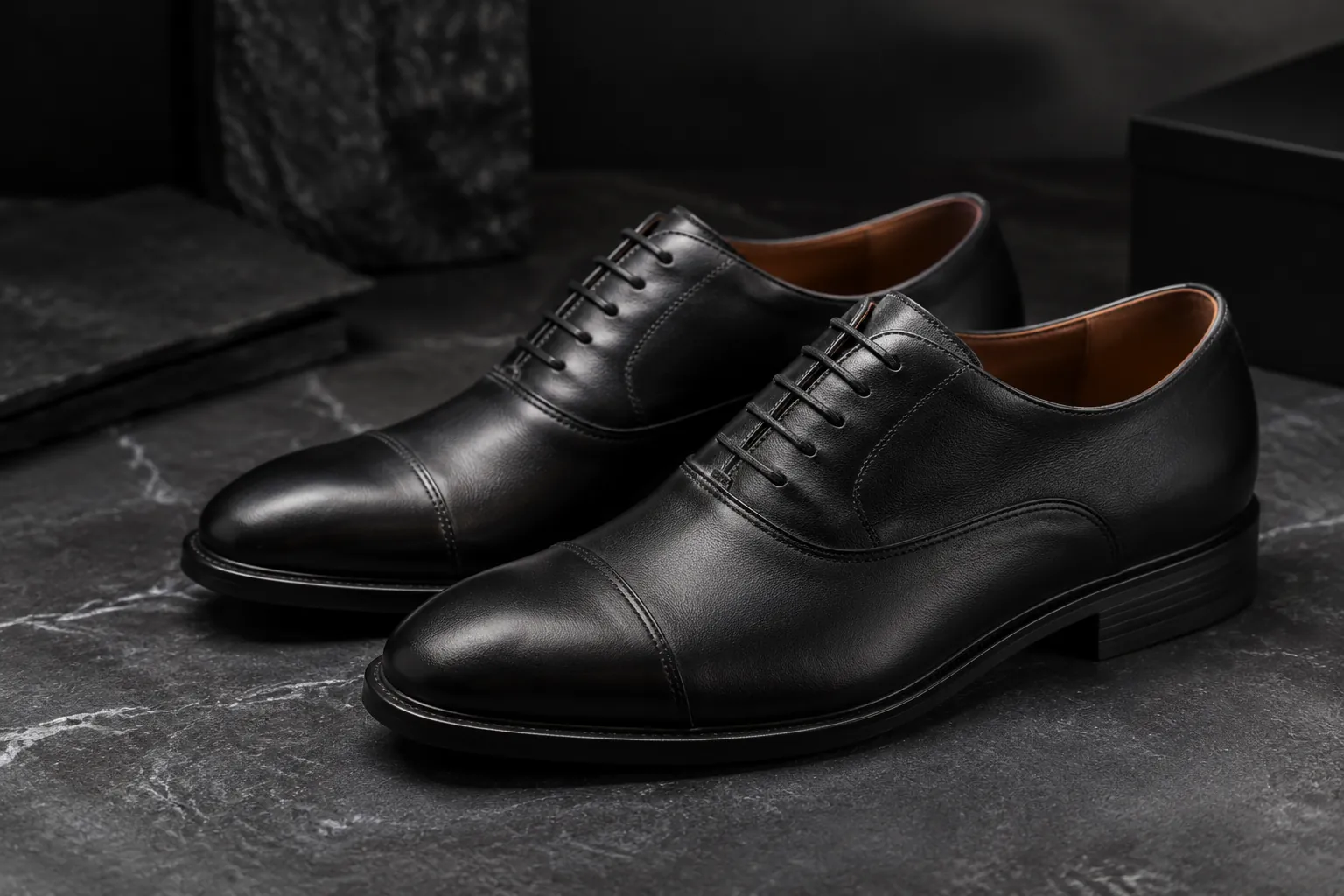
Buyers weighing oem mens dress shoes vs wholesale distributors often treat catalog selection and factory programs as the same decision. They are not. The commercial gap is less about price lists than about language. A wholesale SKU tells a buyer which finished shoe to reorder. An OEM or private-label brief must tell a manufacturer which facing gap, toe geometry, polish level, pair match, and material appearance range will define acceptance. Without that translation, sampling and quotation requests stay incomplete even when a reference photo looks exact.
This article treats a wholesale-distributor purchase as an unfinished brief. It maps Oxford and penny loafer control points catalogs usually leave unspoken, places material appearance questions next to those style definitions, and separates locked requirements from open development questions before you send a definition for assessment.
Why a wholesale distributor SKU is not a factory brief
Wholesale assortment language is built for replenishment. It names a model, color, size run, and sometimes a broad leather grade. That is enough when the supplier already owns the last, the pattern, the component set, and the visual standard. It is not enough when you want a private label mens dress shoes program that must hold across reorders under your brand rules.
Catalog copy rarely freezes the manufacturing variables that drive cost, sample rounds, and later returns. Facing geometry on an Oxford, saddle proportion on a loafer, polish depth, and how hides are paired across a shipment all sit outside typical wholesale product cards. A buyer who pastes a distributor SKU into a manufacturer inquiry is asking a factory to invent the missing control points, then hoping those inventions match retail expectations later.
As an editorial recommendation for the buyer, keep the wholesale reference as a visual starting point and rewrite the style as a manufacturing definition. The sections below use only the control points published for formal Oxford and core penny loafer programs on this site, kept in separate lanes so Oxford language is not reused on loafers by accident.
Cap-toe Oxford controls wholesale catalogs leave unspoken
Two site pages describe formal cap-toe Oxford controls. They overlap in theme but are not one combined capability list, and neither invents numeric tolerances. Keep the source of each control visible when you convert a wholesale formal shoe into OEM language.
On the dress shoes page, a black cap-toe style is framed as a core formal program. That page treats facing gap, toe proportion, cap placement, polish, and pair symmetry as control points.
Separately, the men's leather shoes page describes a cap-toe Oxford direction in which facing gap, toe shape, polish level, and pair symmetry need a documented approval standard. Cap placement appears on the dress shoes page only. Toe proportion appears on the dress shoes page; toe shape appears on the men's leather shoes page. Write each as its own decision rather than merging them into one anonymous factory set.
When a wholesale formal shoe moves into OEM development, write mens oxford private label controls in plain language before you ask for sampling or quotation assessment:
- Facing gap (dress shoes page and men's leather shoes page): how open or closed the lace opening should read when the shoe is at rest, and whether that read must match left and right pairs.
- Toe proportion (dress shoes page): the length and fullness of the toe relative to the last, stated as the visual target you will approve against.
- Toe shape (men's leather shoes page): the silhouette of the toe as a documented approval standard, kept distinct from proportion language above.
- Cap placement (dress shoes page): where the cap seam sits on the vamp.
- Polish / polish level (dress shoes page polish; men's leather shoes page polish level): the depth and evenness of finish expected on the upper.
- Pair symmetry (both pages): which left-right matches must hold for facing, cap where used, and overall silhouette before a pair is accepted.
A distributor catalog may show one polished black Oxford. That photo does not freeze facing geometry, cap position, or the polish standard you will enforce on every size. If those points stay oral or implied, each sample round becomes a negotiation about taste rather than a check against a written standard. For formal programs, write the control points first, then attach the wholesale image only as commercial context. Explore related formal style framing on the dress shoes and men's leather shoes pages when you need those published control points in context.
Penny loafer controls that change the manufacturing brief
Loafers fail when buyers paste Oxford language onto a slip-on last. The loafers page isolates a men's core penny loafer and lists a different set of manufacturing controls: saddle proportion, apron symmetry, vamp length, opening retention, heel hold, and flex for a repeatable core style. That list is the ceiling for what this article can attribute to that program. It is not a general claim about every loafer construction, and it does not include Oxford facing or cap language.
A useful penny loafer oem specification for private-label work therefore answers a different set of questions:
- Saddle proportion: width and placement of the saddle band relative to the vamp and opening.
- Apron symmetry: how even the apron stitching and panel read from left to right and across pairs.
- Vamp length: how far the vamp extends before the opening, which changes both look and fit feel.
- Opening retention: whether the throat holds its shape after wear rather than collapsing or gapping unevenly.
- Heel hold: how the heel cup keeps the foot without relying on a closed lace system.
- Flex: where and how the sole and upper are expected to bend in normal walk-in use for that core style.
Wholesale loafer cards often stop at color and a lifestyle image. Those cards do not lock saddle geometry or opening behavior. If your assortment will mix Oxfords and loafers under one private label, keep two control tables rather than one blended “dress shoe” brief. Reusing Oxford polish and facing language on a penny loafer creates false confidence and late-stage pattern changes. For the published loafer control set, see the custom loafers page.
Material appearance questions that belong beside the style definition
Style geometry is only half of the translation problem. Leather appearance is the other half, and wholesale distributors rarely answer the questions a manufacturer needs when hides or components must stay consistent across an order. The materials page frames appearance range as a set of buyer questions: what variation is natural, what becomes a defect, how colors are approved, and how hides or component lots are paired across the order.
Place those questions next to the Oxford or loafer definition rather than in a separate materials appendix that nobody reads until a dispute. A black cap-toe program and a tan penny loafer program may share a leather family yet need different answers for acceptable grain scatter, dye depth, and pair matching. Write the answers as decisions your brand is willing to live with, not as vague preferences.
As an editorial recommendation for the buyer, draft appearance answers in this order:
- State the leather type or family you intend to use, without inventing grades the factory has not confirmed.
- Define natural variation you will accept versus defects you will reject.
- Describe color approval method: physical swatch, sealed sample, or digital reference, and which one wins if they conflict.
- State how pairs and sizes should be matched from hides or component lots so the order does not drift mid-shipment.
None of those points is a substitute for a laboratory test plan, and this article does not invent pass rates or shade tolerances. Appearance questions sit beside style controls because both determine whether a wholesale look can become a repeatable private-label product. Use the materials page as the source for those appearance-range questions when you build the brief.
Keep locked requirements distinct from open sampling questions
Once Oxford or loafer controls and appearance questions are written, separate what is already decided from what you still need the factory to propose. Mixing the two columns is a common failure mode. Buyers list every preference as a hard requirement, then discover that some items were really open questions about last options, construction, or sampling sequence. Factories cannot price or schedule a definition that still contains undecided geometry.
The table below is an editorial organizer, not a service menu and not a claim about commercial quantities or timelines. It uses only the control themes already cited for formal Oxford, core penny loafer, and appearance range.
| Locked in the buyer definition | Left open for development or sampling discussion |
|---|---|
| Oxford controls from the dress shoes page: facing gap, toe proportion, cap placement, polish, and pair symmetry as written approval standards | Whether a new last, pattern tweak, or construction path is needed to hit those standards |
| Oxford controls from the men's leather shoes page: facing gap, toe shape, polish level, and pair symmetry as a documented approval standard | How those standards are proven on sample pairs without inventing numeric tolerances |
| Penny loafer saddle proportion, apron symmetry, vamp length, opening retention, heel hold, and flex targets for the core style | Which sample stages or trial lasts should be used to prove those targets |
| Appearance answers: natural variation, defect boundary, color approval method, hide or component lot pairing across the order | Material options or lot strategies the factory may propose against those answers |
| Style lane identity: formal Oxford versus core penny loafer, not a blended “dress shoe” label | How many style variants to develop first, and which commercial questions to raise later |
Keep locked rows short and testable. Keep open rows honest about uncertainty. That split lets a manufacturer assess development, sampling, or quotation options against a stable core rather than against a moving wish list. It also prevents wholesale catalog language from re-entering as a silent default when a detail is missing.
Send one footwear definition for development or quotation assessment
You do not need a multi-stage workflow document to start a serious conversation. You need one coherent footwear definition that a manufacturer can read without reverse-engineering your distributor catalog. Assemble it as follows.
- Name the style lane: formal cap-toe Oxford or core penny loafer, using the control vocabulary that belongs to that lane only.
- Write the control points that are already decided. For Oxfords, keep dress-shoes-page controls (facing gap, toe proportion, cap placement, polish, pair symmetry) distinct from men's-leather-shoes-page controls (facing gap, toe shape, polish level, pair symmetry). For penny loafers, use saddle, apron, vamp, opening, heel, and flex language only.
- Answer the appearance-range questions: natural variation, defect boundary, color approval, and hide or component lot pairing.
- List open questions separately: items you want the factory to advise on, not items you have already frozen as brand law.
- Attach wholesale photos only as commercial context, and mark them as non-binding where they conflict with the written controls.
When that definition is ready, share the current leather footwear brief and ask which development, sampling, or quotation options may apply to the project. Scope stays limited to the published Oxford, loafer, and materials topics used above.
If your assortment still lives mainly inside wholesale distributor channels, treat the next reorder cycle as the moment to write the missing factory language rather than as another catalog refresh. The practical difference between OEM men's dress shoes and wholesale-distributor buying shows up in fewer ambiguous sample rounds and clearer acceptance standards. Start from the written definition, then use the contact page to send that definition for assessment against the program you actually want to own.
Sources and verification
- Custom Leather Dress Shoes Manufacturer | OEM & Private Label First-party site source
- Leather Shoe Materials | Full Grain, Suede, Lining & Outsoles First-party site source
- Custom Loafers Manufacturer | OEM & Private Label Leather Loafers First-party site source
- Men's Leather Shoes Manufacturer | Custom Oxfords & Loafers First-party site source
Share the current leather footwear definition and ask which development, sampling or quotation options may apply to the project.
Send your project brief