
OEM Development
OEM Custom Leather Sneakers Development Brief and Proposal Rights
A usable OEM custom leather sneakers development brief freezes one commercial frame and states which decisions the factory may propose, so quotation reviews the package together and incoming material control stays a later production gate.
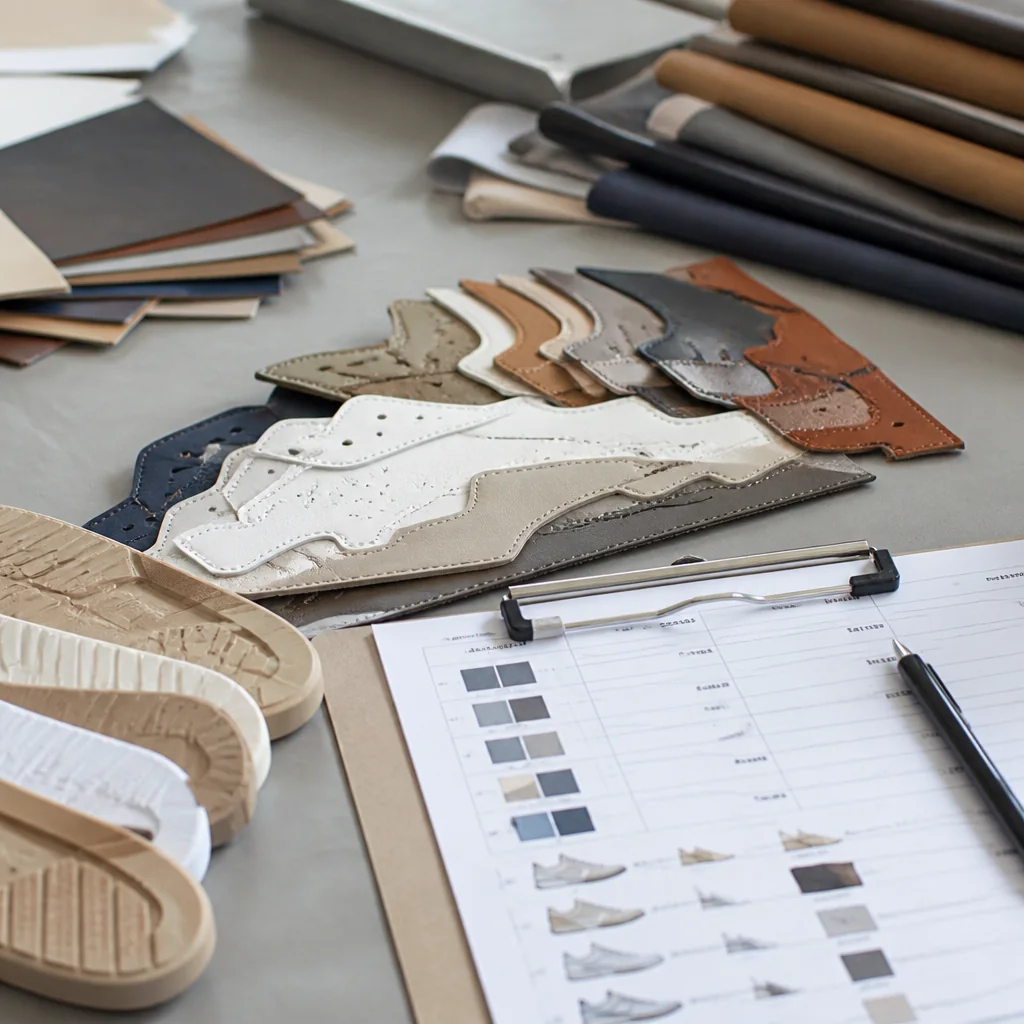
An OEM custom leather sneakers development brief earns its name only when it freezes a commercial frame, not merely a silhouette or a materials note. Brands, importers, and product teams often lead with style references and hold market position, size range, delivery need, and price band offline. The factory then lacks a boundary it can use.
Ownership of open construction and trim choices is usually missing as well. Style-only or materials-only inputs leave the factory unable to tell whether it is answering a development question, a commercial feasibility question, or both. Until those layers sit in one freeze, proposal rights stay ambiguous. Early unit prices float as provisional guesses, and sampling paths restart when commercial facts appear late.
What stalls when the OEM brief is incomplete?
Without a stated market, expected quantity, size range, or delivery need, the factory cannot tell which decisions it may suggest and which ones the buyer has already locked. That ambiguity produces clarification loops and price talk that sits as isolated line items instead of one shared frame.
Private-label teams hit the same stall when brand artwork arrives without a price position, or when a silhouette is fixed while the size run and ship window remain open. Incomplete inputs force the factory to reconstruct intent from partial notes. The practical failure is ownership: nobody can defend a sample iteration or a quote line against a commercial boundary that was never written down.
Commercial frame fields that must travel together
On the site’s OEM and ODM process, the brief step is to freeze the commercial frame by stating a defined set of fields together. Treat each field as a buyer input you bring into the discussion. Do not invent quantities, prices, or calendars that merchandising has not approved.
- Customer: who the program serves (brand, channel, or private-label owner)
- Market: geography and retail context that shape fit, look, and compliance expectations
- Style family: the sneaker silhouette group under development, not a full collection matrix
- Target price position: the commercial band that constrains materials and construction options
- Expected quantity: the volume assumption the team is planning against, even if still a range
- Size range: the run the program must cover
- Delivery need: the timing constraint that bounds development and production planning
- Decisions the factory may propose: explicit ownership of open technical or commercial choices
A private label custom leather sneakers brief that scatters these items across mood boards, chat threads, and partial tech packs forces reconstruction after the fact. Keep them in one package so later quotation and sampling work against the same constraints.
If a field is still open, mark it open inside the freeze rather than omitting it. Omission reads as “not considered.” An open label preserves ownership for the next step.
Buyer-locked decisions versus factory-open proposals
The same OEM brief language asks you to state the decisions the factory may propose. That clause is about ownership before sampling talk begins. It does not expand into an unlimited menu of services.
Separating locked buyer decisions from open factory proposals keeps OEM or private-label development from reopening the commercial frame every time a sample iteration appears.
- List buyer-locked decisions first: brand identity rules, must-have silhouette boundaries, a fixed retail or wholesale price band, non-negotiable compliance or labeling rules, and any construction or material exclusions already set by product leadership.
- List factory-open decisions second: options the factory may propose within the frozen style family, price position, size range, and delivery need. Examples include last refinements, material alternatives that still meet the commercial band, or construction routes that preserve the stated constraints.
- Write the split in the brief itself so proposal rights travel with the package. Verbal “we’ll figure it out later” leaves both sides free to reinterpret ownership when a quote or sample conflicts with an unstated assumption.
Editorial recommendation for buyers: if merchandising has already frozen the silhouette family and price position, say so. If last shape, upper panel layout, or outsole path may still be proposed inside those limits, say that too. Ambiguity on proposal rights is what turns a custom leather sneakers commercial frame into a negotiation after sampling has already started.
Why quotation needs the same package, not line items
Once the freeze exists, quotation should not become a stack of independent unit prices.
The site’s request-a-quote path describes reading the product and commercial frame together: style, market, quantity, size range, materials, branding, packaging, and delivery need are reviewed as one package rather than priced as isolated line items. That custom leather sneakers quotation review only works if the brief already carries those fields in one place.
Materials and branding may still be partially open when you first inquire. The review then flags gaps against the commercial frame instead of inventing a complete cost stack. Use the same freeze you built at brief stage so product constraints and commercial constraints move together into the quote conversation.
Editorial recommendation for buyers: do not send a style board for ballpark pricing while holding market, quantity, size range, and delivery need offline. The joint review model depends on those fields being present. If one field is still provisional, present it as provisional inside the package so the factory can respond to uncertainty without treating an incomplete brief as a finished RFQ.
Incoming material control after definition
After definition, production still needs a gate that stops mixed or unclear materials from entering the line. That gate is not the OEM brief. The brief freezes commercial frame and proposal rights. Incoming review confirms that leather, components, packaging, and artwork that arrive match the agreed identity and lot control.
Factory quality guidance describes controlled review of leather article, color, thickness, lining, outsoles, hardware, packaging, artwork, and lot identity before mixed or unclear materials enter production. Confusing that stage with the brief either overloads early definition with lot-level detail or weakens intake by treating style notes as material control.
- Leather article
- Color
- Thickness
- Lining
- Outsoles
- Hardware
- Packaging
- Artwork
- Lot identity
Keep the gate’s field list separate from the brief’s commercial fields. Article, thickness, and lot identity belong to intake confirmation after the program is defined. Customer, market, style family, price position, quantity, size range, delivery need, and proposal rights belong to the freeze that enables quotation. Mixing them into one early document blurs stage ownership and invites rework when commercial assumptions change after materials have already been ordered against an incomplete frame.
Inquiry topics that remain open
After you freeze the frame, you may still ask which development, sampling, or quotation options may apply to the project. Those questions remain buyer inquiry topics. They are not automatically documented factory services or promises until the factory responds against your definition.
- Which development path fits the frozen style family, market, and price position
- Which sampling steps may apply before any bulk commitment
- How the joint product-and-commercial package should be presented for quotation review
- Whether any commercial field still blocks a complete review
- How proposal rights written in the brief will be reflected in sample iterations
Keep this list as questions for review of the current definition. Do not convert it into a claim that a specific sampling ladder, MOQ path, or quotation format is already guaranteed. The useful handoff is the freeze plus an explicit ask for which options may apply, not a request that pretends the program is already fully specified.
Where the freeze goes for option review
Submit the current leather footwear definition: customer, market, style family, target price position, expected quantity, size range, delivery need, and the decisions the factory may propose. Then ask which development, sampling, or quotation options may apply to that package.
That handoff matches a joint review of product and commercial frame rather than a request for isolated line-item prices. Start from the contact path with the freeze already written so the first reply can address options against a coherent package. Incoming material control remains a later production gate once definition is stable. The OEM custom leather sneakers development brief is the freeze that makes those later stages possible, not a substitute for them.
Sources and verification
- OEM Shoes & ODM Leather Footwear | Custom Shoe Manufacturer First-party site source
- Request a Quote | Leather Shoe Manufacturer First-party site source
- Leather Shoe Factory in China | Capability & Export QC First-party site source
Share the current leather footwear definition and ask which development, sampling or quotation options may apply to the project.
Send your project brief