
Wholesale Footwear Standards
Cap-Toe Controls for mens dress shoes wholesale pair symmetry
Formal wholesale pairs diverge when polish and symmetry stay unlocked. Keep dress-shoes and men's leather shoes Oxford lists separate as commercial fields. Treat development options as open questions only.
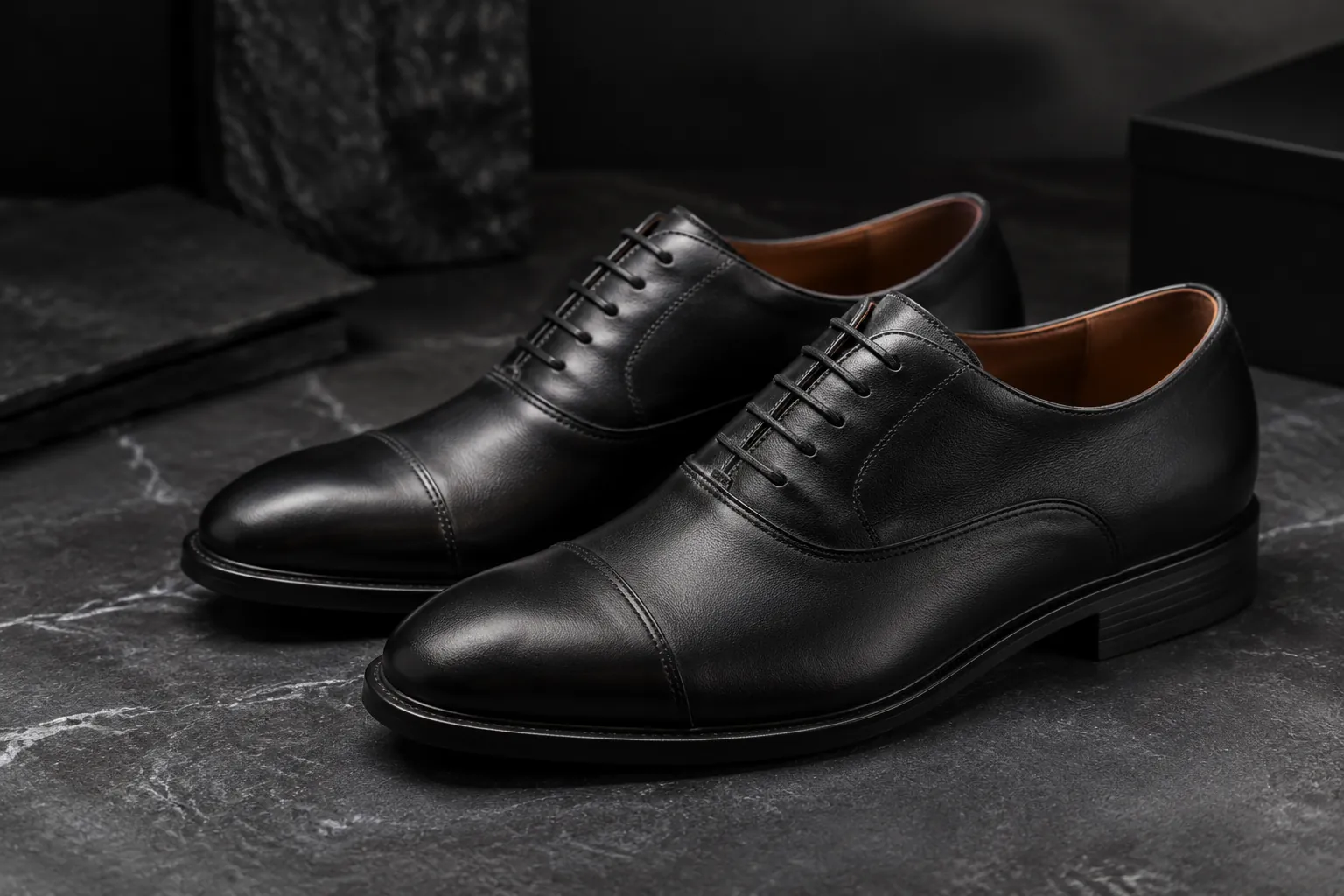
Addressing mens dress shoes wholesale pair symmetry starts before sampling begins. Wholesale buyers of formal cap-toe Oxfords often leave polish level and left-right matching as conversational notes rather than documented fields. The result is pairs that no longer read as matched sets once bulk production runs. Cap toe oxford wholesale controls become the practical remedy when those points are converted into early commercial locks. Dress shoe polish control points and wholesale oxford pair consistency then protect the appearance of the finished pair under retail lighting.
When pair symmetry fails after a wholesale formal brief is open
Formal wholesale programs for cap-toe Oxfords rely on visual discipline across every pair. When the relevant control points remain informal notes, production lots can diverge even when last and material stay correct. As a hypothetical illustration of the failure mode, a finished pair may display mismatched facing openings or uneven polish depth after the brief has already been opened and the silhouette approved. These outcomes are control-point failures rather than ordinary material defects. Importers and brand teams selling into business or uniform channels then face returns or rejections that could have been prevented by an earlier approval standard.
The same risk appears when polish is treated only as a finishing preference. A sample may show one sheen character while later pairs settle into another. Editorial recommendation for the buyer is to treat pair symmetry and polish as locked fields drawn strictly from the published source lists rather than as late visual preferences.
Two separate source lists of cap-toe Oxford control points
The dress-shoes page and the men's leather shoes page each name a distinct set of control points for the core formal cap-toe Oxford. These lists must remain separate. No combined checklist is formed from them.
On the dress-shoes page, the cap-toe Oxford is presented as the disciplined anchor of a formal program, with facing gap, toe proportion, cap placement, polish, and pair symmetry treated as control points. A buyer converting this excerpt into brief fields records exactly those five items:
- Facing gap
- Toe proportion
- Cap placement
- Polish
- Pair symmetry
On the men's leather shoes page, the core formal cap-toe Oxford is described as a disciplined business and uniform direction where facing gap, toe shape, polish level, and pair symmetry need a documented approval standard. The buyer converting this second excerpt records exactly those four items:
- Facing gap
- Toe shape
- Polish level
- Pair symmetry
Cap toe oxford wholesale controls therefore rest on whichever source list the buyer elects to adopt for the program, or on both lists kept as parallel references. Editorial recommendation is to avoid any union that would invent attributes such as a single expanded field set. Once one or both exact lists sit on the brief, the approval sample becomes the reference object for subsequent checks against those named points alone.
Appearance-range questions that protect polish consistency across the order
Polish and pair-symmetry locks hold only when the materials conversation matches their precision. The materials page frames four questions: what variation is natural, what becomes a defect, how colors are approved, and how hides or component lots are paired across the order. Those questions support the formal Oxford controls drawn from either source list.
Natural grain or tone variation must be distinguished from a finish defect that would break pair symmetry. Color approval should reference the lighting and viewing conditions planned for bulk inspection. Pairing hides or component lots across the order is the practical mechanism that keeps left and right shoes from drawing on visibly different material ranges. When these appearance-range questions are answered early, dress shoe polish control points and wholesale oxford pair consistency become enforceable. Editorial recommendation for the buyer is to elevate the four questions into the commercial record so that polish consistency is protected; the buyer still decides which development or sampling options to explore later.
Penny loafer controls stay separate from the formal Oxford standard
Formal Oxford language must not be imported into casual or smart-casual styles. The loafer page identifies a distinct set of control points for the men's core penny loafer: saddle proportion, apron symmetry, vamp length, opening retention, heel hold, and flex for a repeatable core style. These fields govern a different silhouette and wearing motion. Apron symmetry and saddle proportion address visual balance on an open-throat shoe; opening retention and heel hold address fit behavior an Oxford facing does not share. Flex characteristics matter for the unbroken vamp of a loafer in ways that do not map onto a closed Oxford.
Keeping the two styles separate protects both programs. A buyer who copies polish-level language from an Oxford brief onto a penny loafer RFQ risks locking a finish that conflicts with the intended character. Conversely, importing vamp-length or flex criteria into an Oxford brief adds controls the formal style does not require. The evidence presents the two styles with their own named points; commercial practice should respect that boundary. Programs that mix Oxfords and loafers therefore maintain two parallel approval standards rather than a single blended checklist.
Locked approval standard versus open development and sampling questions
Once the chosen Oxford fields from the selected source list are written into the brief, the control record itself is closed. The exact points from that list become the documented reference. That closed record is distinct from the still-open commercial questions a buyer may later raise: which development routes, sampling sequences, or quotation formats may apply to the project. Treating the control record as finished prevents scope creep; treating the process questions as open prevents the brief from inventing service packages that the evidence does not describe.
Editorial recommendation for the buyer is to place the locked fields on the first page of the commercial package and to list the open inquiry topics on a separate sheet. The first page can be shared with any manufacturing partner as the appearance standard. The second sheet invites discussion without converting the invitation into a promised deliverable. This separation also makes reorders cleaner: the locked standard travels with the style, while sampling or quotation choices can be reassessed if volumes or calendars change.
Share one pair-symmetry-locked footwear definition for assessment
Buyers who want an assessment of applicable options can assemble a single definition that already contains the formal locks drawn from the source pages. The steps below keep the package concise and decision-ready.
- State the style as a cap-toe Oxford or other formal silhouette and attach either the dress-shoes control points (facing gap, toe proportion, cap placement, polish, and pair symmetry) or the men's leather shoes approval fields (facing gap, toe shape, polish level, and pair symmetry), or both as separate parallel lists.
- Attach the answers already obtained on natural variation versus defect, color-approval method, and hide or component-lot pairing.
- Keep any loafer styles on a separate page that uses only the loafer control points: saddle proportion, apron symmetry, vamp length, opening retention, heel hold, and flex.
- Leave development, sampling, and quotation topics as open questions rather than assumed inclusions.
- Share the complete definition through the contact channel so the receiving team can indicate which options may apply to the specific project.
The resulting package gives procurement and product teams a clear record of what has already been decided and what remains to be discussed. It converts the failure mode of uneven pairs into a preventable specification gap, keeps Oxford and loafer disciplines distinct, and preserves the boundary between a locked appearance standard and any later commercial process. For programs that must deliver consistent formal pairs at wholesale scale, that boundary is the difference between a brief that holds and one that drifts after the first sample.
Explore the published Oxford and materials context at dress shoes, men's leather shoes, and materials, keep loafer programs on their own track via loafers, and share the locked definition for assessment at contact.
Sources and verification
- Custom Leather Dress Shoes Manufacturer | OEM & Private Label First-party site source
- Custom Loafers Manufacturer | OEM & Private Label Leather Loafers First-party site source
- Men's Leather Shoes Manufacturer | Custom Oxfords & Loafers First-party site source
- Leather Shoe Materials | Full Grain, Suede, Lining & Outsoles First-party site source
Share the current leather footwear definition and ask which development, sampling or quotation options may apply to the project.
Send your project brief