
Men's Dress Shoes
Men's Dress Shoes Wholesale: Build an Approval Matrix
A buyer-oriented framework for defining style geometry, pair consistency and leather appearance before comparing quotations for men's dress shoes.
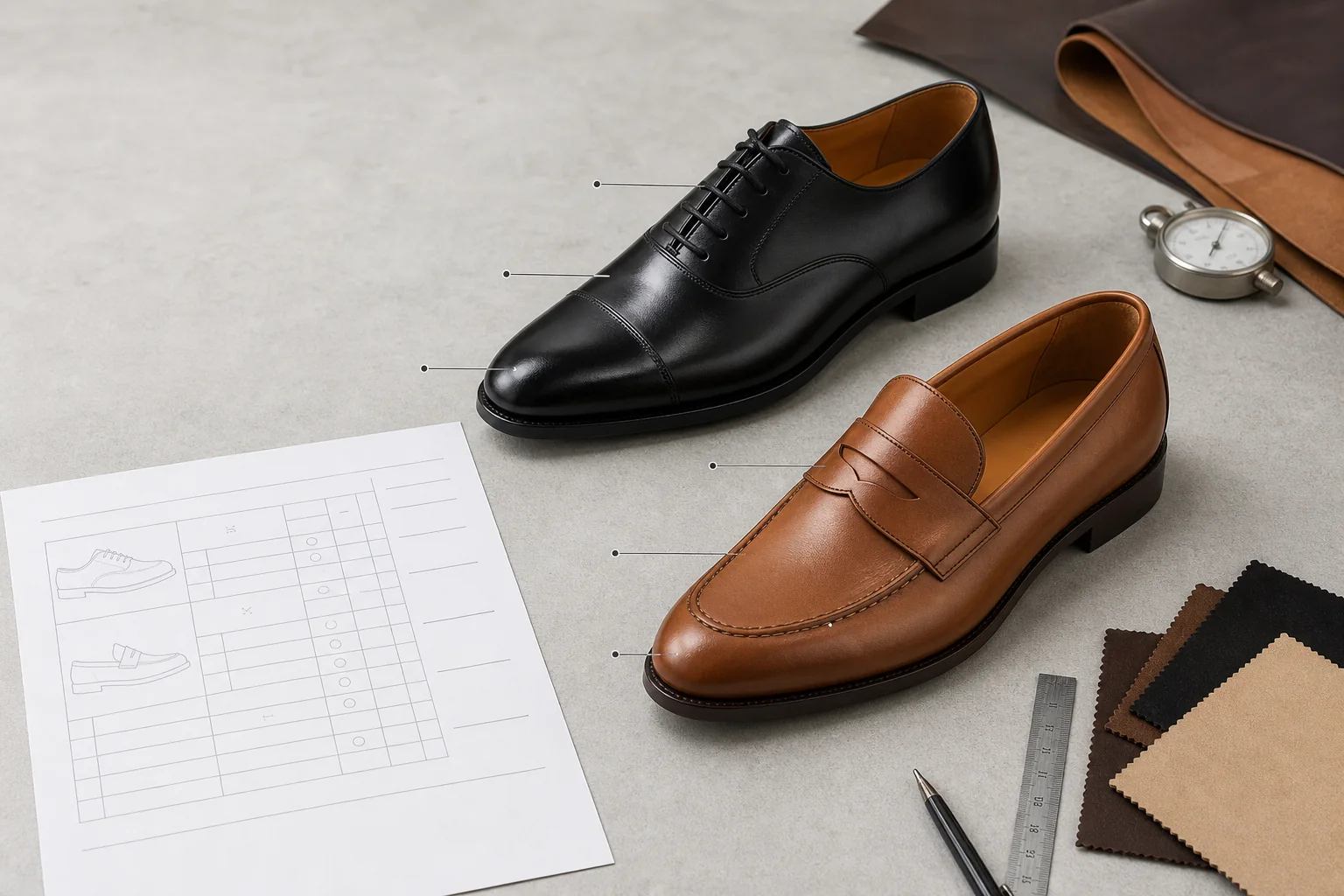
Quotations for men's dress shoes wholesale are difficult to compare when the inquiry names a category and color but leaves the visible result open to interpretation. A reference photograph may show the general design without identifying which details govern approval.
An approval matrix gives those details a place in the quotation package. In this article, the matrix is an editorial recommendation for buyers, not a documented factory inspection procedure. It records the shoe area under review, the attribute that matters, the reference used to communicate it, the variation the buyer considers acceptable and any question that remains unresolved.
The matrix should follow the construction of the selected shoe. The available first-party examples identify different control points for two cap-toe Oxfords and one penny loafer. Keeping those examples separate prevents a useful product reference from becoming an unsupported universal standard.
Organize the matrix in three levels
Start with three distinct levels: style geometry, consistency within a pair and material appearance across the proposed order. This division keeps unlike decisions out of the same matrix row.
- Style geometry
- Record the shape, proportion, placement or other construction-specific features that define the selected design.
- Pair-level consistency
- Identify the left-to-right relationships that need a named reference or further discussion.
- Order-level material appearance
- Document questions about natural variation, defects, color approval and the pairing of hides or component lots across the order.
A feature may appear at more than one level, but each entry should address only one decision. For example, the position of a cap is a style question. The visible relationship between the caps on the left and right shoes is a pair question. Color character across multiple pairs belongs under order-level material appearance.
Match the control points to the shoe
The black cap-toe Oxford D-01 identifies facing gap, toe proportion, cap placement, polish and pair symmetry as control points. Those attributes describe that source example and should remain attached to it.
A second example on the men's leather shoes page, the black cap-toe Oxford M-01, states that facing gap, toe shape, polish level and pair symmetry need a documented approval standard. Although the two Oxford examples overlap, the wording is not identical: one names toe proportion and cap placement, while the other names toe shape. Combining them into a single definitive Oxford checklist would expand the sources beyond their stated scope.
The tan penny loafer L-01 identifies saddle proportion, apron symmetry, vamp length, opening retention, heel hold and flex for that core style. This list belongs to the L-01 example. It neither establishes a standard for every loafer nor confirms that a particular fit or flex test has been completed.
| Source example | Documented attributes | Suggested buyer document |
|---|---|---|
| Black cap-toe Oxford D-01 | Facing gap, toe proportion, cap placement, polish and pair symmetry | Annotated references for the relevant proportions, placement, finish and left-to-right appearance |
| Black cap-toe Oxford M-01 | Facing gap, toe shape, polish level and pair symmetry | A named shape reference, a separate polish reference and the question to resolve for pair symmetry |
| Tan penny loafer L-01 | Saddle proportion, apron symmetry, vamp length, opening retention, heel hold and flex | References for visible proportions and a list of unresolved functional questions |
Label each reference by purpose. An image marked “toe shape” communicates a narrower decision than an unlabeled style photograph. Use separate references where shape, placement and finish require separate approvals.
Describe what must match within a pair
Pair-level entries should identify the location and relationship being reviewed. The D-01 and M-01 examples both name pair symmetry. The L-01 example separately names apron symmetry. Neither source supplies a numerical tolerance, so the matrix should not invent one.
Use an annotated image, swatch or current sample reference to show the requested appearance. Where the reference does not settle the issue, leave a direct question. Heel hold, for instance, can remain in the unresolved-question column until the parties determine which method or approval basis may apply to the project.
| Pair review entry | What to document | Question when unresolved |
|---|---|---|
| Overall geometry | The shoe areas to compare from left to right and the reference that shows the requested result | Which visible differences require review? |
| Cap, apron or saddle relationship | The relevant feature, its visual position and its named reference | How should this relationship be assessed for the selected design? |
| Finish appearance | The reference used for polish or another requested visible finish direction | What variation may be accepted within the pair? |
| Leather appearance | The requested relationship in color character or visible grain appearance | Which differences should be treated as natural variation and which should be reviewed as possible defects? |
Do not place several attributes under a vague instruction such as “match approved sample.” Toe shape, cap position, polish and leather appearance may depend on different references. Separate rows make omissions visible when competing proposals are reviewed.
Set the material-appearance questions
The materials guidance asks what variation is natural, what becomes a defect, how colors are approved and how hides or component lots are paired across the order. These are four separate questions, not a combined assurance about material control.
Connect each question to a visible location or reference. A color decision may concern the overall shoe, while grain appearance may need separate consideration on the vamp or toe. Pair matching is another decision again. A broad color name such as “dark brown” can communicate direction, but the matrix should identify the swatch, image or current product reference intended to define the request.
The acceptable-variation field should contain a product-specific decision rather than a generic leather grade or an unsupported numerical range. When that decision has not been made, state the question plainly. The quotation package then shows which material assumptions are settled and which still require assessment.
Record decisions without invented tolerances
A compact matrix can use five fields. They are buyer-side document headings, not claims about a supplier's inspection system.
| Field | Entry |
|---|---|
| Reference location | Name one area, such as the toe, cap, facing, apron, saddle, vamp, opening or visible leather panel. |
| Observable attribute | Identify one characteristic, such as proportion, shape, placement, symmetry, polish level or material appearance. |
| Approval reference | Point to the annotated image, swatch, current sample or other project document intended to communicate the requested result. |
| Acceptable variation | State the difference the buyer is prepared to accept, if that boundary has been defined. |
| Unresolved question | Record the decision that still needs assessment, clarification or later approval. |
Concrete entries are easier to compare than abstract labels. “Review apron shape and left-to-right position against reference L-APR-01” identifies both the location and the document. It does not claim a factory method, measurement threshold or inspection outcome.
Compare quotations against the same document
Read each quotation beside the matrix rather than treating price as a complete product comparison. The review should show whether every proposal refers to the same style example, material direction and approval references. It should also reveal where a response depends on an assumption that the inquiry did not settle.
- Confirm the product family and exact style reference used in the proposal.
- Check that every image, swatch or sample reference has a stated purpose.
- Keep the D-01 and M-01 Oxford attribute sets attached to their separate source examples.
- Use the L-01 attributes only where they are relevant to the selected loafer direction.
- Review pair symmetry separately from color and material appearance across the order.
- List open questions about natural variation, defects, color approval and the pairing of hides or component lots.
- Ask which minimums, timing, packing, testing, inspection and commercial terms apply to the project.
The last item is an inquiry list. The supplied evidence does not document specific minimum quantities, lead times, packing support, test requirements, inspection systems or commercial terms. These subjects therefore remain questions for the current project rather than stated company services or promises.
Send the footwear definition for assessment
Prepare the product family, style references, material and color direction, visible approval points and unresolved questions before approaching a men's dress shoe supplier. A request involving private label men's dress shoes can also identify the brand-specific appearance decisions that need to be represented in the proposed product.
Share that current footwear definition through the contact page. Ask which development, sampling or quotation options may apply, and include the unanswered commercial and approval questions that must be considered with the same product definition.
Sources and verification
- Custom Leather Dress Shoes Manufacturer | OEM & Private Label First-party site source
- Custom Loafers Manufacturer | OEM & Private Label Leather Loafers First-party site source
- Men's Leather Shoes Manufacturer | Custom Oxfords & Loafers First-party site source
- Leather Shoe Materials | Full Grain, Suede, Lining & Outsoles First-party site source
Share the current leather footwear definition and ask which development, sampling or quotation options may apply to the project.
Send your project brief