
Men's Dress Shoes
Men's Dress Shoes Wholesale: Set Appearance Standards
A buyer-focused framework for defining leather variation, Oxford details, pair consistency, and unresolved approval questions before commercial assessment.
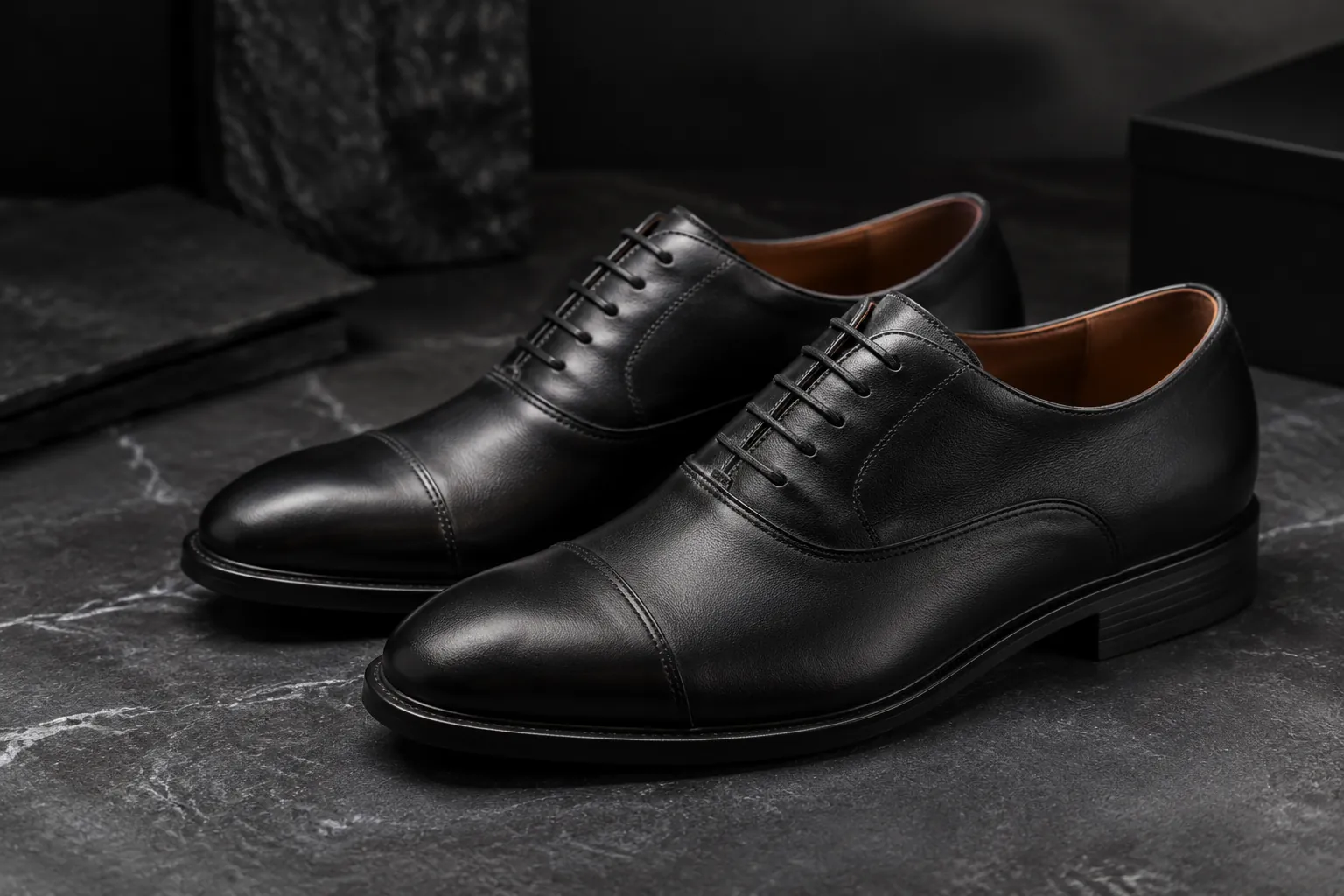
“Consistent black” sounds like a clear direction until someone must decide what it approves. Does it refer only to color? Does it also cover surface character, polish, or the relationship between the left and right shoes? A product image may show the desired result, but it does not answer those questions by itself.
For a men's dress shoes wholesale project, the buyer can turn broad appearance language into a matrix of separate decisions. Each row should address one attribute, identify the proposed reference, state the intended result, and record what still requires assessment. That structure keeps approval of one feature from being treated as approval of several unrelated features.
What does “consistent black” approve?
Consider a clearly labeled hypothetical row for a black cap-toe Oxford:
| Matrix field | Hypothetical buyer entry |
|---|---|
| Feature | Leather color |
| Proposed reference | Buyer-selected black leather reference |
| Intended appearance | Black color aligned with the nominated reference |
| Proposed allowed variation | To be defined after the current material and reference have been assessed |
| Unacceptable condition | A visible color difference that the buyer has not approved |
| Comparison level | Material and left-right pair |
| Buyer approval owner | Buyer-nominated product approver |
| Open question | Which reference and comparison approach may apply to this material definition? |
This hypothetical entry does not set a tolerance or prescribe an inspection method. It shows how the buyer can replace an ambiguous phrase with a reviewable proposal. Surface character and polish would need their own rows because acceptance of color does not define either attribute.
The evidence boundary is narrow. The supplied excerpts identify control points and questions, but they do not establish numerical tolerances, leather-grading rules, shade bands, sampling plans, inspection procedures, or disposition authority. The matrix structure and approval fields in this article are editorial recommendations for the buyer, not documented factory procedures.
The four comparison levels
An appearance requirement can become unclear when its comparison level is left unstated. The buyer can assign each row to one or more of four levels, selected according to the feature under review.
| Level | Decision recorded by the buyer | Project question |
|---|---|---|
| Material | The intended color or visible character of the leather reference. | What reference can be considered for the current material definition? |
| Individual shoe | The intended appearance of one named feature on one shoe. | What views or reference points are needed to discuss that feature? |
| Left-right pair | The intended visual relationship between the two shoes for one specified attribute. | Which differences require a buyer decision? |
| Across the order | The buyer's proposed expectation for appearance across hides or component lots. | How should that expectation be presented for assessment? |
A material-level color decision does not automatically resolve pair symmetry or cap placement. Likewise, approval of one left-right relationship should not be read as approval of every visible feature. The comparison level limits the scope of each decision.
Material variation and defect boundaries
The materials excerpt raises four separate questions: what variation is natural, what becomes a defect, how colors are approved, and how hides or component lots are paired across the order. These are useful headings for a buyer's material definition, but the excerpt does not provide project-specific answers.
For wholesale men's leather dress shoes, the buyer can record those decisions in separate fields:
- Intended material appearance
Identify the color or visible character represented by the proposed reference.
- Proposed natural variation
Describe the variation the buyer is prepared to consider, while leaving the proposal open for assessment against the current material.
- Potentially unacceptable condition
Describe what should be referred to the buyer instead of being treated as accepted by default.
- Color approval question
Ask which reference and approval approach may apply to the intended color result.
- Pairing question
State the buyer's expectation for the relevant attribute and ask how the question should be framed across hides or component lots.
Color, surface character, and polish should occupy different rows. The same separation applies to pair matching: a buyer concerned about both color and polish should describe each concern independently. This makes the approval record easier to interpret without creating an unsupported combined standard.
Two Oxford references, two scopes
The supplied Oxford excerpts overlap, but they do not contain identical lists. They should remain source-specific rather than being merged into a single specification.
Dress-shoes excerpt
The dress-shoes excerpt treats the following as control points for its cap-toe Oxford direction:
| Documented control point | Buyer definition to prepare |
|---|---|
| Facing gap | The intended visual relationship shown by the proposed reference. |
| Toe proportion | The intended balance of the toe from the buyer-selected views. |
| Cap placement | The intended position and visual balance of the cap. |
| Polish | The visible finish represented by the nominated reference. |
| Pair symmetry | The specific left-right relationships the buyer wants considered. |
Men's leather shoes excerpt
The men's leather shoes excerpt states that the following details need a documented approval standard for its cap-toe Oxford direction:
| Documented detail | Buyer definition to prepare |
|---|---|
| Facing gap | The intended facing relationship in the condition represented by the proposed reference. |
| Toe shape | The intended silhouette shown from selected views. |
| Polish level | The desired visible finish supported by a nominated reference. |
| Pair symmetry | The named left-right relationships to be covered by the proposed standard. |
The distinction between toe proportion and toe shape should be preserved unless the project definition explicitly resolves it. The same care applies to polish and polish level. A buyer can select the source-specific control points relevant to the current Oxford direction and ask what references would clarify them.
A working appearance matrix
The matrix becomes easier to review when each row contains one decision. A buyer-side format can include these fields:
- Feature under review: One material or style-specific attribute.
- Source scope: The product excerpt, buyer drawing, image, sample, or other reference from which the feature was selected.
- Proposed reference: The material intended to communicate the desired appearance.
- Intended appearance: The visual result the buyer wants the reference to represent.
- Proposed allowed variation: The buyer's current position, clearly recorded as a proposal until assessed.
- Unacceptable condition: The condition the buyer wants referred for a decision.
- Comparison level: Material, individual shoe, left-right pair, or across-order comparison.
- Buyer approval owner: The buyer-side role assigned to decide the reference and exceptions.
- Open manufacturer question: The missing information requiring project-specific assessment.
- Status: Buyer proposal, open question, or approved standard.
The status field separates direction from agreement. A reference can be ready for discussion without yet being an approved standard. Similarly, an unacceptable-condition entry records the buyer's requested boundary; it does not establish how the condition will be assessed or handled.
Images should also have a stated purpose. One view may communicate toe shape, while another shows cap placement or the relationship between the facings. Naming that purpose reduces the risk that a photograph will be interpreted as governing every visible detail.
Why do loafer criteria stay separate?
The loafers excerpt identifies saddle proportion, apron symmetry, vamp length, opening retention, heel hold, and flex in its penny loafer description. Those considerations differ from the control points named in the two cap-toe Oxford excerpts.
For a private label men's dress shoes program, the buyer should therefore maintain style-specific rows. A cap-toe Oxford definition can use the relevant facing, toe, cap, polish, and pair-related language from its respective source. A penny loafer definition can address the saddle, apron, vamp, opening, heel hold, and flex considerations documented for that style.
A shared color direction may be proposed across styles when that reflects the buyer's intent. It does not make the construction-specific rows interchangeable. Each product definition should retain the controls and questions relevant to that style.
The inquiry package
The finished buyer package can bring the visual direction and unresolved decisions together without presenting open items as settled requirements. For the current cap-toe Oxford definition, include:
- The selected style direction and the source-specific Oxford control points relevant to it.
- Visual references labeled with the feature each image is intended to govern.
- The intended leather color and visible character.
- The buyer's proposed boundary between natural variation and a potentially unacceptable condition.
- Separate pair-matching expectations for each attribute under review.
- The comparison level and proposed buyer approval owner for every matrix row.
- A visible status for each item: buyer proposal, open question, or approved standard.
The accompanying questions can ask which references may be assessed for the intended leather appearance, what information is needed to discuss natural variation, how pair-matching expectations should be framed, and how questions about hides or component lots should be presented. For Oxford details, refer to the source-specific control points selected for the project rather than supplying a consolidated list.
Share the current definition through the project inquiry and ask which development, sampling, or quotation options may apply. The purpose of the matrix is to show what the buyer intends, what has been decided, and what still needs project-specific assessment.
Sources and verification
- Leather Shoe Materials | Full Grain, Suede, Lining & Outsoles First-party site source
- Custom Leather Dress Shoes Manufacturer | OEM & Private Label First-party site source
- Men's Leather Shoes Manufacturer | Custom Oxfords & Loafers First-party site source
- Custom Loafers Manufacturer | OEM & Private Label Leather Loafers First-party site source
Share the current leather footwear definition and ask which development, sampling or quotation options may apply to the project.
Send your project brief