
Factory Quality
Mens Designer Dress Shoes Wholesale Incoming Materials Checklist
After a dress form family is named, wholesale risk often shifts from price lines to uncontrolled inputs. Use the published incoming materials fields as a buyer-owned confirmation list before production.
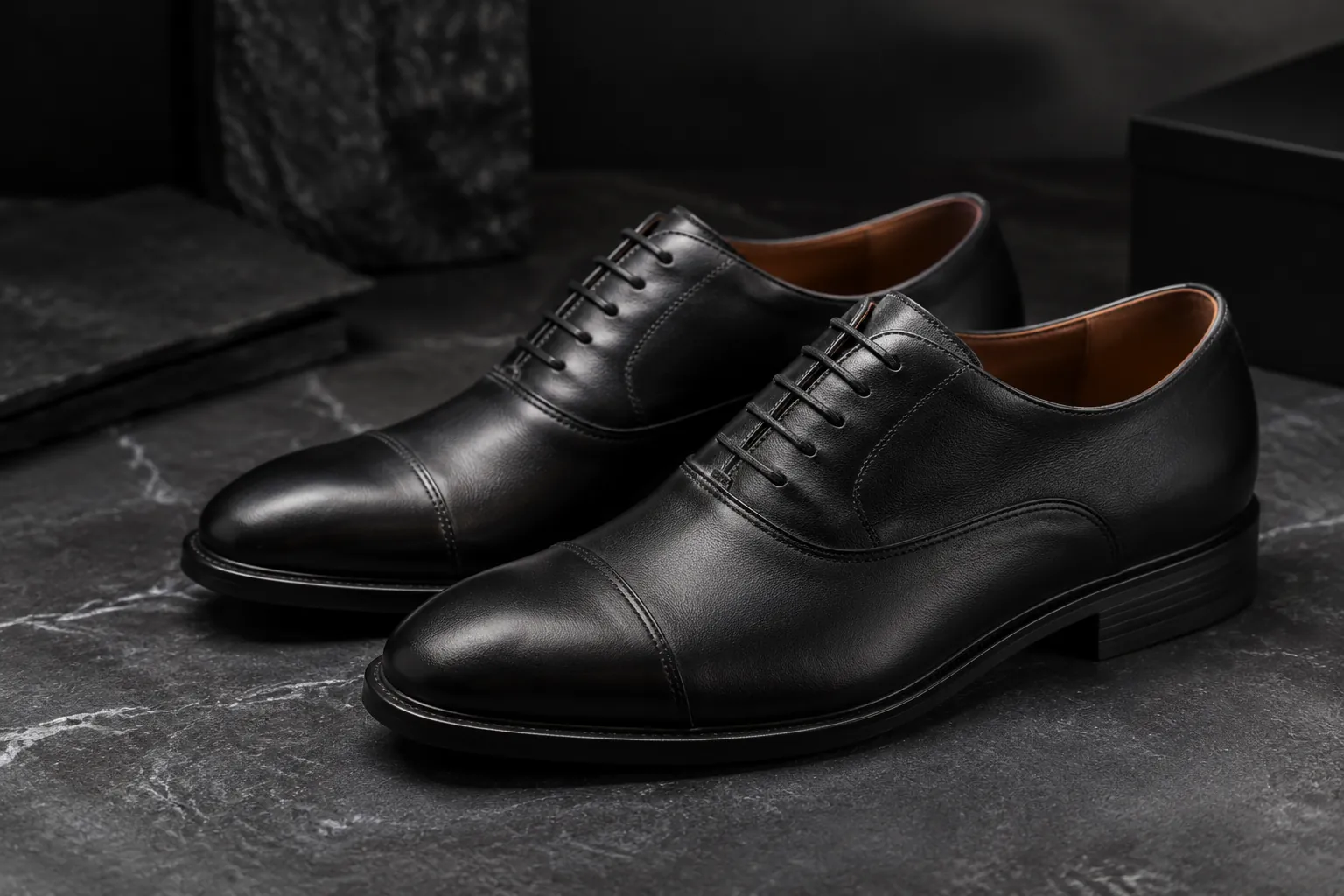
Buyers who chase mens designer dress shoes wholesale often lock a style name and a rough commercial frame while leather article, color, thickness, lining, outsoles, hardware, packaging, artwork, and lot identity stay open. Production risk then shows up as mixed or unclear materials rather than as a missing price line. A mens designer dress shoes wholesale incoming materials checklist, owned by the product team after the form family is named, freezes those fields so market language cannot mask soft inputs entering bulk.
Catalog copy can still call the program designer. Pair-level finish and brand packaging cannot repair material identity that was never written down. The job of this brief is narrower than a full sourcing guide: map the published incoming fields, bind them to a named dress form, and separate what you freeze from what you still ask about on contact.
Open materials after the style name sells
Transactional searches tend to freeze assortment language first: cap-toe Oxford, penny loafer, black formal. That language is useful for planning. It is incomplete as a production brief. A style name without material identity leaves room for substitutes, mixed lots, and adjacent hardware that still read as dress in a photograph and fail under pair review.
Price can still close. A sample can still look acceptable. Bulk then shows variation no one agreed was natural, or color drift across sizes no one framed as an approval rule. Treat the factory’s published incoming step as a field map you freeze on your side. Do not hope that review will invent standards you never stated.
On the factory quality page, that step is described as confirming controlled materials by reviewing leather article, color, thickness, lining, outsoles, hardware, packaging, artwork, and lot identity before mixed or unclear materials enter production. That is a process description. It is not a pass-rate claim, and it does not establish that pair symmetry will follow without your own standards.
Cap-toe Oxford: when material fields become non-optional
Material confirmation becomes enforceable when it supports a named form rather than a generic formal shoe. On the dress shoes page, the cap-toe Oxford is presented as a core business form, with facing gap, toe proportion, cap placement, polish, and pair symmetry treated as control points. Those controls are style language. They only stay meaningful if the leather article, thickness, color, and lot identity behind the upper are stable enough for polish and pair matching to be judged fairly.
The links below are buyer judgment about how inputs support form controls. They are not additional factory measurements published on the page.
| Cap-toe Oxford control | Why incoming fields matter (buyer guidance) |
|---|---|
| Facing gap | Leather thickness and article affect how the facing settles after lasting. Mixed articles make gap judgment noisy. |
| Toe proportion and cap placement | Upper leather behavior under the last depends on a defined article and thickness, not a family of near-matches. |
| Polish | Color and surface identity must be named so polish is judged against an approved appearance range, not against whatever hide arrived. |
| Pair symmetry | Lot identity and color review support pair-level consistency. They do not replace a buyer standard for what match means. |
For wholesale programs that use designer language in market, name the form family first, then map each incoming field to that form. Cap-toe Oxford wholesale material controls are not fashion notes. They are the reason article and lot identity cannot stay open after the style name is sold into the assortment plan.
Fields the published incoming gate names
Use the published list as one pre-production confirmation set for a wholesale dress program. Keep each field explicit. Do not collapse the set into “materials OK.”
- Leather article: which leather type or construction language is intended for the upper, stated so substitutes cannot hide behind generic “genuine leather.”
- Color: target shade and how color will be judged against approval references once hides move through the order.
- Thickness: expected leather thickness so structure and lasting behavior are not left to chance interpretation.
- Lining: lining material identity for the footbed and upper interior, not only an exterior story.
- Outsoles: outsole type and construction language for the dress form you intend to ship.
- Hardware: metal or other component identity when the style uses hardware. Buyer annotation often covers finish intent (for example eyelets or hooks on laced forms).
- Packaging: pack materials as commercial fields on the same list. Buyer annotation often covers boxes, tissue, dust bags, and related pack items; those examples are buyer detail, not a longer factory field list.
- Artwork: labels, stamps, hangtags, and printed identity tied to the program, as buyer-defined lines under the published artwork field.
- Lot identity: how leather and component lots are identified so mixed or unclear inputs are visible before production absorbs them.
These fields belong on one buyer checklist. Packaging and artwork sit on that list; they are not the whole thesis. Lot identity sits on that list; it is not a substitute for article, color, and thickness. If a field is still TBD, the program is not ready to treat production risk as closed.
Tradeoff when a penny loafer joins the Oxford core
Many wholesale assortments do not stop at Oxfords. If a penny loafer sits as a second core, material identity must be tied to that form family as well. The loafers page describes the men’s penny loafer with control language on saddle proportion, apron symmetry, vamp length, opening retention, heel hold, and flex for a repeatable core style. That is a different mechanical set from facing gap and cap placement. It still depends on the same class of incoming fields: article, thickness, lining, outsole, hardware if used, packaging, artwork, and lot identity.
Dual-form programs fail when buyers freeze one material story for “dress leather” and apply it blindly to both silhouettes. A loafer vamp and apron read surface variation differently than a closed Oxford toe. Outsole and lining choices may also differ by wear story even when the leather article looks related. Keep one shared incoming checklist, then annotate which fields are shared across the assortment and which must be restated per form family. That annotation is not sample approval. Sample approval freezes what a sample has already shown. This gate is earlier: what is allowed into production once the form is named.
Which appearance-range questions travel with color and lot identity?
Lot identity and color on the incoming list need a judgment layer. The materials page frames appearance range as a set of questions: what variation is natural, what becomes a defect, how colors are approved, and how hides or component lots are paired across the order. Put those leather dress shoe appearance range approval questions on the same brief that carries wholesale dress shoes lot identity before production.
- Natural variation versus defect. Write the line you will accept as leather character and the line you will reject as a commercial defect. If the line is only “high quality,” you have not defined a range.
- Color approval method. State how color will be frozen for audit. Buyer annotation may use a physical swatch, an approved sample, or another method you can re-check. Open color language collapses under multi-size wholesale runs.
- Hide and component pairing across the order. Ask how pairs and size runs will be related to lot identity. Pairing rules belong next to lot identity, not as a separate conversation after bulk is already mixed.
These questions do not invent numeric tolerances the published pages do not provide. They keep buyer judgment visible. Incoming review of controlled materials can surface mixed or unclear inputs only if someone has already said what controlled means for this program.
What freezes on the brief; what stays open for assessment
Separate buyer-owned freezes from inquiry topics. Freezes are decisions you can put on paper without waiting for a quotation exercise.
- Freeze: form family (for example, cap-toe Oxford as core, and penny loafer only if it is truly in the assortment).
- Freeze: the full incoming field list (leather article, color, thickness, lining, outsoles, hardware, packaging, artwork, lot identity).
- Freeze: appearance-range answers for natural variation, defect lines, color approval, and lot pairing intent.
- Leave open: which development path may fit the project.
- Leave open: which sampling route, if any, is appropriate after materials are defined.
- Leave open: which quotation options apply once the definition is stable enough to price.
Do not treat development, sampling, or quotation as already awarded services. They are topics a buyer may ask about on the contact path. Published pages also do not document wholesale MOQs, designer grading scales, or numeric appearance tolerances in the excerpts used here. Keep those as open questions rather than inventing commercial figures to sound complete.
A short editorial illustration (hypothetical): a wholesale buyer freezes a black cap-toe Oxford form and a full grain leather article, then still leaves lining, outsole type, and lot-pairing rules blank. That brief looks designer-ready in a catalog conversation and remains production-open at the exact gate where mixed inputs are supposed to be stopped.
One materials-bound dress definition for contact
When the form family and the incoming checklist are written, send one current leather footwear definition rather than a loose mood board. Attach the checklist fields as explicit lines. Include appearance-range answers next to color and lot identity. Then ask which development, sampling, or quotation options may apply to that project. The contact page is the right place for that inquiry because the next step depends on assessment of the definition you actually provided, not on an assumed capability award.
If the definition is still missing thickness, lining, outsoles, hardware, packaging, or artwork, fix those fields before you ask for commercial options. Designer-positioned wholesale language does not replace controlled materials. Controlled materials, stated by the buyer and checked against a named form, are what make that language enforceable after the style name is already sold.
Sources and verification
- Leather Shoe Factory in China | Capability & Export QC First-party site source
- Custom Leather Dress Shoes Manufacturer | OEM & Private Label First-party site source
- Custom Loafers Manufacturer | OEM & Private Label Leather Loafers First-party site source
- Leather Shoe Materials | Full Grain, Suede, Lining & Outsoles First-party site source
Share the current leather footwear definition and ask which development, sampling or quotation options may apply to the project.
Send your project brief