
Sourcing Guides
Leather Shoes Wholesale UK Branding Packaging Review
UK wholesale leather shoe programs stall when branding and packaging are priced after the shoe is “defined.” Review them with style, materials, market, size range, and delivery need in one commercial frame.
Many UK buyers still lock a last, upper leather, and construction first, then email logos, boxes, tissue, and hangtags as separate line items. That sequence looks tidy in a spreadsheet. For leather shoes wholesale uk branding packaging work, it blocks a single commercial-frame review, because market, quantity, size range, materials, and delivery need must be read with style in the same pass. Until those fields sit together, a manufacturer cannot assess the program as a controlled whole.
Why isolated line items block a UK wholesale review
A line-item RFQ often prices the shoe body first, then branding, then packaging, then delivery as if each were an independent SKU. The commercial risk is not only administrative friction. When branding artwork, box construction, or tissue weight land after materials and style are already “agreed,” cost, tooling, and packing methods have already been assumed without those inputs. At quote request, style, market, quantity, size range, materials, branding, packaging, and delivery need are reviewed together rather than priced as isolated line items.
For a UK wholesale or private-label buyer, that distinction matters early. A dress collection aimed at multi-door retail does not carry the same packaging load or size spread as a narrow online drop. If packaging and branding stay outside the first definition, later adds reopen material, labor, and carton assumptions that should have been visible from the start. Do not treat branding and packaging as decorative extras after the shoe is defined; put them in the same frame as leather and last.
Branding and packaging as commercial inputs
Branding and packaging belong in the commercial frame because they change how the product is finished, packed, and identified. They also reappear at the factory’s incoming gate. Incoming materials confirmation reviews leather article, color, thickness, lining, outsoles, hardware, packaging, artwork, and lot identity before mixed or unclear materials enter production. Unclear logos, unapproved hangtag copy, or undefined box specs are not harmless delays; they leave packaging and artwork outside the same control that applies to leather and hardware.
Fields buyers should define before asking about development, sampling, or quotation options:
- Brand marks on the shoe and where each mark sits (for example, deboss, foil, printed sock, or heel stamp if those methods are part of your brief)
- Artwork ownership and file readiness for any logo that must match retail presentation
- Primary pack: box type, tissue, stuffing, and any silica or care card your channel requires
- Outer presentation: hangtags, belly bands, polybags, or multi-pair cartons if the wholesale channel needs them
- How packaging materials will be identified and lot-tracked with other incoming materials
Those points are buyer definition prompts, not a factory menu of finished branding systems. They require enough clarity that branding and packaging can be reviewed with materials instead of billed as an afterthought. If artwork is still conceptual, say so and keep the open questions explicit rather than forcing a false “packaging TBD” line that looks complete on paper.
Where market, size range, and delivery need fit
Branding and packaging do not stand alone. Market, quantity, size range, and delivery need sit inside the same commercial-frame review as materials and branding. Quantity here is a planning field the buyer states for assessment, not a published MOQ. Delivery need is a stated timing or release requirement the buyer wants considered with the package; it is not a promised production calendar.
| Commercial-frame field | What to state in the first definition | Why it belongs with style and materials |
|---|---|---|
| Market | UK wholesale channel, retail doors, online, or mixed destination intent | Pack presentation, labeling load, and assortment logic often follow the market, not the last alone |
| Quantity | Planned order volume or program scale you want assessed | Packing methods and branding application effort scale with volume assumptions |
| Size range | The full size run you intend to sell, plus any half-size or width notes | Last coverage, pair balance, and carton mix depend on the range, not on one sample size |
| Delivery need | Target season, release window, or sequencing constraint you care about | Stated timing changes how materials, branding, and packing are sequenced in the frame |
| Materials | Leather article, color, lining, outsole, hardware direction | These inputs must later pass incoming confirmation with packaging and artwork |
| Branding & packaging | Marks, artwork status, box and insert plan | Reviewed with the product frame rather than as isolated line items |
A wholesale leather shoes commercial frame therefore treats market, size range, and delivery need as co-equal fields. Buyers sometimes leave wholesale leather shoes size range vague (“full UK run”) or leave leather shoes wholesale uk delivery need as “ASAP.” That language does not complete the pass. Name the range you intend to sell and the delivery need you want the package judged against, even if both remain open to later adjustment.
Cap-toe Oxford versus penny loafer control points
Branding and packaging cannot substitute for style definition. Two common anchors show why control points stay style-specific even when the commercial frame is complete.
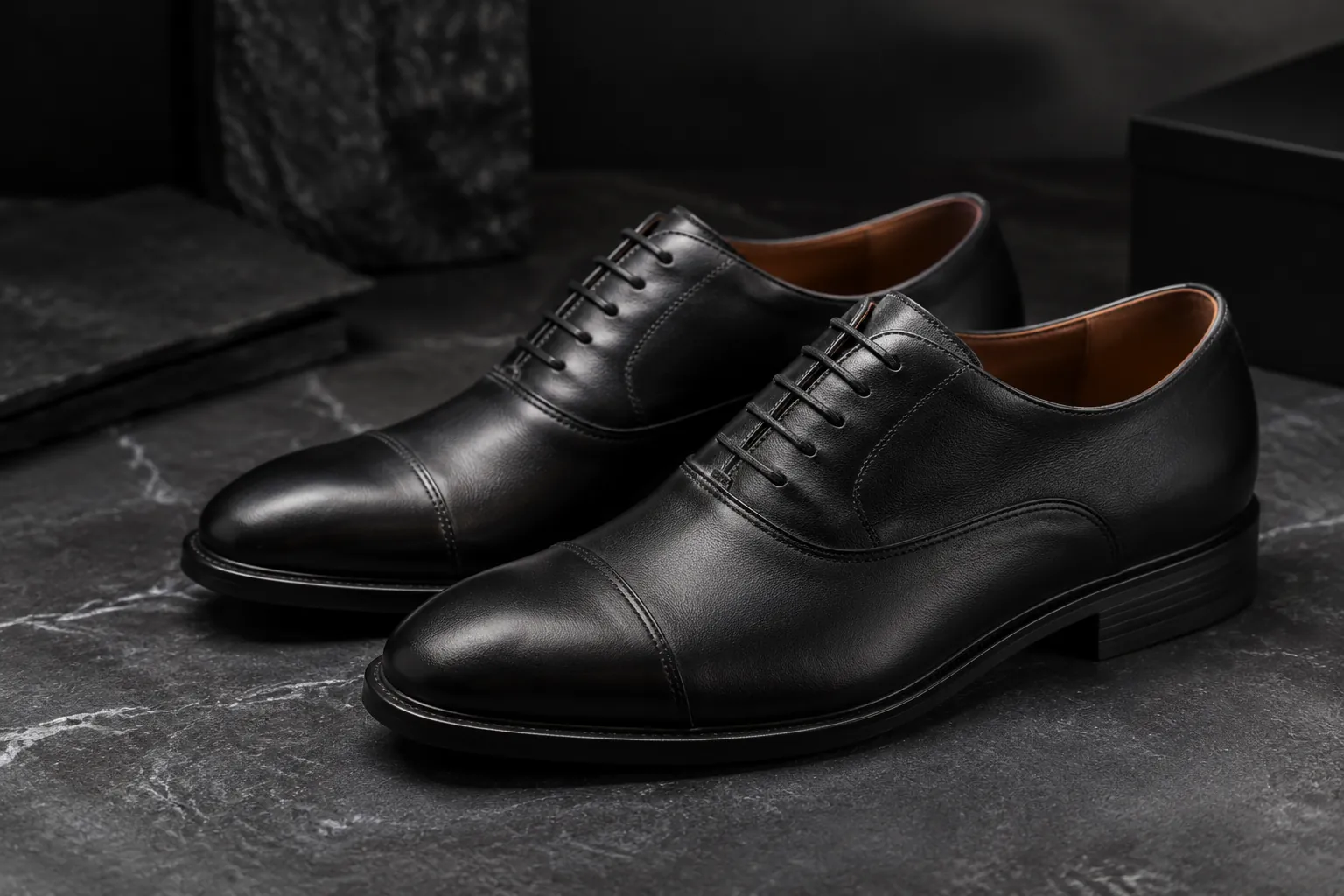
On a black cap-toe Oxford used as a formal-program anchor (documented as D-01), facing gap, toe proportion, cap placement, polish, and pair symmetry are treated as control points. On a tan men’s penny loafer used as a core men’s style (documented as L-01), saddle proportion, apron symmetry, vamp length, opening retention, heel hold, and flex are the control points for a repeatable core. Those lists are not interchangeable, and neither is solved by a better hangtag or a stiffer box.
When you assemble the commercial package, keep style identity explicit: which family you are building, which control points matter for that family, and how branding sits on that geometry. A logo placed on a cap-toe Oxford faces different surface and polish constraints than a sock stamp in a loafer. Packaging still travels with both programs, but it does not erase the style work. For buyers comparing formal and casual cores, link the style definition to the same materials and branding pass rather than sending separate “logo only” emails after construction is frozen.
Useful internal references for those style anchors include the custom leather dress shoes and custom loafers program pages, read as style-control context rather than as finished buyer cases.
Incoming confirmation after materials are named
The commercial-frame review is not a substitute for factory incoming control; it is what makes that gate usable. Incoming confirmation reviews leather article, color, thickness, lining, outsoles, hardware, packaging, artwork, and lot identity before mixed or unclear materials enter production. If the commercial package never named packaging and artwork, the gate has nothing clear to confirm on those lines.
- Name leather article, color, and thickness targets for the uppers you intend to run.
- State lining, outsole, and hardware directions with enough specificity to reject substitutes.
- Attach packaging and artwork definitions so those materials can be checked with the same lot discipline.
- Keep lot identity rules consistent across leather and packing components so mixed or unclear materials do not enter production.
Details of the factory’s quality path sit on the factory quality page. For this article, the buyer takeaway is narrower: packaging and artwork are not post-production merchandising only. They are named inputs that must be clear before production absorbs mixed materials. If any of those fields are still open, mark them as open rather than implying confirmation is already possible.
Confirmed package versus open questions
Separate what you can lock now from what you still need to ask. A buyer can often confirm a style family, materials list, branding approach, packaging plan, market, size range, and delivery need as a single package. Development path, sampling depth, packing variants, MOQ applicability, and quotation structure remain questions the buyer may raise for the project; they are not automatic outcomes of submitting a frame.
Often ready to lock in one definition
- Style family and the control points that define it (Oxford, loafer, or other specified core)
- Materials direction for leather, lining, outsole, and hardware
- Branding locations and artwork status
- Packaging construction and inserts you intend to sell against
- Market, planned quantity, size range, and delivery need
Keep as open inquiry questions
- Which development or sampling path fits the maturity of the brief
- Which quotation breakdown applies once the package is readable
- Whether packing or branding options need staged decisions after a first review
Hypothetical only: a UK importer might freeze a cap-toe Oxford materials list and a branded box plan in one note, then ask which sampling and quotation options apply before any production commitment. That scenario is not a documented case. The useful pattern is the combined package, not a staggered set of line-item emails.
One commercial-frame definition for assessment
For UK wholesale leather shoe programs, send one commercial-frame definition: style, market, quantity, size range, materials, branding, packaging, and delivery need reviewed together. That approach matches how the product and commercial frame are read at quote request, and it keeps packaging and artwork aligned with the same materials that later face incoming confirmation.
If your team still holds branding or packaging in a separate merchandising file, merge the decision fields before you request assessment. You do not need a finished creative system; you need enough clarity that those fields are not isolated line items. Share the combined definition through contact, and ask which development, sampling, or quotation options may apply to the project. The goal is a controlled package the manufacturer can review as one commercial frame, not a sequence of partial prices that never quite add up to a program.
Sources and verification
- Request a Quote | Leather Shoe Manufacturer First-party site source
- Leather Shoe Factory in China | Capability & Export QC First-party site source
- Custom Leather Dress Shoes Manufacturer | OEM & Private Label First-party site source
- Custom Loafers Manufacturer | OEM & Private Label Leather Loafers First-party site source
Share the current leather footwear definition and ask which development, sampling or quotation options may apply to the project.
Send your project brief