
Procurement
Leather Shoes Wholesale Size Range UK Decision Frame
Materials alone do not finish a wholesale leather footwear brief. This piece places size range inside the published commercial frame, keeps Oxford and loafer control notes on that same record, and separates a finished definition from open development or sampling questions.
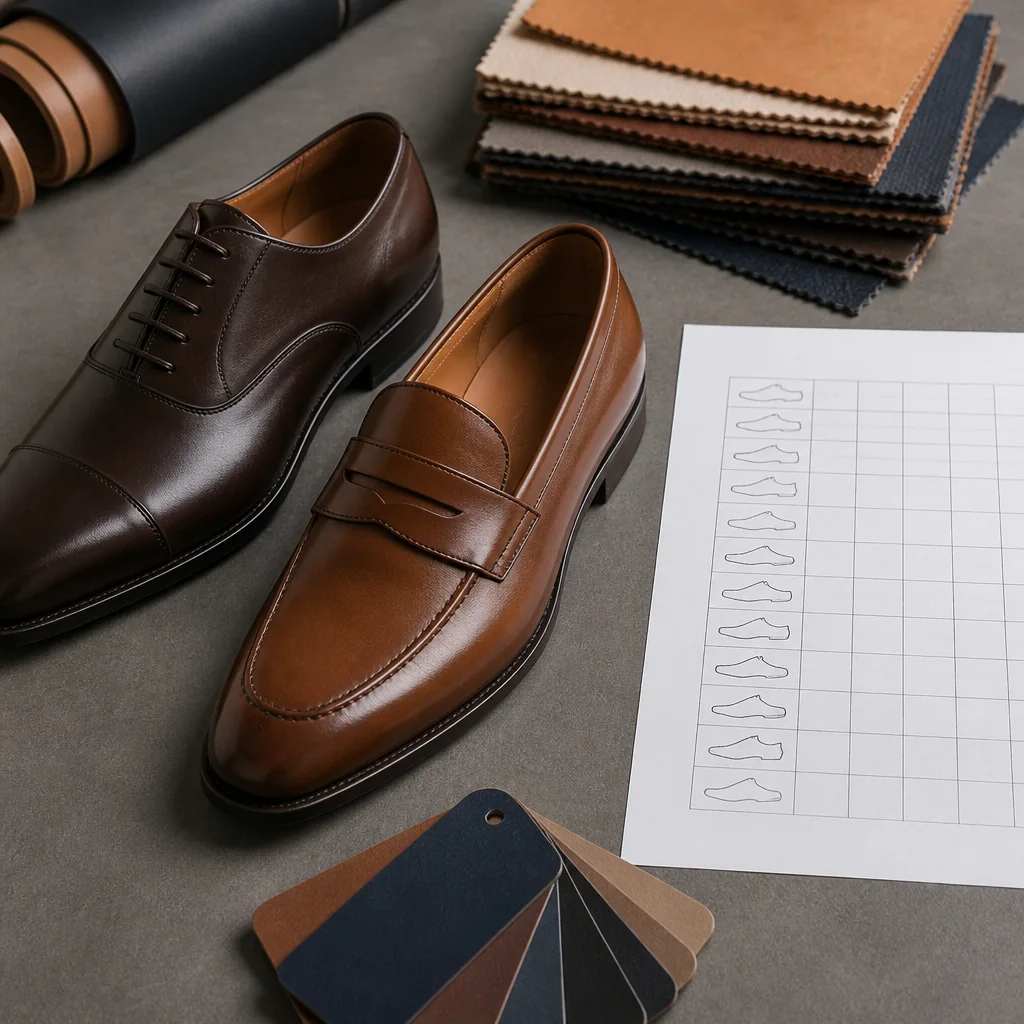
UK wholesale footwear teams often settle leather article, color, and construction while the size grid is still blank. Style and materials then look ready, yet quantity, market fit, and delivery need cannot be read as one package. For leather shoes wholesale size range UK work, the size run belongs in the same product and commercial definition reviewed together, not as a logistics patch after a unit price.
What breaks when the UK size ladder stays open?
Buyers assembling a wholesale leather dress shoes size run commonly name materials before they finalize sizes. Upper leather is named. Lining and outsole choices look settled. Branding and packaging sketches may already circulate. Size range stays a later spreadsheet task: the UK size ladder, how pairs are distributed, and whether the run is a full commercial grid or a narrow sample ladder.
Quantity without a size split is only a headline number. Market without a size ladder cannot show whether the offer matches demand you already know. Delivery need without a size split stays hard to discuss against packing and shipment intent. An incomplete size range means the eight published commercial fields are not yet available to be reviewed together, even when materials look finished.
On the contact review model, style, market, quantity, size range, materials, branding, packaging, and delivery need are reviewed together rather than priced as isolated line items. Size range sits inside that frame.
Commercial-frame companions to size range
Use those eight companions as a closed checklist when you prepare an OEM leather shoes size range brief. Keep each field concrete enough that a reviewer can see one program. Detail under each field beyond the published names is editorial buyer prep, not an extra factory-required input list.
- Style: name the silhouette you intend to hold (for example, cap-toe Oxford or penny loafer), not a vague dress-shoe label.
- Market: state the selling market and any channel constraints that shape size demand, including UK retail or wholesale distribution expectations you already know.
- Quantity: give total pairs only with a size split, or state clearly that the split is still open so the full commercial frame cannot yet be reviewed together.
- Size range: as buyer prep, document the UK size ladder, any width policy you use, and pair distribution across that ladder in plain commercial terms.
- Materials: lock leather article, color, lining, and outsole family; as buyer prep, note thickness intent so size work is not floating against mixed inputs.
- Branding: list logos, stamps, or labels that must appear consistently across the sizes you plan to order.
- Packaging: name box, tissue, and inserts; as buyer prep, note carton logic that should travel with the size grid you define.
- Delivery need: describe timing pressure and any staged shipment intent without inventing factory lead times the evidence does not publish.
If you also keep a private label leather shoes size grid for internal planning, keep those numbers on the same sheet as materials and quantity so the brief stays one package. When any of the eight commercial fields is missing, a buyer may still inquire, but the published package is not yet available for joint review.
Cap-toe Oxford and penny loafer notes travel with the same file
Style control points do not replace size range. Two published core styles show what the site already names. Binding those notes to a brief that already includes size range is editorial buyer practice, not a size-grading method claimed in the excerpts.
The dress-shoe page presents the cap-toe Oxford as a formal anchor, with facing gap, toe proportion, cap placement, polish, and pair symmetry treated as control points. The loafers page presents the penny loafer as a men’s core style, with saddle proportion, apron symmetry, vamp length, opening retention, heel hold, and flex listed as controls for a repeatable core.
| Style | Published control points | Editorial note for the buyer |
|---|---|---|
| Cap-toe Oxford | Facing gap, toe proportion, cap placement, polish, pair symmetry | Place these control notes on the same file as your UK size ladder and pair split so style language and commercial fields travel together |
| Penny loafer | Saddle proportion, apron symmetry, vamp length, opening retention, heel hold, flex | Attach these control notes to the same brief that already names size range, materials, branding, and packaging |
Do not send style controls alone and hope size will sort itself out after a unit price arrives. As an editorial recommendation for the buyer, attach Oxford or loafer control language to the brief that already includes size range when those silhouettes apply.
Why incoming materials review still needs a finished package
Factory quality documentation describes an incoming gate that confirms controlled materials before mixed or unclear inputs enter production. That review covers leather article, color, thickness, lining, outsoles, hardware, packaging, artwork, and lot identity.
The incoming list is a materials and identity check. It does not itself state size-range rules, pair-count scaling, or size-match requirements for hardware and outsoles. Separately, the contact commercial frame still places size range with style, market, quantity, materials, branding, packaging, and delivery need.
If you want production-facing assessment against a stable definition, close style, size range, materials, branding, packaging, and quantity as one package before you ask for that review. That sequencing is an editorial recommendation for the buyer; it is not an extra clause on the incoming gate wording.
Finished size record compared with open path questions
A finished definition that already includes size range lets a reviewer read the contact commercial fields together. Development, sampling, or quotation paths remain buyer decisions. The table keeps each source’s scope separate and does not expand documented services beyond the published review model.
| State | What the buyer holds | What each published page supports | What stays open |
|---|---|---|---|
| Finished definition with size range | Style, market, quantity with size split, materials, branding, packaging, delivery need | Contact page: those eight fields can be read together. Dress-shoe page: named Oxford control points. Loafers page: named penny loafer control points. Factory-quality page: incoming list for leather article, color, thickness, lining, outsoles, hardware, packaging, artwork, and lot identity | Which next commercial conversation the buyer wants to open |
| Open size range | Materials and style notes without a UK size ladder or pair distribution | Only provisional discussion of partial fields; the commercial package remains incomplete | Size grid, quantity realism, delivery intent, and any path that assumes a locked program |
| Open path choice | A complete commercial definition plus an explicit question | The same package can be shared toward development, sampling, or quotation discussion as the buyer requests | MOQ, packing detail, or path scope unless and until the buyer asks and a reply is supported by evidence |
A buyer may ask which sampling, packing, or quotation information applies to the project. That invitation is not a documented service promise. It is a clean hand-off after the commercial definition exists.
Hand-off sequence once size range is on the brief
Use one coherent package rather than a scatter of partial emails.
- Assemble the current definition with size range inside the commercial fields: style, market, quantity with size split, materials, branding, packaging, and delivery need.
- Attach the relevant style control language for cap-toe Oxford or penny loafer if those silhouettes apply, so facing gap, toe proportion, saddle proportion, opening retention, and related points sit on the same file.
- Note incoming confirmation fields you already know: leather article, color, thickness, lining, outsoles, hardware, packaging, artwork, and lot identity, so mixed or unclear materials are not implied.
- Send that single package and ask which development, sampling, or quotation options may apply to the project.
That keeps size range from becoming a late logistics patch and leaves path choice with the buyer until a specific reply is requested.
Hard limits of the published excerpts
Scope is limited to four first-party pages: the contact commercial-frame review, the factory incoming materials gate, the dress-shoe Oxford control points, and the loafer control points. Those excerpts do not publish MOQ, unit price, lead time, capacity, certification, lab result, audit score, UK regulatory detail, customer names, or outcome metrics, so none of those items is stated here as fact. The excerpts also do not describe last grading methods, ownership of size-run SOPs, or fit guarantees across sizes, and they do not present development, sampling, or quotation as pre-scoped service packages.
Verifying claims against the four size-range sources
Check claims against the published pages rather than paraphrase alone. The request a quote page states that style, market, quantity, size range, materials, branding, packaging, and delivery need are reviewed together. The factory quality page documents incoming confirmation of leather article, color, thickness, lining, outsoles, hardware, packaging, artwork, and lot identity before mixed or unclear materials enter production. The dress shoes page names cap-toe Oxford control points. The loafers page names penny loafer control points. Actor, scope, and modality stay with those pages.
Actions after size range sits inside the commercial frame
- Build one commercial-field file that already includes size range before requesting assessment.
- Include Oxford or loafer control language only when those styles are in scope, and keep them on the same record as size range.
- Review the factory quality incoming list so materials, packaging, and artwork identity are not left mixed or unclear.
- Use the contact path to share the current leather footwear definition once size range is locked into the commercial frame, then open the development, sampling, or quotation conversation that fits the project.
Sources and verification
- Request a Quote | Leather Shoe Manufacturer First-party site source
- Leather Shoe Factory in China | Capability & Export QC First-party site source
- Custom Leather Dress Shoes Manufacturer | OEM & Private Label First-party site source
- Custom Loafers Manufacturer | OEM & Private Label Leather Loafers First-party site source
Share the current leather footwear definition and ask which development, sampling or quotation options may apply to the project.
Send your project brief