
Footwear Sourcing Briefs
Style Map: Leather Shoes Wholesale Oxford vs Loafer Sourcing Brief
A procurement map of the documented control points for cap-toe Oxfords and penny loafers, kept separate from the commercial-frame inputs that accompany a footwear inquiry.
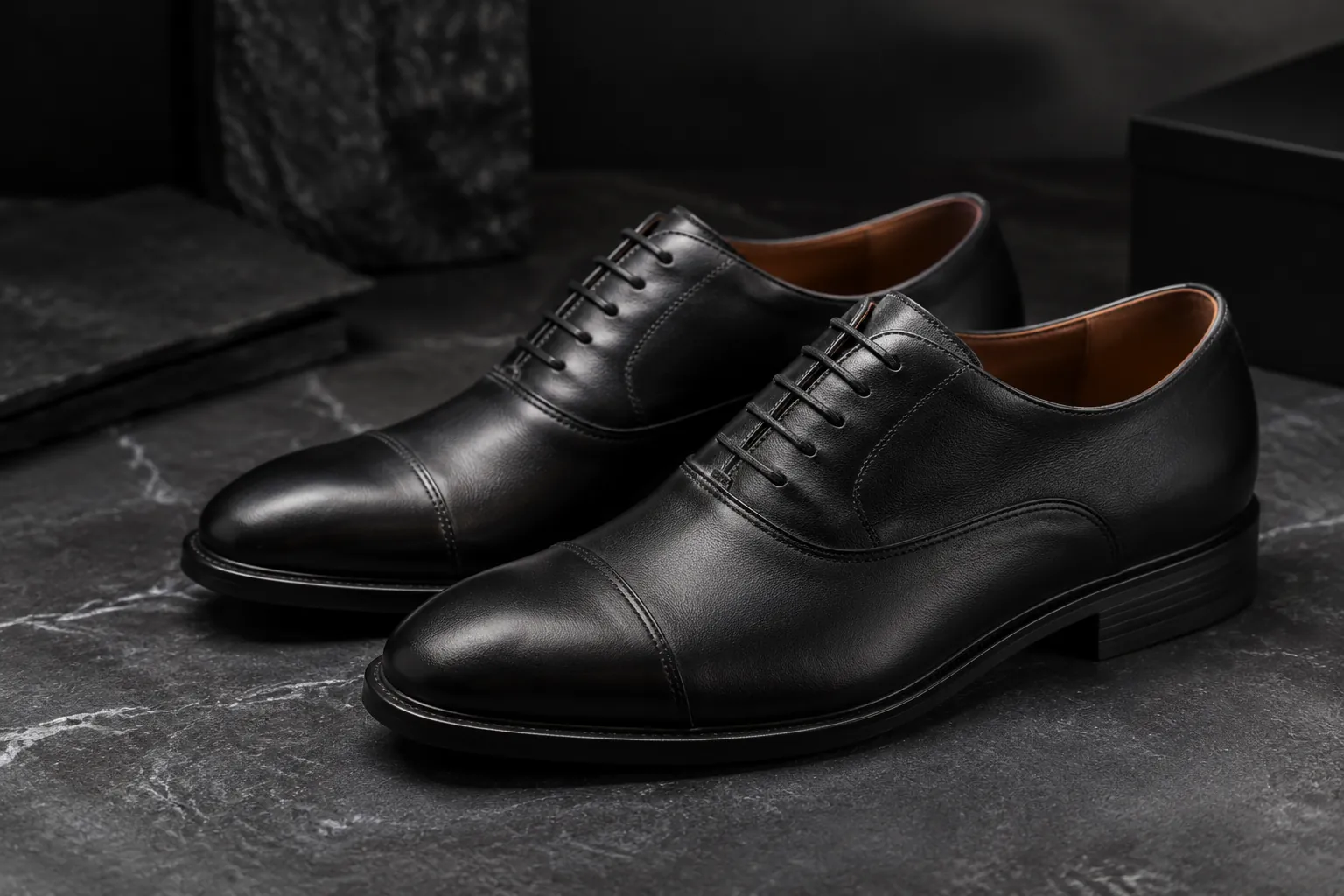
When a buyer is ready to define a leather-shoe wholesale assortment, the useful first decision is simple: is the core style a cap-toe Oxford or a penny loafer? Those two families do not share the same named control points on the source style pages, so a request that leaves the fork open can leave facing, cap, saddle, or opening fields undefined.
This article builds a leather shoes wholesale Oxford vs loafer sourcing brief around that fork. It maps only the documented control points for each style, then places those fields beside the commercial inputs a buyer can already state. It does not recommend one style over the other for any market, channel, customer, or volume plan.
Choose the style fork before building the request
The dress-shoes page names five control points for its cap-toe Oxford: facing gap, toe proportion, cap placement, polish, and pair symmetry.
The loafers page names a different set for its penny loafer: saddle proportion, apron symmetry, vamp length, opening retention, heel hold, and flex, framed there for a repeatable core style.
That difference should shape the first page of a buyer definition. A cap-toe Oxford sourcing requirements sheet can address the facing and cap relationship without borrowing saddle or apron language. A penny loafer specification brief can stay with its own upper and opening-related points without treating Oxford cap placement as relevant. If a collection will include both families, keep one style map for each rather than merging them into a generic appearance note.
Map the named controls side by side
The table below is limited to the control points named on the two style pages. Use it to choose which fields to carry into a style-specific request, not as a universal footwear specification.
| Style family | Named control points | Buyer brief use |
|---|---|---|
| Cap-toe Oxford | Facing gap; toe proportion; cap placement; polish; pair symmetry. | Record the intended Oxford identity under these five headings where they matter to the current design. |
| Penny loafer | Saddle proportion; apron symmetry; vamp length; opening retention; heel hold; flex. | Record the intended loafer identity under this separate set of six headings. |
For an Oxford, keep the request anchored to the facing, toe, cap, polish, and pair relationship rather than reducing the style to color alone. For a loafer, keep saddle, apron, vamp, opening, heel, and flex as their own discussion points.
Keep the wording literal. “Pair symmetry” appears in the Oxford source; “apron symmetry” appears in the penny-loafer source. Similar words do not make the phrases interchangeable, and the evidence does not assign one style’s listed fields to the other.
Limitation note: the named points are definition prompts from the style pages. The excerpts do not state tolerances, inspection methods, acceptance rules, construction specifications, or guaranteed production results. If a buyer needs that level of detail, state the desired definition depth in the inquiry instead of assuming a control-point label resolves it.
Keep style controls separate from the commercial frame
Style selection answers which visual and functional fields belong in the definition. The commercial frame is a different layer. The contact page describes a review of the product and commercial frame together. Its stated inputs are style, market, quantity, size range, materials, branding, packaging, and delivery need, and it says these are considered together rather than priced as isolated line items.
| Documented commercial-frame input | Editorial question for the buyer’s working brief |
|---|---|
| Style | Has the request selected cap-toe Oxford or penny loafer, with the relevant style map attached? |
| Market | What current market context should accompany the style definition? |
| Quantity and size range | What quantity and size-range information is currently available to share? |
| Materials | Which material fields have a current target value, and which remain open? |
| Branding and packaging | What branding and packaging details are part of the present request? |
| Delivery need | What delivery need should be stated without assuming a delivery commitment? |
Separating the layers prevents a style decision from carrying commercial assumptions that have not been stated. A buyer can revise either layer without silently changing the other. For a leather shoe quotation request, presenting the current product and commercial information as one definition is clearer than sending a style name with disconnected price questions.
Limitation note: the contact-page language is a documented review scope. It is not a promise of quotation, sampling route, development outcome, pricing, or acceptance.
Link materials to the chosen style without reopening the whole brief
The factory-quality page describes an incoming-materials step that reviews leather article, color, thickness, lining, outsoles, hardware, packaging, artwork, and lot identity before mixed or unclear materials enter production. That is the source’s stated incoming-review scope. It does not establish material approval, certification, traceability, or a performance claim for a buyer’s project.
As an editorial recommendation for brief assembly, keep those material and component fields visible beside the chosen Oxford or loafer map so they do not disappear once the style fork is closed:
- State the current leather article, color, and thickness information.
- Identify the current lining and outsole information.
- Record any hardware detail that belongs to the chosen design.
- Keep packaging and artwork details distinct from the style-control fields.
- Include the current lot-identity information when it is relevant to the material definition.
This checklist preserves context. It does not prescribe material values or tell a buyer which leather article, thickness, lining, outsole, or hardware configuration to choose.
Distinguish a defined request from an assessment topic
A workable request separates what the buyer has already defined from what still needs to be raised. That distinction clarifies the inquiry without presenting open questions as documented company services.
Buyer-provided definition
- One selected style family: cap-toe Oxford or penny loafer.
- The source-named control points that apply to that selected family.
- The current commercial-frame inputs: market, quantity, size range, materials, branding, packaging, and delivery need.
- The available material and component details: leather article, color, thickness, lining, outsoles, hardware, artwork, packaging, and lot identity.
Topics to raise in the inquiry
- Which development options may apply to the current footwear definition?
- Which sampling options may apply to the project?
- Which quotation information may apply once the current definition has been shared?
The second list stays conditional on purpose. The contact-page excerpt documents a combined review of product and commercial inputs. It does not document that any particular development, sampling, or quotation option will be available for a given project. Asking which options may apply is more accurate than assigning an outcome in advance.
Submit one style-specific definition for review
Before using the contact page, put the selected style map and the commercial frame in the same working definition. For a cap-toe Oxford, retain the five Oxford control points. For a penny loafer, retain the six loafer control points. Then identify the current material, branding, packaging, size-range, quantity, market, and delivery-need information that can be shared without filling gaps with assumptions.
Share that current footwear definition and ask which development, sampling, or quotation options may apply to the project. Limitation note: the brief does not predict response timing, minimums, manufacturing capacity, or quoted outcomes. Its value is a single style-specific starting point that keeps unresolved questions visible.
Sources and verification
- Leather Shoe Factory in China | Capability & Export QC First-party site source
- Request a Quote | Leather Shoe Manufacturer First-party site source
- Custom Leather Dress Shoes Manufacturer | OEM & Private Label First-party site source
- Custom Loafers Manufacturer | OEM & Private Label Leather Loafers First-party site source
Share the current leather footwear definition and ask which development, sampling or quotation options may apply to the project.
Send your project brief