
Supplier Evaluation
Leather Shoes Supplier Quality Control Questions by Scope
A procurement guide to reading published quality language at stated scope and converting each limited process statement into a precise supplier inquiry.
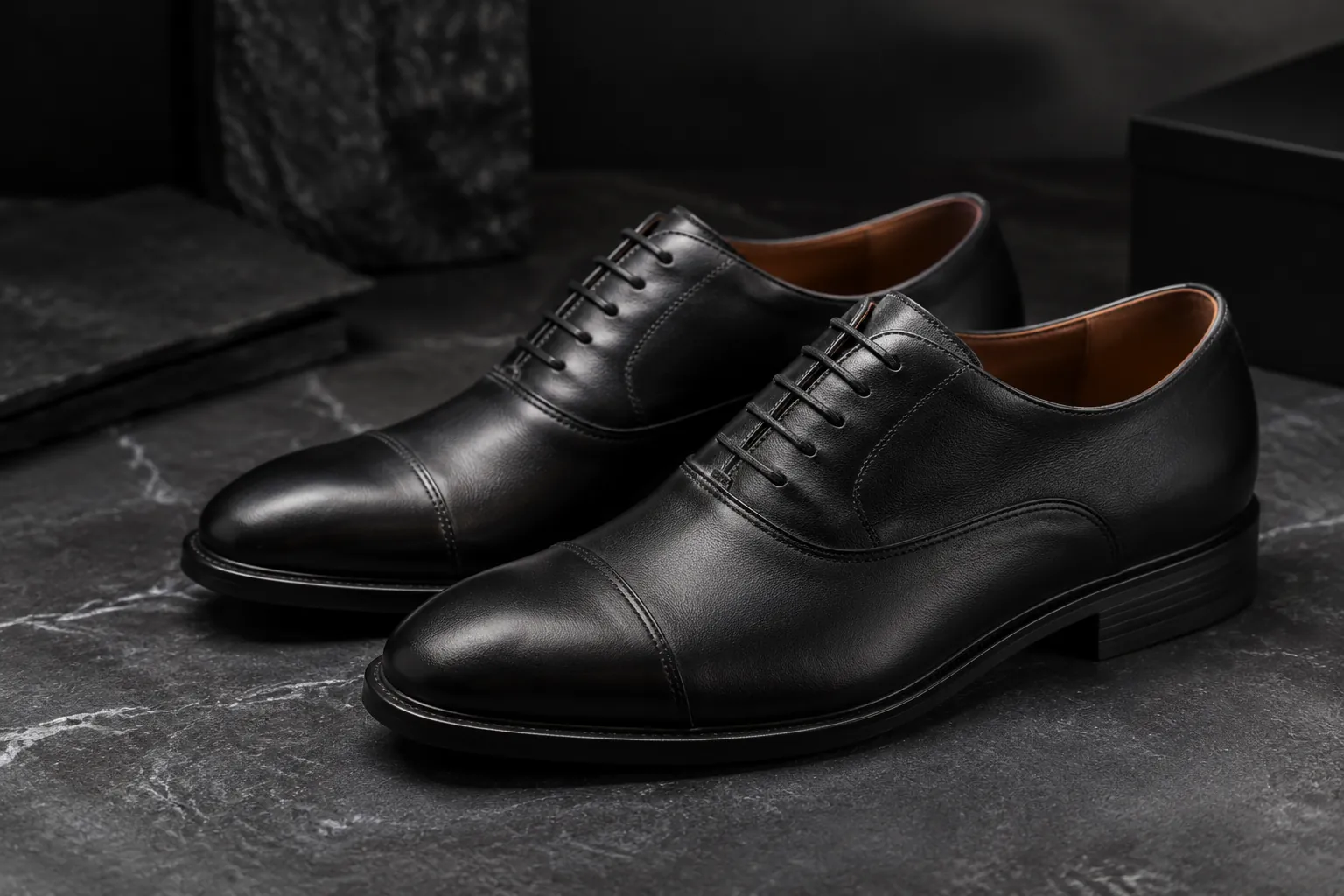
When a footwear buyer evaluates a factory page, the first task is not to decide whether the factory is "good." The first task is to decide what a published quality sentence actually asserts. That is the practical work behind leather shoes supplier quality control questions: matching each claim to its actor, action, scope, and timing, then leaving the rest for a project conversation.
A process note about incoming materials is not a finished-shoe result. A style note about control points is not a fit or durability guarantee. Commercial-frame language is not acceptance of an order. Keeping those boundaries clear protects both the research file and the later request for quotation.
Overreading quality language is the immediate procurement risk
Published quality wording often looks broader than it is. The factory-quality page describes an incoming stage that reviews leather article, color, thickness, lining, outsoles, hardware, packaging, artwork, and lot identity before mixed or unclear materials enter production. That sentence is useful because it names inputs and a process point. It does not, on its own, prove a finished-product acceptance result, a defect rate, testing, certification, or project-wide consistency.
Buyers who expand that sentence into a supplier-wide performance verdict create a false-confidence problem. The safer move is to treat the statement as a scoped research cue: these are the material topics the site names at incoming, so these are the topics to clarify against the buyer's own footwear definition.
The same limit applies to commercial language on the contact page. Style, market, quantity, size range, materials, branding, packaging, and delivery need are reviewed together rather than priced as isolated line items. That is a published review frame. It is not a statement of price, availability, sampling access, lead time, or order acceptance.
Map each published statement to what it can and cannot support
The ledger below is built only from the supplied first-party excerpts. Column two stays inside the wording of those excerpts. Column three is the open inquiry agenda, not a list of supplier failures.
Read the four rows as four separate evidence packages. Do not merge the incoming-material list with the Oxford observations, or the Oxford observations with the loafer observations, even when preparing a multi-style private-label brief.
| Documented statement | What it directly supports | What remains an inquiry topic |
|---|---|---|
| The factory-quality page describes review of leather article, color, thickness, lining, outsoles, hardware, packaging, artwork, and lot identity before mixed or unclear materials enter production. | A published incoming-stage statement covering that listed set of material and related inputs. | Whether the buyer's named inputs are within scope; the record, criteria, frequency, decision authority, and any result for the current project. |
| The contact page says style, market, quantity, size range, materials, branding, packaging, and delivery need are reviewed together. | A published product and commercial review frame rather than isolated-line pricing. | Whether development, sampling, packing, quotation, timing, or delivery information applies to the project. |
| The dress-shoes page identifies facing gap, toe proportion, cap placement, polish, and pair symmetry as control points for its cap-toe Oxford description. | Oxford-specific observations named in that product description. | The relevant tolerances, approval basis, evidence, and applicability to the buyer's Oxford specification. |
| The loafers page names saddle proportion, apron symmetry, vamp length, opening retention, heel hold, and flex in its penny-loafer description. | Penny-loafer-specific observations named for that core style. | The buyer's intended construction, fit criteria, evaluation method, and whether these observations apply to the proposed loafer. |
None of the excerpts states a result, frequency, certification, test method, or project outcome. That gap is informative. It means the next step is a more exact question, documented against the product definition the buyer actually intends to discuss.
Turn an incoming-material statement into precise questions
Editorial recommendation for buyers: convert each named input into a project-specific clarification rather than asking for a generic quality assurance. The published list is a starting vocabulary, not a warranty that every input on every order will be handled the same way.
- Identify the leather article by the information the buyer uses to distinguish it, then ask what information is needed to discuss its color and thickness within the stated incoming-review scope.
- Keep lining and outsole questions separate. Ask what project identifiers or specifications should accompany each rather than assuming that one material description covers both.
- For hardware, packaging, and artwork, state the exact version intended for the project and ask how lot identity or version identity should be communicated where relevant.
- Ask what information would make a material status clear before production, and what question should be raised if an input is mixed or unclear. Do not assume a particular record, hold, rejection, or disposition process unless it is confirmed for the project.
This is how a phrase such as shoe factory incoming material control becomes an auditable discussion topic. The buyer is not requesting a blanket assurance. The buyer is asking how the stated incoming scope relates to named articles, colors, thicknesses, linings, outsoles, hardware, packaging, artwork, and lot identity in the current footwear definition.
Keep Oxford control points separate from penny-loafer points
Style pages can look interchangeable if a buyer harvests every control point into one checklist. The source wording does not support that transfer.
On the dress-shoes page, the cap-toe Oxford description treats facing gap, toe proportion, cap placement, polish, and pair symmetry as control points. Those observations belong to that Oxford description only.
On the loafers page, the penny-loafer description names saddle proportion, apron symmetry, vamp length, opening retention, heel hold, and flex for a repeatable core style. The excerpt names those elements. It does not supply a construction method, fit result, durability claim, or test procedure.
For procurement, the useful question is whether the proposed silhouette has its own relevant observations, and whether those observations are defined tightly enough for the project discussion. Cap-placement questions for a penny loafer, or vamp-length language applied as an Oxford requirement, would mix two separate source scopes. That separation is not pedantry. It is how a buyer keeps the later sampling conversation from testing the wrong points on the wrong last or upper design.
Hold product definition and commercial context in one review frame
The contact page's published frame is practical for inquiry design. Present style, market, quantity, size range, materials, branding, packaging, and delivery need together so review starts from one current definition. That reflects the site's stated scope. It does not document price, availability, lead time, acceptance, or delivery performance.
As editorial guidance, separate already-chosen facts from still-open subjects. A hypothetical buyer preparing a cap-toe Oxford concept might already know market, size range, leather article, branding, and packaging direction, yet still need to ask which development, sampling, packing, or quotation options may apply. Keeping unknowns visible stops a preliminary note from being mistaken for a confirmed commercial arrangement.
Structure the next private-label inquiry in two parts
A concise private label shoe supplier inquiry works best when the known footwear definition and the open questions are visibly separate. The recipient can then review what is already defined and answer only where a project-specific response is requested.
Current footwear definition
- State the style and intended market.
- Provide the current quantity and size-range information.
- Describe materials, branding, packaging, and delivery need as currently known.
- For an Oxford or penny loafer, identify the style-specific observations that matter to the buyer rather than borrowing a list from another silhouette.
Questions requiring project-specific clarification
- Ask how the buyer's leather article, color, thickness, lining, outsole, hardware, packaging, artwork, and lot identity relate to the published incoming-review statement.
- Ask which development, sampling, packing, or quotation options may apply to the project.
- Ask what further product or commercial information is needed for the stated review frame.
Share the current footwear definition through the contact page. Keep open options visibly separate from selected facts so the conversation has a defined scope without implying that an unresolved path has been promised.
What the available evidence does not establish
The supplied excerpts do not provide an independent audit, certification, test data, defect rate, production capacity, minimum order quantity, timing, factory-visit account, customer example, or guarantee. They also do not establish leather source, grade, tannery, origin, traceability, sustainability, or performance characteristics. No market-wide or independently verified conclusion follows from this limited first-party context.
Use the documented statements as precise starting points. Retain their stated scope. Ask for project-relevant clarification where the evidence stops.
Sources and verification
- Leather Shoe Factory in China | Capability & Export QC First-party site source
- Request a Quote | Leather Shoe Manufacturer First-party site source
- Custom Leather Dress Shoes Manufacturer | OEM & Private Label First-party site source
- Custom Loafers Manufacturer | OEM & Private Label Leather Loafers First-party site source
Share the current leather footwear definition and ask which development, sampling or quotation options may apply to the project.
Send your project brief