
Sourcing Guides
Leather Shoes Supplier Packaging Branding Brief for RFQ Control
Lock packaging into commercial and incoming scopes early, keep branding in the commercial frame, and confirm hardware and artwork before production entry.
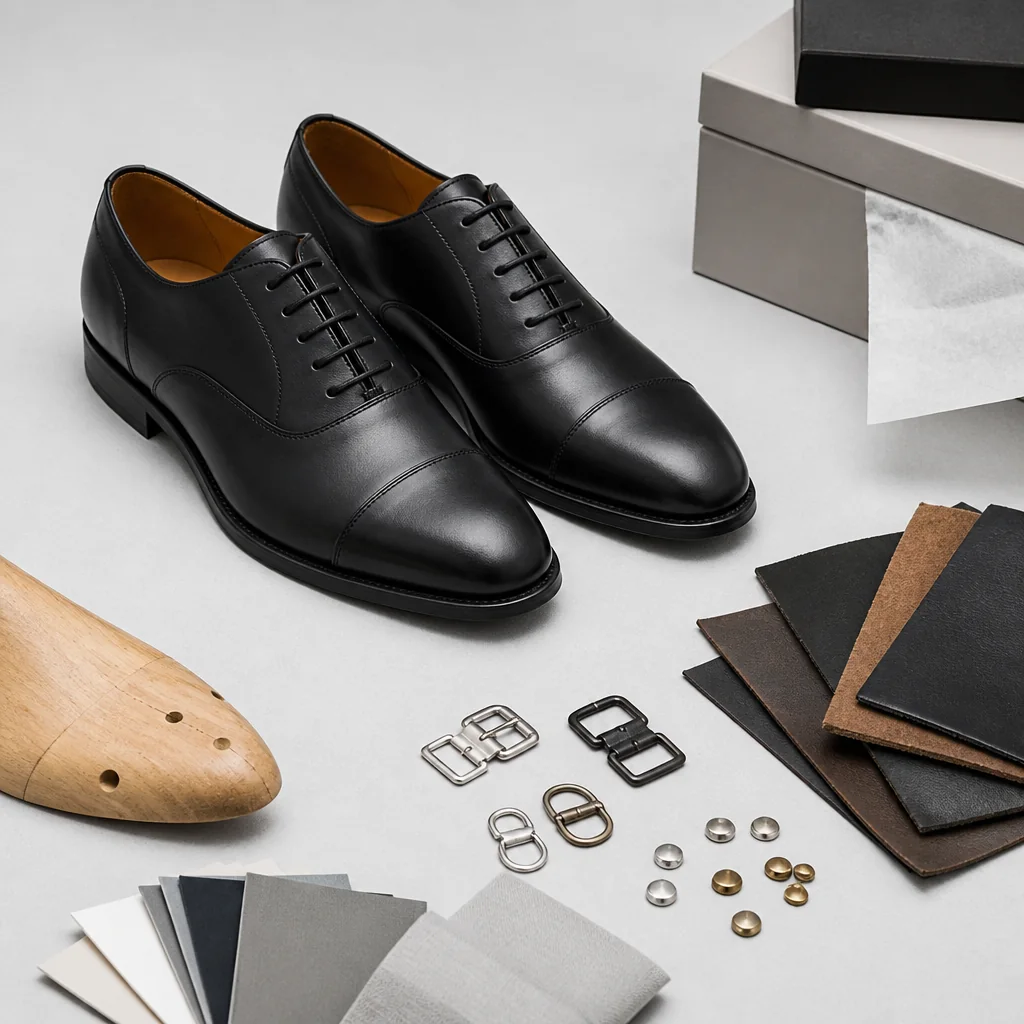
Many leather footwear RFQs freeze last shape, leather article, and lining first, then introduce packaging, artwork, hardware, and branding only after a factory asks for missing references. That lag produces two separate failures: suppliers price different brand packages against the same shoe description, and production teams receive components without a shared identity record. A leather shoes supplier packaging branding brief closes both gaps by putting packaging into the commercial frame and the incoming material list at the first supplier conversation, while placing branding, hardware, and artwork in the scopes where first-party frames actually name them.
Unit costs stop lining up when brand packages differ across responses. Mixed or unclear packaging can still reach the line when identity fields stay blank. The stake is quote comparability and production-entry control, not a deferred aesthetic choice.
The late packaging and branding failure mode
Dress-shoe and loafer programs often follow a product-first sequence. Style and leather receive careful definition. Packaging, artwork, brand marks, and hardware arrive later as isolated commercial extras.
Two buyer problems follow. Suppliers may assume different brand packages, so the shoe description looks identical while the priced object differs. Incoming teams may still lack confirmed packaging, artwork, and hardware even when leather, lining, and outsoles look finished. The missing work is shared commercial scope and material identity, not decoration after style lock.
As an editorial recommendation for the buyer, put packaging, branding, artwork, and hardware into the first supplier conversation rather than after style is frozen. That is brief discipline on the buyer side, not a documented factory design service.
Packaging occupies two scopes at once
Packaging is the field that appears in both documented frames. On the commercial side it is reviewed with the product. On the incoming side it is confirmed before mixed or unclear materials enter production. Branding belongs to the commercial frame. Hardware and artwork belong to the incoming identity set. Private label leather shoe packaging therefore needs dual placement from the start; leather footwear branding requirements need commercial co-review with style and materials.
| Scope | Fields that include packaging or brand-adjacent items | Buyer decision they support |
|---|---|---|
| Commercial frame | Style, market, quantity, size range, materials, branding, packaging, and delivery need reviewed together | Comparable quotes and a shared definition of what is being priced |
| Incoming control | Leather article, color, thickness, lining, outsoles, hardware, packaging, artwork, and lot identity confirmed before production | Stopping mixed or unclear materials from entering production |
If packaging lives only in a cost sheet, incoming teams may still lack a confirmed identity record. If packaging lives only on a warehouse checklist, commercial review may still price the shoe without the brand package. Branding, hardware, and artwork are co-required in the brief early for the same reason, but each sits in the frame that names it. Keep the commercial list and the incoming list separate so each decision stays clear.
Incoming identity fields buyers usually leave blank
On the factory-quality path, incoming review confirms controlled materials before mixed or unclear materials enter production. The documented field set is leather article, color, thickness, lining, outsoles, hardware, packaging, artwork, and lot identity.
- Leather article
- Color
- Thickness
- Lining
- Outsoles
- Hardware
- Packaging
- Artwork
- Lot identity
Hardware, packaging, and artwork sit next to leather and lining because identity is incomplete if only upper materials are named. Capture the full material-identity record as one set tied to the style. Scatter notes across emails leave OEM leather shoes material identity incomplete when production starts.
That incoming step is a confirmation gate with a stated purpose: stop mixed or unclear materials from entering production. It does not guarantee market outcomes. Buyers still decide which packaging and brand marks fit their channel.
Commercial frame fields that must stay bundled with packaging
On the quote-request path, the product and commercial frame are reviewed together. The documented set is style, market, quantity, size range, materials, branding, packaging, and delivery need. Those items are reviewed as one frame rather than priced as isolated line items.
- Style
- Market
- Quantity
- Size range
- Materials
- Branding
- Packaging
- Delivery need
Parking packaging or branding in a later addendum weakens that frame. The shoe description can look identical across suppliers while the commercial object differs. Keeping branding and packaging inside the same review as style and materials reduces that ambiguity. The contact path documents joint review of the frame. It does not, in the excerpts used here, define packaging design or branding strategy as separate factory services.
Market and delivery need still belong in that same commercial set when channel or timing constraints exist. State them early so they re-enter the product brief instead of living only in a logistics thread.
Attach packaging to a named style, not a generic shoe
Packaging and branding travel poorly with a vague product label such as "men's leather shoe." They need a named core style so physical controls and brand presentation refer to one object.
For a formal program, the dress-shoe page treats the cap-toe Oxford as a core style, with facing gap, toe proportion, cap placement, polish, and pair symmetry as control points. For a casual core, the loafers page treats the penny loafer around saddle proportion, apron symmetry, vamp length, opening retention, heel hold, and flex for a repeatable style.
Those style controls are not packaging recipes. They are the product anchor that must sit in the same brief as packaging, branding, hardware, and artwork. A buyer does not need invented matching rules between package and Oxford geometry. Name the style, list its control points, then attach the commercial and incoming fields to that named style rather than to a category noun.
When a program includes both an Oxford and a loafer, keep separate identity blocks. Shared branding does not erase style-level control points, and shared packaging language does not merge hardware, lining, or outsole references across styles.
Confirmed fields versus open inquiry topics
First-party pages document commercial co-review and incoming confirmation of listed materials. They do not, in the provided excerpts, define artwork handoff methods, packaging component ownership, or sampling workflows as fixed services. Keep documented fields separate from open questions for a specific project.
| Documented in first-party frames | Open inquiry topics (ask; do not assume) |
|---|---|
| Commercial review of style, market, quantity, size range, materials, branding, packaging, and delivery need together | Which development, sampling, or quotation options apply to this project |
| Incoming confirmation of leather article, color, thickness, lining, outsoles, hardware, packaging, artwork, and lot identity before mixed or unclear materials enter production | Who supplies which packaging components and brand marks |
| Cap-toe Oxford control points: facing gap, toe proportion, cap placement, polish, pair symmetry | Artwork handoff method and revision ownership |
| Penny loafer control points: saddle proportion, apron symmetry, vamp length, opening retention, heel hold, flex | How packaging variants relate to size runs or market destinations |
Framing inquiry topics as questions keeps the brief honest. A buyer may ask which sampling or quotation information applies without treating those topics as already promised capabilities.
One packaging-and-branding brief to send next
Use one package so commercial and incoming reviewers read the same identity. Adapt the structure below to an internal template if needed.
- Named style block. State the core style (for example cap-toe Oxford or penny loafer) and list the style control points that define it. For Oxford, include facing gap, toe proportion, cap placement, polish, and pair symmetry. For penny loafer, include saddle proportion, apron symmetry, vamp length, opening retention, heel hold, and flex.
- Commercial frame block. Complete style, market, quantity, size range, materials, branding, packaging, and delivery need as one set. Do not park packaging or branding in a later cost addendum.
- Incoming identity block. Record leather article, color, thickness, lining, outsoles, hardware, packaging, artwork, and lot identity so those items can be confirmed before mixed or unclear materials enter production.
- Open questions block. List unresolved ownership or process items as questions, not as assumed factory services.
In a hypothetical private-label Oxford program, a buyer could list packaging in both the commercial frame and the incoming identity block, list branding with the commercial set, list artwork and hardware with the incoming set, then ask which development or quotation options apply. That illustration is not a documented order history.
When the brief is ready, share the current leather footwear definition and ask which development, sampling, or quotation options may apply through the contact path. For verification of the incoming list, see factory quality. For style anchors, see dress shoes and loafers.
Sources and useful next steps
Dual placement for packaging rests on two first-party frames: joint commercial review of product and brand-package fields, and incoming confirmation of materials that include packaging, artwork, and hardware. Branding is named in the commercial frame. Hardware and artwork are named on the incoming list. Style pages supply Oxford and loafer control points that should travel with that package. None of those pages invent package constructions, MOQs, prices, or branding design services in the excerpts used here.
Rebuild any RFQ that still treats packaging as a post-quote extra. Align commercial and incoming field names so suppliers and factory teams refer to the same objects. Keep open process questions visible rather than burying them in assumptions. Then send the brief and confirm which development, sampling, or quotation options fit the project.
Sources and verification
- Leather Shoe Factory in China | Capability & Export QC First-party site source
- Request a Quote | Leather Shoe Manufacturer First-party site source
- Custom Leather Dress Shoes Manufacturer | OEM & Private Label First-party site source
- Custom Loafers Manufacturer | OEM & Private Label Leather Loafers First-party site source
Share the current leather footwear definition and ask which development, sampling or quotation options may apply to the project.
Send your project brief