
Sourcing Guides
Leather Shoes Supplier Control Points Before Production
Price and sample photos alone leave bulk exposed. Build a product definition from published material fields and style-specific control points, then ask which project options may apply.
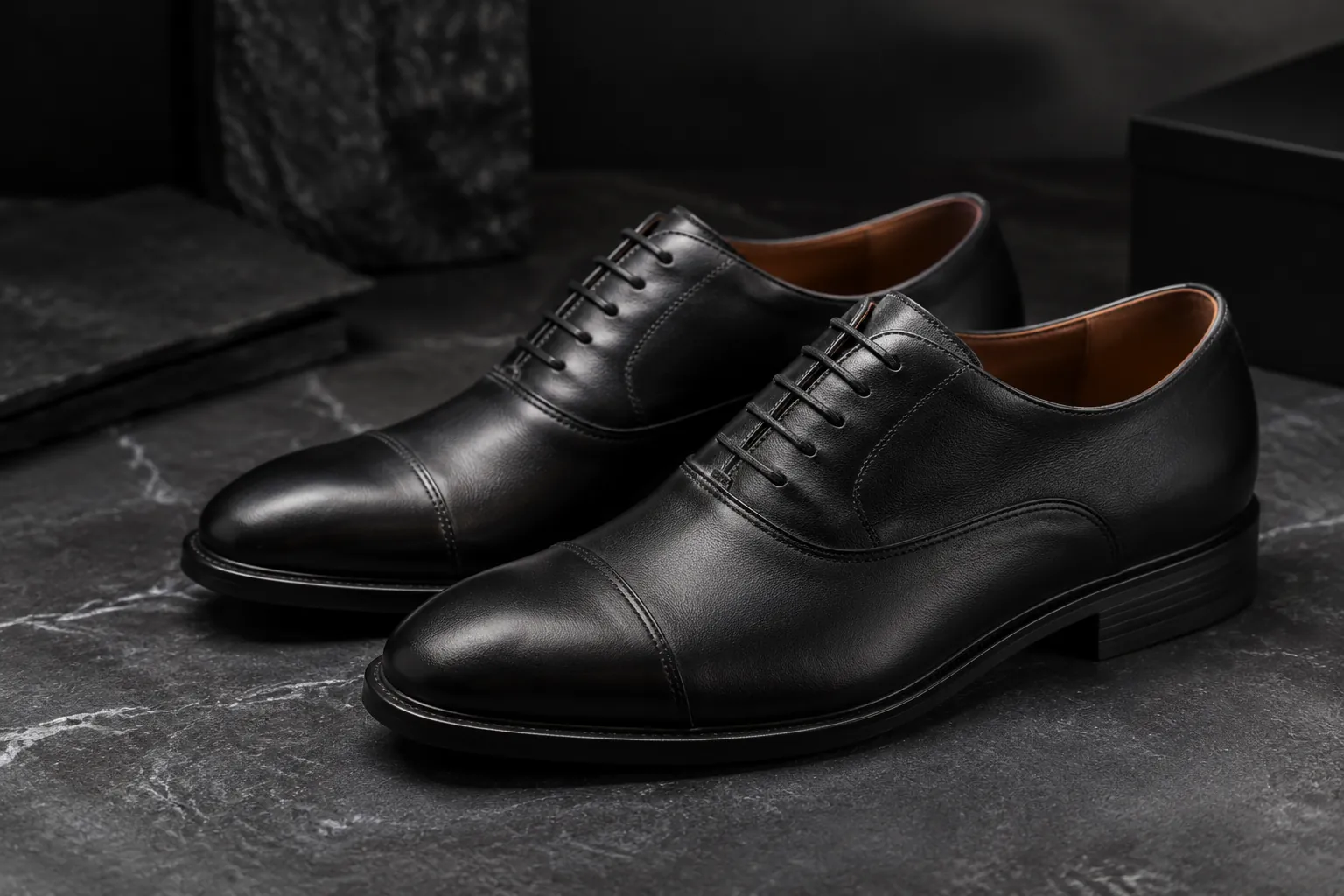
Brands often shortlist a leather shoes supplier on price, capacity, and a sample photo. That shortlist can still leave material identity and style geometry unspecified. Mixed lots or uncontrolled Oxford and loafer proportions can enter bulk even after a polished first conversation.
In this guide, leather shoes supplier control points before production means a buyer-owned product definition: the material fields and style-specific points that must be written down before development, sampling, or quotation questions. The method is an editorial recommendation for how a buyer can prepare. It is not a published factory workflow.
Four source pages supply the facts used here. The factory-quality page covers incoming materials. The contact page covers the product and commercial frame. The dress-shoes page names cap-toe Oxford control points. The loafers page names penny loafer controls. Each section below keeps those scopes separate so one page is not used to imply another’s content.
The Gap Price-First Shortlists Leave Open
Commercial interest without a locked definition creates two common failure modes. When material fields are blank, the project has no buyer reference for leather article, color, thickness, lining, outsoles, hardware, packaging, artwork, or lot identity at intake. When only style geometry is blank, “dress shoe” or “loafer” may still allow facing gap, toe proportion, saddle proportion, or vamp length to drift between sample and bulk.
Editorial recommendation: keep price and capacity notes in a separate commercial file. Put the product definition in its own document. That split does not change how a factory works; it changes how clearly the buyer states what the project is.
Incoming Material Identity as an Evaluation Gate
The factory-quality page describes an incoming stage. Controlled materials are confirmed by reviewing leather article, color, thickness, lining, outsoles, hardware, packaging, artwork, and lot identity before mixed or unclear materials enter production. That is the documented timing for leather shoes supplier material identity.
The excerpt does not supply a buyer form, a pre-inquiry deadline, or an acceptance rule. A practical buyer move is still simple: record a current reference against each named field so the definition is not empty when production talk begins.
- Leather article
- Color
- Thickness
- Lining
- Outsoles
- Hardware
- Packaging
- Artwork
- Lot identity
Leave tolerances, laboratory methods, and substitute-material policies out of this list unless the buyer has already decided them independently. The source supplies field names and intake timing only.
Product and Commercial Frame Reviewed Together
Material identity alone does not describe the commercial ask. The contact page states that style, market, quantity, size range, materials, branding, packaging, and delivery need are reviewed together rather than priced as isolated line items.
That statement is quote-review practice as published on the contact page. It is not a timeline, a price model, or a menu of guaranteed services. Editorial recommendation: place this frame next to the material and style blocks so the inquiry carries one coherent package instead of scattered line items.
- Style
- Market
- Quantity
- Size range
- Materials
- Branding
- Packaging
- Delivery need
Cap-Toe Oxford Controls That Belong in the Brief
Calling a product a dress shoe is not enough for an OEM program. The dress-shoes page treats facing gap, toe proportion, cap placement, polish, and pair symmetry as control points for its cap-toe Oxford. An OEM leather dress shoe control points block should preserve those five labels and attach the buyer’s approved reference to each one.
| Published control point | What to capture in the buyer brief |
|---|---|
| Facing gap | Note the approved lace-facing spacing from the reference sample or drawing. |
| Toe proportion | Record the intended toe length and shape relative to the last. |
| Cap placement | Mark where the toe cap seam should sit on the approved model. |
| Polish | State the finish level expected on the approved upper surface. |
| Pair symmetry | Require left/right match against the approved pair standard. |
These notes stay within the published labels. They do not add measurements, inspection methods, or acceptance standards that the source does not provide.
Penny Loafer Controls That Are Not Interchangeable With Oxfords
A formal Oxford checklist should not be pasted onto a loafer. The loafers page instructs control of saddle proportion, apron symmetry, vamp length, opening retention, heel hold, and flex for a repeatable penny loafer core style. Those terms are loafer-specific.
For a private label loafer specification brief, give the loafer points their own block. The Oxford source and the loafer source name different sets; separate blocks keep each approved reference tied to the correct core style.
| Style family | Published control points | Buyer risk if the list is swapped |
|---|---|---|
| Cap-toe Oxford | Facing gap, toe proportion, cap placement, polish, pair symmetry | Loafer geometry (saddle, apron, opening) is never named, so bulk can still drift on those axes. |
| Penny loafer | Saddle proportion, apron symmetry, vamp length, opening retention, heel hold, flex | Oxford facing and cap placement never apply, so a copied dress-shoe list leaves the loafer core uncontrolled. |
Editorial recommendation: identify which style block the project uses before filling any control cells. The excerpts do not define measurement methods; do not present added criteria as published factory guidance.
Documented Statements Versus Open Inquiry Topics
A clear inquiry separates what the pages already state from what still needs a project-specific answer. The open questions below are buyer questions. They are not documented services or promises.
| Topic | Published statement | Open buyer question |
|---|---|---|
| Incoming materials | The factory-quality page says leather article, color, thickness, lining, outsoles, hardware, packaging, artwork, and lot identity are reviewed before mixed or unclear materials enter production. | Which buyer reference will accompany each named material field? |
| Product and commercial frame | The contact page says style, market, quantity, size range, materials, branding, packaging, and delivery need are reviewed together rather than priced as isolated line items. | Which development, sampling, or quotation options may apply to this project? |
| Cap-toe Oxford | The dress-shoes page treats facing gap, toe proportion, cap placement, polish, and pair symmetry as control points. | Which buyer-approved reference identifies each named Oxford point? |
| Penny loafer | The loafers page instructs control of saddle proportion, apron symmetry, vamp length, opening retention, heel hold, and flex for a repeatable core style. | Which buyer-approved reference identifies each named loafer point? |
With that matrix filled, the supplier receives a current definition before the buyer asks which options may apply.
One Definition Package to Send Next
Editorial recommendation: send one compact document with separate headings for each source scope. Keep material, Oxford, loafer, and commercial lists under their own headings so combined attribute lists are never treated as a single claim.
- Material identity
- Leather article, color, thickness, lining, outsoles, hardware, packaging, artwork, and lot identity—with the buyer’s current reference noted where known.
- Cap-toe Oxford block (if applicable)
- Facing gap, toe proportion, cap placement, polish, and pair symmetry.
- Penny loafer block (if applicable)
- Saddle proportion, apron symmetry, vamp length, opening retention, heel hold, and flex.
- Product and commercial frame
- Style, market, quantity, size range, materials, branding, packaging, and delivery need.
- Project question
- Ask which development, sampling, or quotation options may apply to the current definition.
If material fields stay blank while style geometry is complete, intake still lacks a buyer reference for mixed or unclear materials. If geometry stays blank while materials are named, the style family can still shift between sample and bulk. Closing both gaps in one package is the practical control step available to the buyer before any production conversation.
Share the current product definition and ask which development, sampling, or quotation options may apply. Start from a clear buyer brief; leave open questions labeled as questions, not as company commitments.
Sources and verification
- Leather Shoe Factory in China | Capability & Export QC First-party site source
- Request a Quote | Leather Shoe Manufacturer First-party site source
- Custom Leather Dress Shoes Manufacturer | OEM & Private Label First-party site source
- Custom Loafers Manufacturer | OEM & Private Label Leather Loafers First-party site source
Share the current leather footwear definition and ask which development, sampling or quotation options may apply to the project.
Send your project brief