
Footwear Sourcing
Leather Shoe Supplier Sample Review Checklist
An editorial framework for separating the buyer's footwear definition, observable sample findings, and unresolved supplier questions.
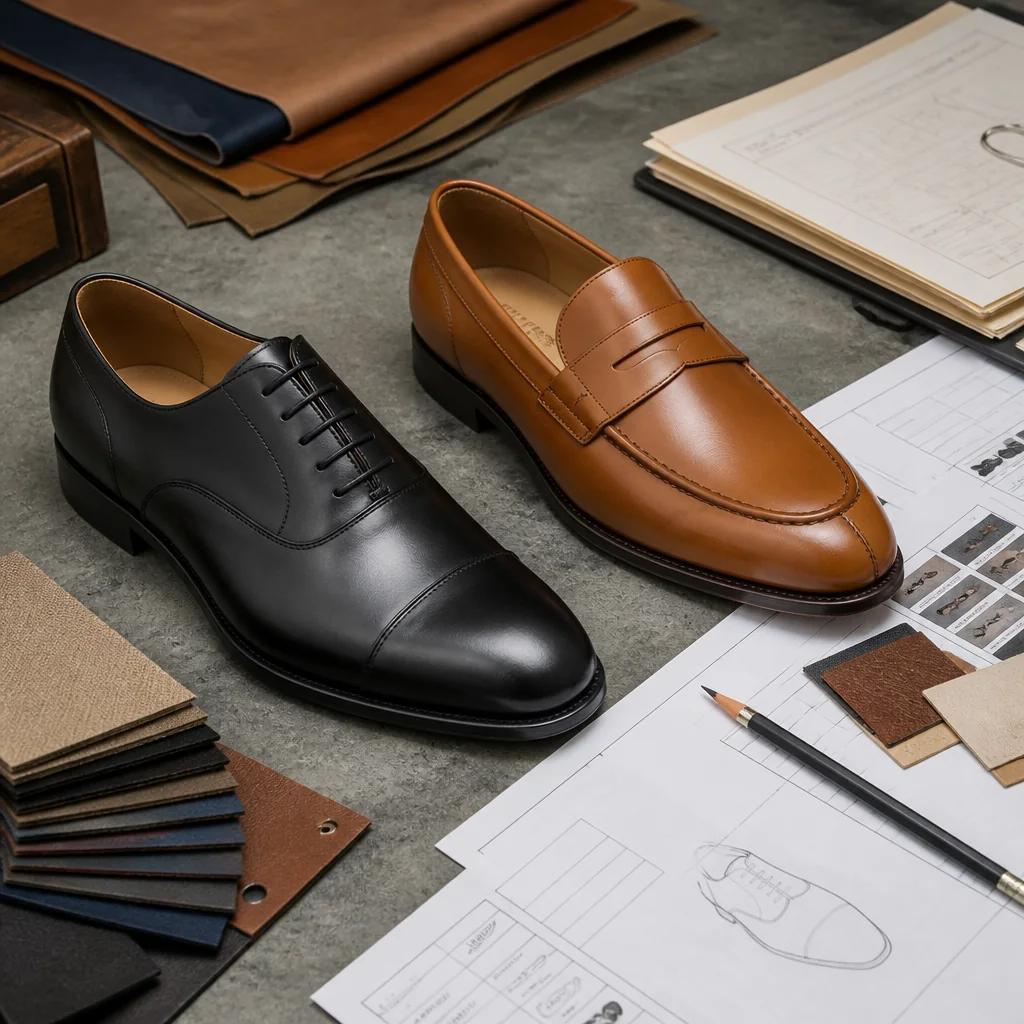
This leather shoe supplier sample review checklist is built around a narrow buyer decision: does the sample correspond to the current footwear definition, where does it differ, and what still needs clarification? Our editorial recommendation is to record those answers in three separate layers: the stated requirement, the sample finding, and the open question. A single pass-or-fail label loses that separation.
For a cautious procurement record, buyers should limit conclusions to the stated review basis. A visual review, for example, should not be presented as proof of material identity, fit performance, comfort, durability, production consistency, or conformity of a later production lot. Those conclusions require evidence that the supplied sources do not document.
Build the Review Sheet Before Scoring the Shoe
Our recommended buyer worksheet starts with four columns. This structure preserves the reference behind each comment and gives unresolved points somewhere explicit to go.
Recommended columns for the buyer's sample review
| Requirement reference | Sample finding | Difference or uncertainty | Question for follow-up |
|---|---|---|---|
| Name the relevant specification field, drawing, image, or buyer reference. | Describe what was observed and state the basis of that observation. | Identify the point that differs or could not be established. | Ask for the information or project-specific clarification needed to resolve it. |
For the buyer's internal record, we also recommend fields for the sample reference, review date, product name, style category, and requirement version. The review basis can be marked as direct observation, assessment under a separately defined method, or not assessed. This helps prevent a visual note from being read as a material, fit, or performance finding.
Practical editorial status labels include corresponds to stated requirement, differs from stated requirement, not assessed, and needs clarification. These labels organize buyer feedback; they do not establish tolerances, test methods, or approval rules.
Attach the Product and Commercial Frame
Leather Shoe Manufacturer's inquiry page says style, market, quantity, size range, materials, branding, packaging, and delivery need are reviewed together rather than priced as isolated line items. That is the documented project frame. It does not confirm that a particular material, commercial threshold, schedule, or development option is available.
The table below is an editorial recommendation for keeping the sample record tied to that documented frame.
Suggested product and commercial fields
| Category | Buyer definition | Sample record | Open point |
|---|---|---|---|
| Style | Reference the current style definition and its version. | Identify the style represented by the sample. | Record any difference that needs clarification. |
| Market | Preserve the market information supplied with the inquiry. | Note only market-related points within the review scope. | Leave unsupported requirements open for confirmation. |
| Quantity | State the buyer's current quantity requirement. | Treat quantity as project context, not a physical sample finding. | Ask what quantity information applies to the defined project. |
| Size range | State the requested range. | Identify the reviewed sample size when known. | Separate that sample observation from questions about the range. |
| Materials | Reference the current material definition. | Record only findings supported by the stated review basis. | Ask how unresolved material details should be identified. |
| Branding | Reference the buyer's artwork and placement requirement. | Describe visible correspondence or difference. | List unconfirmed artwork, placement, or execution details. |
| Packaging | Reference the current packaging definition. | State whether packaging was present and reviewed. | Ask what packaging information applies to the project. |
| Delivery need | Record the requested need without treating it as an agreed date. | Place timing outside the physical sample findings. | Ask what timing information can be provided for the defined project. |
We recommend retaining the original requirement beside every observation. If the buyer changes that requirement, a new version reference preserves which definition was used for each review.
Give the Cap-Toe Oxford Its Own Fields
The company's dress-shoe page identifies facing gap, toe proportion, cap placement, polish, and pair symmetry as control points for its cap-toe Oxford. An Oxford shoe sample review can turn each documented point into a separate observation field.
- Facing gap: As an editorial review prompt, reference the buyer's intended appearance and describe what is visible in the sample.
- Toe proportion: Compare the sample with the buyer's current design reference, while leaving any dimensional method or tolerance open.
- Cap placement: Record the observed position on each shoe and identify questions the available reference cannot resolve.
- Polish: Describe the visible finish in terms tied to the stated requirement. The observation should remain separate from any claim about leather identity or later production.
- Pair symmetry: Note visible left-to-right correspondence or difference without creating a permitted variation.
These are buyer-facing observation prompts, not documented factory test procedures. The source names the control points but provides no tolerance, measurement method, defect limit, or approval threshold.
Use a Separate Penny Loafer Lens
The loafer page separately identifies saddle proportion, apron symmetry, vamp length, opening retention, heel hold, and flex as control points for its penny loafer. A dedicated penny loafer sample checklist keeps those points attached to the correct style.
Editorial prompts for penny loafer feedback
| Documented control point | Recommended buyer entry | Evidence limit |
|---|---|---|
| Saddle proportion | Describe how the sample corresponds to the current design reference. | No proportion or tolerance is supplied by the source. |
| Apron symmetry | Record visible correspondence or difference within each shoe and across the pair. | Any permitted variation remains an open question. |
| Vamp length | Reference the intended profile and describe the observed sample. | Appearance alone does not establish a fit result. |
| Opening retention | State whether the point was assessed and record the review basis. | Use an unresolved status when the review does not support a conclusion. |
| Heel hold | Record the defined assessment basis and resulting observation, if assessed. | An individual finding should not be generalized to the full size range. |
| Flex | Identify whether flex was reviewed and describe only that observation. | The observation does not establish durability or comfort. |
The Oxford and loafer lists remain separate because the cited product pages provide different control points. This separation also keeps private label footwear sample feedback tied to the style and requirement under review.
Separate Sample Notes From the Incoming Statement
The factory-quality page documents an incoming step that reviews leather article, color, thickness, lining, outsoles, hardware, packaging, artwork, and lot identity before mixed or unclear materials enter production. The excerpt identifies the scope and timing of that step, but it does not identify who performs the review or provide a test method.
Our recommended reading of the evidence boundary is set out below.
Sample record and incoming-step evidence boundary
| Buyer-created sample record | Documented incoming step |
|---|---|
| Records the buyer's requirement, sample observation, and open question. | Reviews the material, packaging, artwork, and lot-identity categories named in the factory-quality excerpt. |
| Applies to the identified sample and stated review basis. | Has the documented timing boundary of occurring before mixed or unclear materials enter production. |
| May describe visible material appearance without establishing material identity. | Includes leather article, color, thickness, lining, outsoles, hardware, packaging, artwork, and lot identity. |
| Provides no proof that the sample represents a later production lot. | Is not documented in the excerpt as a buyer inspection, certification, test result, or guarantee. |
A color observation in the sample record therefore remains a sample observation. The incoming statement should not be used to infer that the sample and a later lot are identical or that approval is performed on the buyer's behalf.
Write Questions That Preserve the Uncertainty
For the supplier handoff, our editorial recommendation is to phrase each unresolved item as a compact four-part entry rather than an implied rejection or approval.
- Requirement reference
- Name the buyer specification, drawing, image, or internal reference used for comparison.
- Observation
- Describe what is present in the sample using neutral language.
- Unresolved point
- State what differs or what the review could not establish.
- Question
- Ask what definition, information, or project-specific next step may apply.
Tolerances, fit-assessment methods, revision handling, sample stages, timing, testing, and approval procedures remain inquiry topics because the supplied evidence does not document them. For cap placement, the buyer can ask which tolerance or reference should govern. For heel hold, the buyer can ask how the point should be assessed. Neither question presumes that a particular method or service is available.
Where no supported assessment was made, we recommend the explicit status not assessed; method to be clarified. That entry records the evidence limit without turning an empty field into an implied decision.
Send the Current Definition With the Record
Our recommended handoff package contains the current footwear definition, the completed review sheet, referenced supporting images where useful, and one consolidated set of open questions. It should also carry the current style, market, quantity, size range, materials, branding, packaging, and delivery need from the documented inquiry frame.
- Identify the sample and the requirement version used for review.
- Separate Oxford fields from penny loafer fields.
- Mark observations, differences, unassessed points, and questions distinctly.
- Keep incoming-step statements separate from buyer sample findings.
Share that package through the project inquiry and ask which development, sampling, or quotation options may apply to the project as currently defined. This wording requests project-specific information without presuming a revision round, sample type, price, quantity threshold, schedule, testing route, or approval process.
Sources and verification
- Request a Quote | Leather Shoe Manufacturer First-party site source
- Custom Leather Dress Shoes Manufacturer | OEM & Private Label First-party site source
- Custom Loafers Manufacturer | OEM & Private Label Leather Loafers First-party site source
- Leather Shoe Factory in China | Capability & Export QC First-party site source
Share the current leather footwear definition and ask which development, sampling or quotation options may apply to the project.
Send your project brief