
OEM Footwear Development
Who Decides What in a leather shoe OEM decision matrix?
A buyer-held matrix can separate fixed footwear requirements, proposal permission, unresolved questions, and excluded topics before a project inquiry.
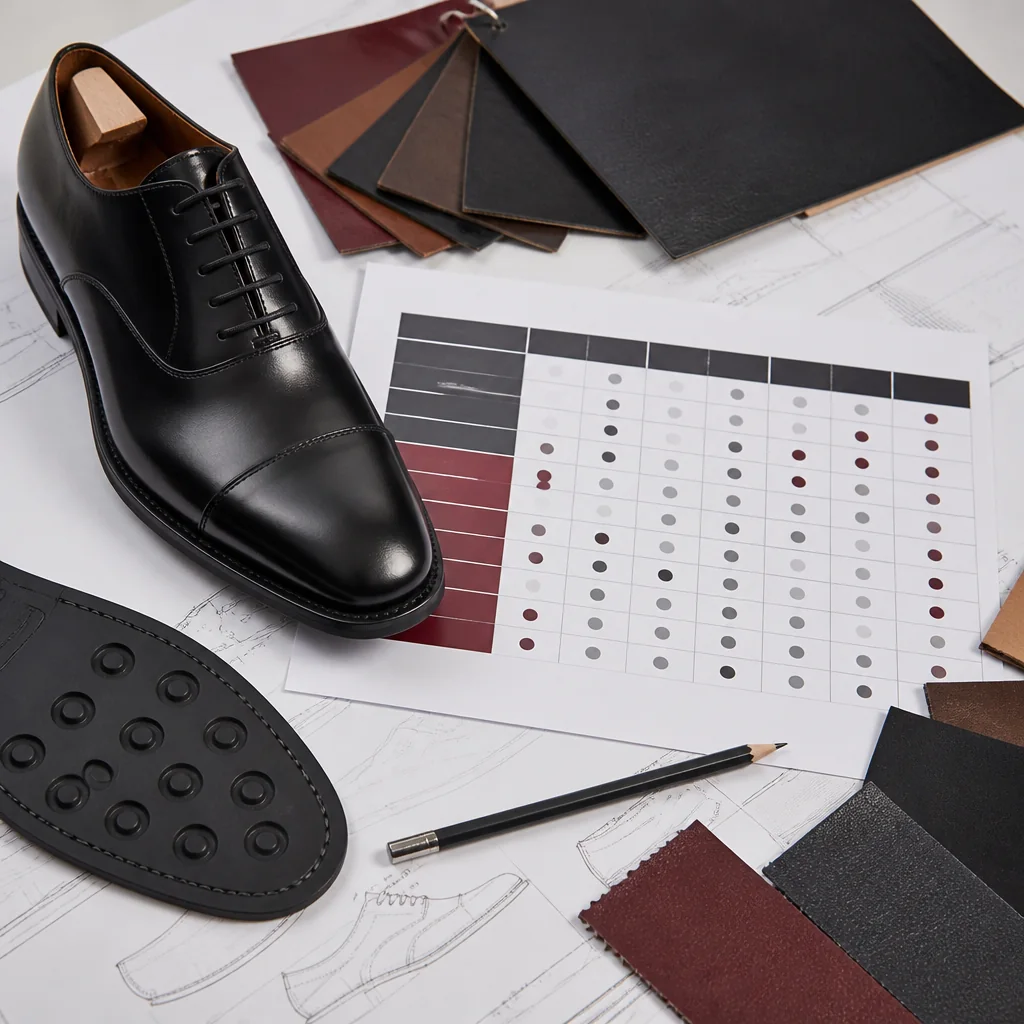
A draft row that says Cap placement: open leaves a practical question unanswered: who may decide or propose what? In a buyer's working record, open could indicate an internal decision still in progress, a request for information, permission for the factory to propose an option, or a subject excluded from the current inquiry.
A leather shoe OEM decision matrix makes that distinction row by row. The buyer records the current definition and assigns a state showing how the subject should be treated in the inquiry. This is an editorial procurement tool for clarifying OEM footwear decision rights; it is not a documented factory process or a list of available services.
The point is narrower than writing a complete product specification. The matrix controls proposal permission at the individual-decision level, so a buyer can invite input on one subject without making every related product choice open.
Four authority states
The published OEM and ODM guidance instructs the buyer to state which decisions the factory may propose. Based on that instruction, the following four-state taxonomy is recommended for the buyer's own record.
| Authority state | Meaning in the buyer's record | Recommended treatment |
|---|---|---|
| Buyer-fixed | The buyer has supplied the current requirement and is not inviting an alternative for this row. | Record the requirement or reference and mark it fixed for the inquiry. |
| Factory may propose | The buyer expressly permits a proposal on the named subject. | Define the permitted subject and preserve any boundaries that remain fixed. This state does not confirm that an applicable option is available. |
| Unresolved inquiry | The buyer needs information before deciding how to close or reclassify the row. | Record what is known and ask a bounded question. Within this taxonomy, the row grants no proposal permission. |
| Out of scope | The subject is excluded from the present inquiry. | State the exclusion instead of leaving the row blank. |
As an editorial rule, assign one state to each row. If a subject contains both fixed and open elements, divide it. A buyer could keep the required color in one row and the method used to communicate that color in another, allowing each to carry a different state. This avoids turning limited proposal permission into discretion over a broader subject.
A compact buyer-held record can use five columns: subject, current definition, authority state, fixed boundary, and open question. Those columns are recommended here for clarity; the cited material does not prescribe a matrix format.
Two source roles in the commercial frame
The commercial brief and the quotation review describe different activities. Keeping them separate prevents fields from one source from being presented as though they appeared in the other.
| Published context | Stated activity | Fields identified by that source |
|---|---|---|
| OEM and ODM brief | The buyer is instructed to state the commercial frame. | Customer, market, style family, target price position, expected quantity, size range, delivery need, and the decisions the factory may propose. |
| Quotation review | The company states that the identified product and commercial inputs are reviewed together rather than priced as isolated line items. | Style, market, quantity, size range, materials, branding, packaging, and delivery need. |
The buyer can create an authority row for each field in the OEM and ODM instruction when a decision-right distinction is useful. Materials, branding, and packaging can also become buyer-authored rows if their status needs clarification. Their appearance in the quotation-review source establishes that they are among the inputs reviewed together; it does not place them in the OEM and ODM field list or give them a company-defined proposal category.
Expected quantity and target price position can be recorded without inserting unsupported figures. Delivery need can likewise remain a project definition or a question without implying a schedule. The matrix should show whether each item is fixed, open to a proposal, unresolved, or outside the inquiry.
What changes for a cap-toe Oxford?
The dress-shoe page treats facing gap, toe proportion, cap placement, polish, and pair symmetry as control points for its cap-toe Oxford. These documented subjects can become matrix rows, but the excerpt supplies no measurements, tolerances, inspection methods, or acceptance thresholds.
Recommended buyer records for the published Oxford control points
| Control point | Current-definition entry | Authority question |
|---|---|---|
| Facing gap | Record the current appearance reference, or note that a reference has not been stated. | Is this row fixed, open to a proposal, unresolved, or out of scope? |
| Toe proportion | Identify the current shape reference and any element the buyer intends to preserve. | Would proposal permission apply only to toe proportion? |
| Cap placement | Enter the current placement reference, if one has been defined. | Is placement open while the cap-toe style remains fixed? |
| Polish | Record the intended appearance reference or a clearly stated question. | Is the appearance fixed, open to a proposal, or still unresolved? |
| Pair symmetry | Identify the buyer's current comparison reference, if available. | Has the buyer fixed the reference or expressly invited a proposal? |
These entries assign a treatment to each subject; they do not provide a technical answer. The editorial recommendation is to keep the style definition, proposal permission, and request for information in separate cells. A recipient can then see which part of the row may be addressed without reading broad authority into the word open.
Material definitions at the incoming gate
The factory-quality page describes an incoming review of leather article, color, thickness, lining, outsoles, hardware, packaging, artwork, and lot identity before mixed or unclear materials enter production. The timing matters: this is an incoming control, not a review documented as occurring during quotation or development.
For the buyer's own preparation, those subjects can be carried as separate matrix rows. Doing so preserves the current definition and the authority state associated with it. The source does not state that the company uses this matrix or receives an operational handoff from it.
- Keep leather article, color, and thickness in separate rows when they do not share the same authority state.
- Give lining, outsoles, and hardware their own definitions or bounded questions.
- Separate packaging from artwork when the buyer intends different treatment for each subject.
- Record lot identity as its own subject rather than using it as a substitute for another material definition.
These are buyer-record recommendations tied to the subjects named in the incoming-review excerpt. They should not be read as evidence of material sourcing, laboratory testing, certification, authentication, or performance validation.
From unresolved row to bounded question
An unresolved row should identify the missing decision without silently inviting a change. The buyer can use the following editorial sequence for each such row.
- State the current definition. Record the requirement, reference, or project context already available for that subject.
- Preserve the fixed boundary. Name the elements that are not open while the question is considered.
- Address proposal permission. Say expressly whether the factory is invited to propose an option for this row.
- Ask for project-specific clarification. Ask which development, sampling, or quotation options may apply to the current project.
Suggested inquiry wording: The current definition for [subject] is [definition]. [Boundary] remains fixed. We are [inviting/not inviting] a proposal for this row. Please indicate which development, sampling, or quotation options may apply to this project.
When the buyer wants information only, the proposal sentence should say so directly. This wording does not presume that an option is available and does not itself grant proposal or approval authority.
Was the reply within authorized scope?
The matrix can also be used as the buyer's response-review record. This editorial review asks whether the reply stayed within the scope of the inquiry, not whether it contained a particular number of ideas or recommendations.
- Check whether buyer-fixed rows remain unchanged in the record.
- Match each proposal to a row that expressly invited one.
- Keep supplied information, stated assumptions, proposals, and buyer decisions as separate entries.
- Leave an unanswered row unresolved until the buyer deliberately changes its state.
- Do not treat discussion of an out-of-scope subject as the buyer's acceptance of that subject.
After this row-level review, the buyer can consider the quotation context separately. The company's statement that its listed quotation inputs are reviewed together should not be converted into proposal permission. That permission comes only from the state the buyer assigned to the relevant row under this editorial method.
Where the published evidence stops
The cited excerpts support the source-specific fields, control points, incoming-review subjects, and timing described above. They do not document company proposal categories, design or engineering scope, material sourcing responsibility, sampling procedures, prices, minimums, schedules, testing, certifications, conflict-resolution procedures, or final product approval authority.
The matrix therefore remains a buyer-held procurement tool. It can clarify private label shoe development responsibilities inside the inquiry, but it cannot establish which company capabilities or options are available for a particular project.
Share the current footwear definition through the project inquiry. Identify the fixed rows, the subjects on which a proposal is expressly invited, the questions that remain unresolved, and anything outside the present scope. Then ask which development, sampling, or quotation options may apply to that project.
Sources and verification
- OEM Shoes & ODM Leather Footwear | Custom Shoe Manufacturer First-party site source
- Request a Quote | Leather Shoe Manufacturer First-party site source
- Custom Leather Dress Shoes Manufacturer | OEM & Private Label First-party site source
- Leather Shoe Factory in China | Capability & Export QC First-party site source
Share the current leather footwear definition and ask which development, sampling or quotation options may apply to the project.
Send your project brief