
Sourcing and Procurement
Build a leather shoe manufacturing quote comparison
A buyer-owned method for comparing quotations against one current product and commercial frame while keeping incoming review and Oxford language within their documented scopes.
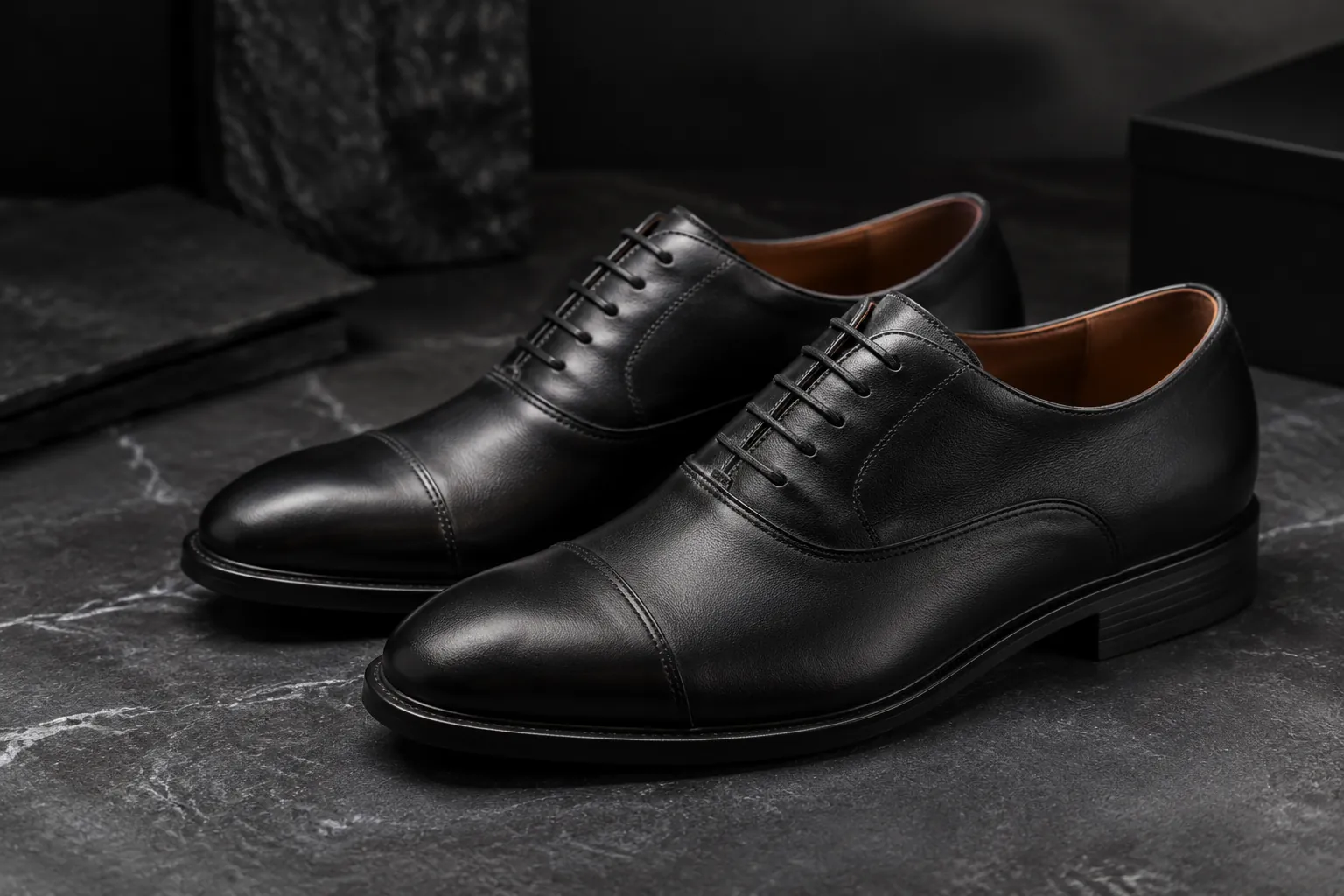
For a leather shoe manufacturing quote comparison, place each response beside one dated product definition and record whether each requirement is included, excluded or unanswered. This buyer-owned method is an editorial recommendation created for this article.
The supplied company evidence has several bounded subjects. The quotation excerpt names the product and commercial fields reviewed together. The factory-quality excerpt separately identifies subjects reviewed at an incoming stage before mixed or unclear materials enter production. The two product-page excerpts each define a particular cap-toe Oxford appearance direction.
The buyer-owned comparison record
Begin with a record that preserves the buyer requirement, the submitted reference and the response received. Keep each requirement on its own row so that a reply about one subject does not appear to answer another. The table structure below is an editorial recommendation for buyers, not a company quotation template.
Recommended structure for the buyer's comparison record
| Buyer requirement | Submitted reference | Supplier response | Quoted inclusion | Unresolved point | Source document |
|---|---|---|---|---|---|
| State one requirement in the buyer's current wording. | Name the file, product direction or revision submitted for review. | Record the relevant response without removing conditional language. | Classify the response as included, excluded or unanswered. | Write the question that still requires a project-specific answer. | Identify the quotation, message, artwork file or specification containing the statement. |
Use the submitted reference column to distinguish current information from earlier versions. If a response refers to a different version, retain both references instead of rewriting the response as though it addressed the current definition. Where an alternative is proposed, keep the original requirement and the alternative in separate columns.
- Included
- The response expressly includes the requirement as written or identifies the included version.
- Excluded
- The response expressly excludes the requirement or places it outside the quoted scope.
- Unanswered
- The response does not provide enough information for the buyer to classify the requirement as included or excluded.
These status definitions are part of the editorial comparison method. They are descriptive rather than a supplier score, and they do not predict production performance.
What is documented at quotation review?
The request-a-quote excerpt states that style, market, quantity, size range, materials, branding, packaging and delivery need are reviewed together rather than priced as isolated line items. These documented headings can form the top level of the OEM leather shoe RFQ fields in the buyer's record.
Editorial buyer worksheet based on the documented quotation fields
| Documented field | Recommended buyer entry | Question for the comparison record |
|---|---|---|
| Style | Copy the current style name, code and submitted revision reference. | Does the response identify the same style definition? |
| Market | Repeat the market definition stated in the request. | Does the response address that submitted market? |
| Quantity | Copy the requested quantity definition without adding assumptions. | Is the response tied to the submitted quantity basis? |
| Size range | Record the submitted size system and range. | Does the response cover the same size definition? |
| Materials | Copy the material definitions and references from the current brief. | Does the response retain those references or state an alternative? |
| Branding | Identify the submitted branding definition and its reference files. | Which branding requirements are expressly addressed? |
| Packaging | Identify the submitted packaging definition and reference files. | Is the same packaging scope included, excluded or unanswered? |
| Delivery need | Copy the delivery need stated in the request. | Does the response address that need without introducing an assumed term? |
When documenting private label shoe quotation requirements, this article recommends keeping branding and packaging on separate rows. They are separate fields in the quotation excerpt, and separate entries preserve which response applies to each subject.
Any additional subfield should be identified as a buyer requirement or an open inquiry. It should not be presented as a factory practice merely because it appears in the buyer's worksheet.
Included, excluded or unanswered?
A comparison record is most useful when it preserves what a response actually says. As an editorial rule for the buyer, mark a requirement as included only when the response expressly includes it. Use excluded only for an express exclusion. Leave the status unanswered when the response is silent or too general to classify.
Acknowledgment of a document should not be converted automatically into confirmation of every item inside it. Instead, identify the document in the submitted reference column, copy the response into its own column and write a direct question for any point that remains open.
Keep the record descriptive. Supplier weighting, mandatory requirements and negotiable terms belong to the buyer's separate decision process. The source excerpts provided for this article do not define scores, weights or acceptance thresholds.
Quotation scope and incoming scope
The quotation excerpt and the factory-quality excerpt describe different scopes. The comparison below keeps each source list intact and applies buyer guidance in a separate column.
Separate treatment of the two documented review scopes
| Documented activity | Source-specific subjects | Editorial treatment in the buyer record |
|---|---|---|
| Quotation review | Style, market, quantity, size range, materials, branding, packaging and delivery need are reviewed together rather than priced as isolated line items. | Use these subjects to organize the product and commercial frame behind each quotation. |
| Incoming review | Leather article, color, thickness, lining, outsoles, hardware, packaging, artwork and lot identity are reviewed before mixed or unclear materials enter production. | Record this as a separate documented scope. Do not mark these subjects as quote-stage confirmations based on the incoming excerpt. |
The incoming excerpt supplies a timing boundary: the review occurs before mixed or unclear materials enter production. It does not place the incoming list within quotation review. Packaging appears in both excerpts, but each occurrence remains attached to the activity described by its source.
For the buyer's record, do not convert the word review into a status such as approved, conforming, traceable or consistent. Those outcomes are not stated in the incoming excerpt. If a project requires evidence of a particular outcome, keep that requirement open until an applicable project-specific response or document addresses it.
One style label, two Oxford directions
The supplied product pages use different appearance language for their identified cap-toe Oxford directions. Each list should remain connected to its own product-page source.
Source-specific cap-toe Oxford appearance language
| Direction | Published description | Editorial treatment in the quote record |
|---|---|---|
| D-01 | The dress-shoes page treats facing gap, toe proportion, cap placement, polish and pair symmetry as control points. | Retain the D-01 identifier and these exact terms together. |
| M-01 | The men's leather shoes page states that facing gap, toe shape, polish level and pair symmetry need a documented approval standard. | Retain the M-01 identifier and these exact terms together. |
For cap-toe Oxford quote specifications, the buyer should name the intended direction instead of relying only on the generic style label. Keep toe proportion distinct from toe shape, and keep polish distinct from polish level. Combining the two lists would create a specification that appears in neither source.
These excerpts define D-01 and M-01 directions only. They do not establish a universal appearance standard for every cap-toe Oxford.
Which terms remain open?
The provided excerpts do not document the commercial and technical subjects below. Treat them as buyer inquiry topics rather than quoted inclusions or available company options:
- Pricing structure, the basis of a quoted figure and quotation validity.
- Any minimum order quantity. The quotation excerpt names quantity but does not state a minimum.
- Sample terms, development routes and tooling requirements.
- Testing, certifications and inspection methods.
- Payment terms, production lead times and shipping terms.
- Packing options beyond the packaging field named in the quotation and incoming excerpts.
An unanswered subject does not show that an option is available or unavailable. The editorial recommendation is to place each subject in the unresolved-point column and request a project-specific answer without presuming a price, term, timeline or service.
A current definition for the inquiry
Prepare the inquiry from the same record used for comparison:
- Confirm the current style, market, quantity, size range, materials, branding, packaging and delivery need.
- Identify the submitted files and revisions, then retain any supplier alternatives as separate responses.
- List every unanswered commercial or technical subject as an open question.
- Share the current leather-footwear definition and ask which development, sampling or quotation options may apply to the project.
Keep the final request conditional. It should ask for a response to the current definition without presuming availability, commercial terms, production timing or a particular outcome.
Sources and verification
- Request a Quote | Leather Shoe Manufacturer First-party site source
- Leather Shoe Factory in China | Capability & Export QC First-party site source
- Custom Leather Dress Shoes Manufacturer | OEM & Private Label First-party site source
- Men's Leather Shoes Manufacturer | Custom Oxfords & Loafers First-party site source
Share the current leather footwear definition and ask which development, sampling or quotation options may apply to the project.
Send your project brief