
Sourcing Guides
Factory Formal Shoe Approval Standards Kitchener Buyers Need
Kitchener buyers often price formal pairs before pair-level acceptance rules exist. Keep dress-shoe and men's formal control-point lists separate, freeze a commercial frame, then open development, sampling, or quotation as distinct asks.
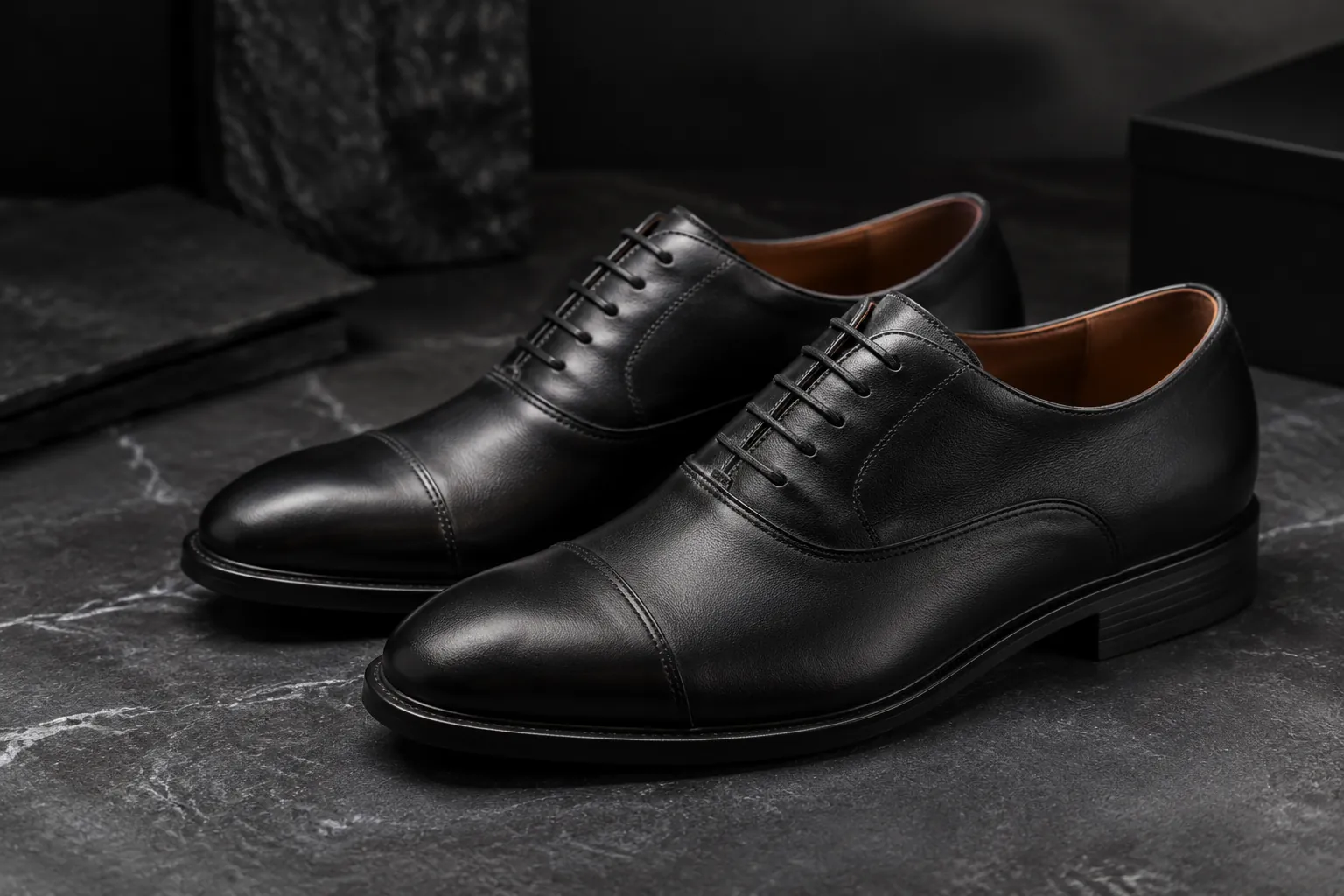
When a Kitchener product team searches for a factory shoe, the path often jumps to price, samples, or a supplier shortlist. That order skips the real gate for formal footwear. Document factory formal shoe approval standards Kitchener buyers will enforce at pair level before bulk dress shoes are priced or sampled. Without those rules, commercial acceptance can still fail on facing, toe, polish, and left-right match even when a quotation looks complete. China OEM and private-label programs become reviewable only after the pair-level rules are written.
What a Kitchener factory-shoe search still leaves undefined
Local search language names a market and a manufacturing interest. It does not name acceptance.
A factory-shoe query from Waterloo Region usually implies dress or business footwear for Canadian retail, wholesale, or private-label channels. It rarely states which visible pair attributes must match left to right, how close facings may sit when laced, how sharp or rounded the toe may read, or how much shine counts as finished. Those decisions are the product definition. Until they are written, a factory is being asked to price or sample against an incomplete brief.
Treat Kitchener as buyer-market context only. The useful move is not hunting a Canadian plant name; it is deciding what a formal pair must look like when it is accepted. For brands and importers building OEM or ODM leather footwear programs, that written standard is the first commercial asset. Price, materials, and packaging can be discussed only after pair-level rules are frozen, because those rules change which constructions, last shapes, and finishing routes are eligible for review.
The formal-program failure mode buyers hit after the quote
The failure mode is quiet and expensive. A quote arrives with style notes, a leather grade, and a packaging sketch. Samples are approved under soft language such as “clean finish” or “balanced look.” Production pairs then arrive with uneven facing openings, mismatched toe silhouettes within a pair, uneven polish depth, or left-right asymmetry that retail staff reject on the floor. None of those defects required a missing material certificate. They required an approval standard that never existed before money and calendar time were committed.
On the men’s leather shoes framing, a black cap-toe Oxford is described as a disciplined business and uniform direction where facing gap, toe shape, polish level, and pair symmetry need a documented approval standard. That framing is the practical risk statement for formal work on that program page: without documentation, those attributes stay subjective, and subjectivity rarely survives bulk inspection or multi-store receiving.
Write the acceptance rules first, then open sampling or quotation. Do not reverse that order because calendar pressure or a competitor price seems urgent. Private label dress shoe pair symmetry is a common commercial acceptance risk when left-right match is never written down before production starts.
Cap-toe Oxford control points that must be documented first
Use the cap-toe Oxford as a disciplined formal anchor. The silhouette exposes facing geometry, toe reading, surface finish, and left-right match more clearly than many casual shapes. Two first-party program pages name control points for this style. Keep those lists separate. Do not blend them into one invented minimum standard or a single QC system.
On the custom leather dress shoes program page, the cap-toe Oxford is presented as the disciplined anchor of a formal program, with facing gap, toe proportion, cap placement, polish, and pair symmetry treated as control points:
- Facing gap
- Toe proportion
- Cap placement
- Polish
- Pair symmetry
On the men’s leather shoes framing, the same style family is cast as a core formal direction where facing gap, toe shape, polish level, and pair symmetry need a documented approval standard:
- Facing gap
- Toe shape
- Polish level
- Pair symmetry
Cap-toe Oxford factory control points therefore depend on which program page you are following. Capture the relevant list in a short standard the buyer owns—annotated photos, callouts on a tech pack page, or a one-page pair acceptance sheet. As an editorial recommendation for the buyer, soft adjectives without photos or measurable language recreate the post-quote failure mode. Expanded inspection language such as eyelet count, lighting notes, or photo callouts is buyer-owned guidance, not a factory-stated method from these excerpts.
How the approval standard changes the commercial frame
Once pair-level rules exist, commercial fields stop being optional afterthoughts. An OEM formal shoe approval standard belongs inside style family and quality intent: it tells the factory which last, pattern, and finishing choices remain eligible before quantity or delivery pressure is applied.
On the OEM and ODM briefing path, the commercial frame is frozen by stating the customer, market, style family, target price position, expected quantity, size range, delivery need, and the decisions the factory may propose. That list is a single frame, not a menu of independent line items.
| Without a frozen formal standard | With pair-level approval rules written first |
|---|---|
| Quote requests emphasize unit price and a style photo only. | Review starts from the acceptance rules named for the formal style family you are building. |
| Samples are judged with soft language after tooling time is spent. | Samples are judged against documented control points the buyer already owns. |
| Market, size range, and delivery need arrive late or incomplete. | Customer, market, style family, price position, quantity, size range, delivery need, and proposal scope are stated as one frame. |
| Bulk receiving disputes often rest on memory of what “looked balanced” at sampling. | Buyers can reference the same written pair standard used at sampling when bulk pairs are checked. |
Freeze those commercial fields in the same document as the pair standard. Do not treat expected quantity or size range as something to fill in later after a unit price looks attractive. A factory cannot responsibly propose construction or finishing options when the market, price position, and delivery need are still unknown, because those constraints change material grade, lasting method, and packing design.
Why style, materials, branding, and packaging are reviewed together
A line-item price request treats leather, sole, box, and logo as separate shopping-cart rows. Formal control points do not work that way. Facing gap and toe reading depend on last and pattern. Polish depends on leather type and finishing sequence. Pair symmetry depends on lasting discipline and final inspection lighting. Branding hardware and packaging can hide or highlight those same attributes when the shoe is unboxed in a store.
On the quote request path, the product and commercial frame are read together: style, market, quantity, size range, materials, branding, packaging, and delivery need are reviewed as a set rather than priced as isolated line items. That is the buyer-facing implication of a pair standard. If polish is a control point on the program you follow, leather and finishing route must be chosen inside the same review as logo placement and the box that will present the shoe. If pair symmetry is a control point, size-run planning and lasting discipline matter as much as a unit-cost cell on a spreadsheet.
These two source paths serve different moments. The OEM briefing freezes the commercial frame before development. The contact-page review then reads the product and commercial details as one package at quotation. Both push the same procurement discipline: formal footwear is a program, not a shopping list. As an editorial recommendation for the buyer, do not restate the full field lists in every message—keep one complete frame document and point each inquiry back to it.
Development, sampling, or quotation—only after the standard is frozen
After the pair approval standard and commercial frame are clear, a Kitchener product team can open a focused inquiry without treating every topic as a promised service. Useful inquiry types stay distinct.
- Development inquiry: Share the written formal standard, style family (for example cap-toe Oxford), market, and the decisions you want the factory to propose. Ask which last, pattern, and material directions remain compatible with the control points you documented.
- Sampling inquiry: Ask which sampling path applies once the standard is frozen, and how samples will be judged against the same written rules you already own. Do not treat sampling as a free substitute for a written standard.
- Quotation inquiry: Provide the product and commercial package—style through delivery need—as one set so pricing is not attempted on isolated line items.
Share the current leather footwear definition, including the pair-level approval standard and commercial frame, through the request path, and ask which development, sampling, or quotation options may apply. The sequence matters more than the channel: standard first, commercial frame second, then development, sampling, or quotation as separate, intentional asks.
For Kitchener-area brands, importers, and retail product teams, the competitive advantage is not a faster price email. It is an acceptance document that makes formal factory work reviewable. Keep the cap-toe Oxford control points each program page actually names, place the relevant list inside a complete commercial frame, and only then decide whether the next message is development, sampling, or quotation. That order reduces the chance that bulk formal pairs miss commercial acceptance for reasons a complete quote never measured.
Sources and verification
- OEM Shoes & ODM Leather Footwear | Custom Shoe Manufacturer First-party site source
- Custom Leather Dress Shoes Manufacturer | OEM & Private Label First-party site source
- Men's Leather Shoes Manufacturer | Custom Oxfords & Loafers First-party site source
- Request a Quote | Leather Shoe Manufacturer First-party site source
Share the current leather footwear definition and ask which development, sampling or quotation options may apply to the project.
Send your project brief