
Sourcing
Custom Leather Boots Material Control Before Production
A frozen style does not protect custom leather boots if incoming materials stay mixed or open. Own every controlled field before production, then hand off one definition for development, sampling, or quotation review.
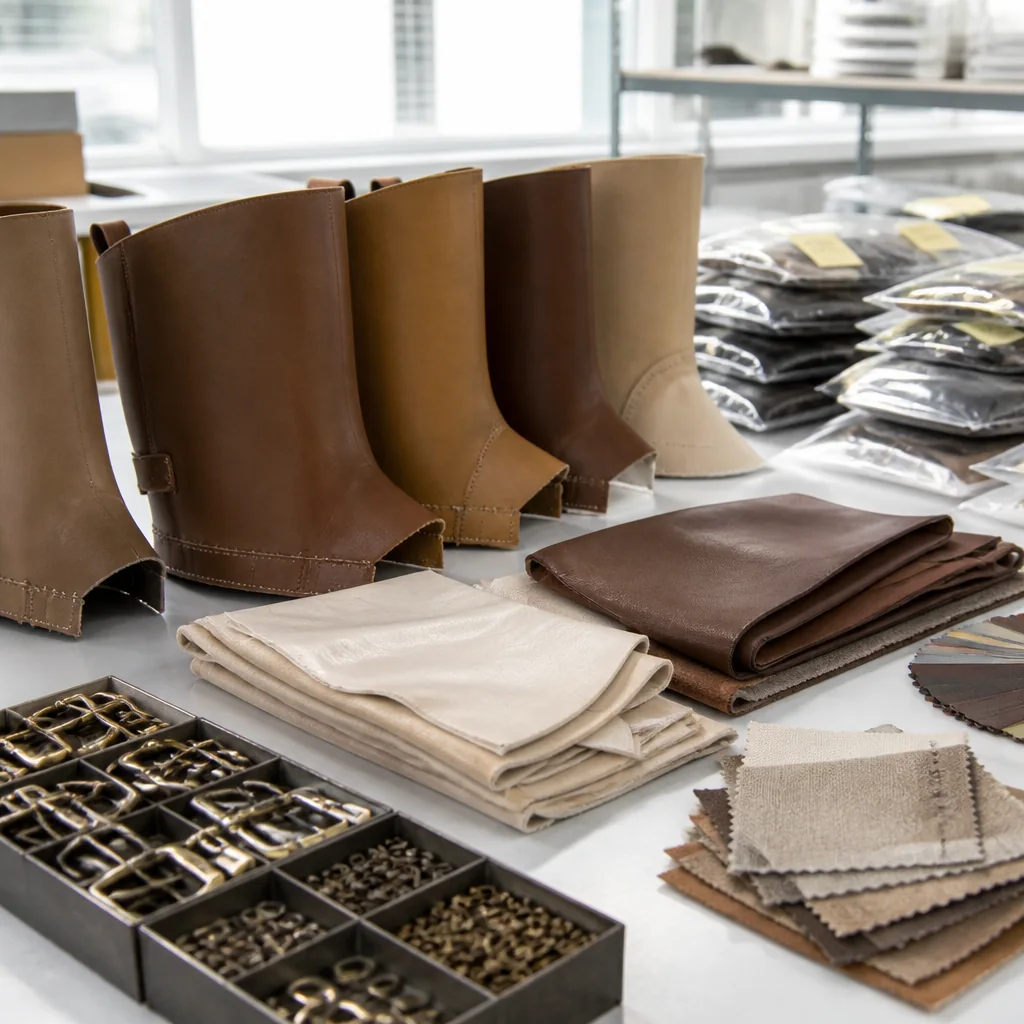
Custom leather boots material control before production is a buyer-owned gate. Style family, last direction, and commercial intent can already feel closed while leather article, color, thickness, lining, outsoles, hardware, packaging, artwork, and lot identity remain half-decided. When those fields stay mixed or silent, production still receives unclear stock, and the program that looked locked begins to drift.
Treat incoming confirmation as the last decision layer you own before materials enter the line. The controlled-material fields and commercial-frame fields below come only from this site’s factory-quality, OEM, materials, and quote pages. No quantities, lead times, or case results are implied beyond those excerpts.
When style freeze still leaves materials open
Teams often lock market, style family, target price position, expected quantity, size range, and delivery need first. That commercial freeze is necessary for custom leather boots. It is not enough by itself. A vague article, an unstated lining weight, or an open lot rule still reaches the floor as mixed stock.
Reference pairs can look right while order language still says “similar leather,” “match hardware,” or “standard packaging.” Incoming control then has nothing firm to check. Mixed hides, swapped linings, or packaging kits that do not match the brand kit can enter the line before anyone stops them. The damage is renegotiation after stock is already in use, not only scrap.
Keep the commercial freeze and the material gate as sequential buyer jobs. The frame states what the program is for. The gate states what may physically enter production. Close both before any production-release language is signed.
Build a custom leather boots incoming material checklist
On the factory-quality page, incoming control is a review of controlled materials before mixed or unclear materials enter production. The named fields are leather article, color, thickness, lining, outsoles, hardware, packaging, artwork, and lot identity. For OEM custom leather boots material confirmation, treat each field as decided or explicitly left open with a written owner. Packaging, artwork, and hardware are named incoming materials, not later add-ons.
The list below restates those nine source fields. Sub-notes under each field are buyer-side specification tips for how you may close the field; they are not extra factory-published subfields.
- Leather article: full name or internal code for the upper leather, not a marketing nickname.
- Color: approved reference method and the rule for shade tolerance you will accept. Buyer tip: name whether you will use a physical swatch, a lab dip cycle, or another agreed standard.
- Thickness: target and any allowable band for the parts cut from that article.
- Lining: material family and color. Buyer tip: add any weight or hand requirement that affects boot shaft comfort if that matters to your program.
- Outsoles: construction type, material, and any sole identity expected on the finished pair.
- Hardware: the approved set of metal or mechanical parts. Buyer tip: list eyelets, hooks, zippers, buckles, or other parts only when they belong to your approved set.
- Packaging: the retail-ready kit that ships with the pair. Buyer tip: name box, tissue, fillers, and labels when they are part of that kit.
- Artwork: logos, stamps, hangtags, care cards, and print files that travel with the goods.
- Lot identity: how hide lots and component lots are identified, held, and paired so reorders and color runs stay coherent.
If a field is truly open, write that openness into the brief with a decision owner and a stop rule: materials for that field do not enter production until the open item is closed. Silence is not an open item; silence is how mixed stock arrives.
Why lot identity before production matters
Custom leather boots lot identity before production is one of the nine incoming fields, not a post-shipment register. Without a pairing rule at intake, left and right boots, shaft panels, and replacement components can drift across available hide lots. Warehouse issue of “next available lot” then becomes the default, even when the commercial frame felt closed.
Write how lots are labeled, held, and paired across the order next to the leather article and color fields. Refuse production-release language that leaves lot identity blank or “to be advised.” A blank lot field is an open gate for mixed materials.
How should appearance range ride with each field?
Appearance questions are not a separate essay after materials are already mixed. The materials page frames appearance range as practical asks: what variation is natural, what becomes a defect, how colors are approved, and how hides or component lots are paired across the order. Attach those asks to the same incoming fields.
- Natural variation versus defect on the leather article. State which grain, scar, or tonal marks remain acceptable on the boot shaft and vamp, and which marks reject a panel. Keep the rule with the article and thickness fields, not only in a photo caption.
- Color approval method. Tie the method to the color field. If the program uses a physical standard, say so. If it uses a lab dip cycle, name that. Do not leave “match the sample” as the only sentence when the production hide lot will not be the sample hide lot.
- Hide and component lot pairing. Use the lot-identity field to answer how left and right boots, shaft panels, and replacement components stay in the same visual family across the order.
- Hardware and outsole finish consistency. Metal tone, sole edge finish, and molded sole color can shift across suppliers. Write the acceptance range next to those component fields so incoming QC has a comparison object.
Keep natural-versus-defect language, color approval, and lot pairing on the named fields before release. Admiring a sample without recording those rules turns “same as sample” into an argument after shipment.
Why product and commercial inputs belong in one package
Quote intake on this site reviews the product and commercial frame together: style, market, quantity, size range, materials, branding, packaging, and delivery need, rather than pricing isolated line items. That joint review fits boots. A thickness change can move cost and shaft hand. A packaging kit change can move landed presentation without changing the last. A hardware upgrade can protect brand image while altering unit economics. Pricing any of those alone invites a quote that no longer matches the program you will run.
Keep one package when you ask for development, sampling, or quotation options. Include at least:
- Market and customer context that constrain compliance language and retail presentation.
- Style family (boot height, closure type, formal or casual position).
- Target price position as a band or competitive frame, stated only at the precision you actually hold.
- Expected quantity and size range as planning inputs you own, at the precision you know.
- Delivery need as a calendar or window, not a promise the factory has not accepted.
- Materials, branding, and packaging as the same controlled fields used at incoming.
Splitting materials to the technician, price to purchasing, and packaging to marketing recreates mixed entry in reverse. Use one shared brief that commercial and product owners can read without translation.
Name residual decisions inside the commercial frame
The OEM brief step freezes a commercial frame that includes customer, market, style family, target price position, expected quantity, size range, delivery need, and the decisions the factory may propose. That last phrase is a field the buyer must state. The excerpt does not list construction options, tooling paths, packing sequences, scheduling rights, or sampling packages as factory residual licenses.
Write residual decisions the same way you write other frame fields: name what you still want proposed, and keep those residual items outside the frozen incoming material list. Leather article, color, thickness, lining, outsoles, hardware, packaging, artwork, and lot identity stay buyer-owned at the gate unless you deliberately reopen them.
If a later proposal would change a frozen incoming field, treat acceptance or rejection as your decision before stock moves. Do not treat silence as permission to substitute materials.
One material-gate definition for assessment
Hand off a single definition rather than a stack of partial emails. A complete current definition for custom leather boots material control before production can read as follows.
- Commercial frame: customer or brand context, market, style family, target price position, expected quantity, size range, delivery need, and the decisions you still invite the factory to propose—named by you, not invented as fixed factory rights.
- Controlled materials: leather article, color, thickness, lining, outsoles, hardware, packaging, artwork, and lot identity, each either decided or explicitly open with an owner.
- Appearance range attached to those fields: natural variation versus defect, color approval method, and hide or component lot pairing across the order.
- Joint review rule: style, market, quantity, size range, materials, branding, packaging, and delivery need stay in one package for assessment.
When that package is ready, share it and ask which development, sampling, or quotation options may apply to the project. That ask matches a normal sourcing conversation; it is not a claim that any specific service level, MOQ, or calendar is already documented for your program. For field detail, compare the incoming material control list, the OEM commercial brief freeze, the materials appearance-range questions, and the joint product-commercial review before you request assessment.
Write the controlled fields, attach the appearance rules, and keep the commercial package whole. Then open the conversation about which development, sampling, or quotation path fits the boots you intend to sell.
Sources and verification
- Leather Shoe Factory in China | Capability & Export QC First-party site source
- OEM Shoes & ODM Leather Footwear | Custom Shoe Manufacturer First-party site source
- Request a Quote | Leather Shoe Manufacturer First-party site source
- Leather Shoe Materials | Full Grain, Suede, Lining & Outsoles First-party site source
Share the current leather footwear definition and ask which development, sampling or quotation options may apply to the project.
Send your project brief