
Sourcing Guides
Custom Leather Boots Factory Proposal Decisions
A frozen boot style still leaves path selection unclear if residual factory-proposable decisions stay unnamed. Separate fixed commercial fields, bounded proposal items, and incoming material gates into one handoff package.
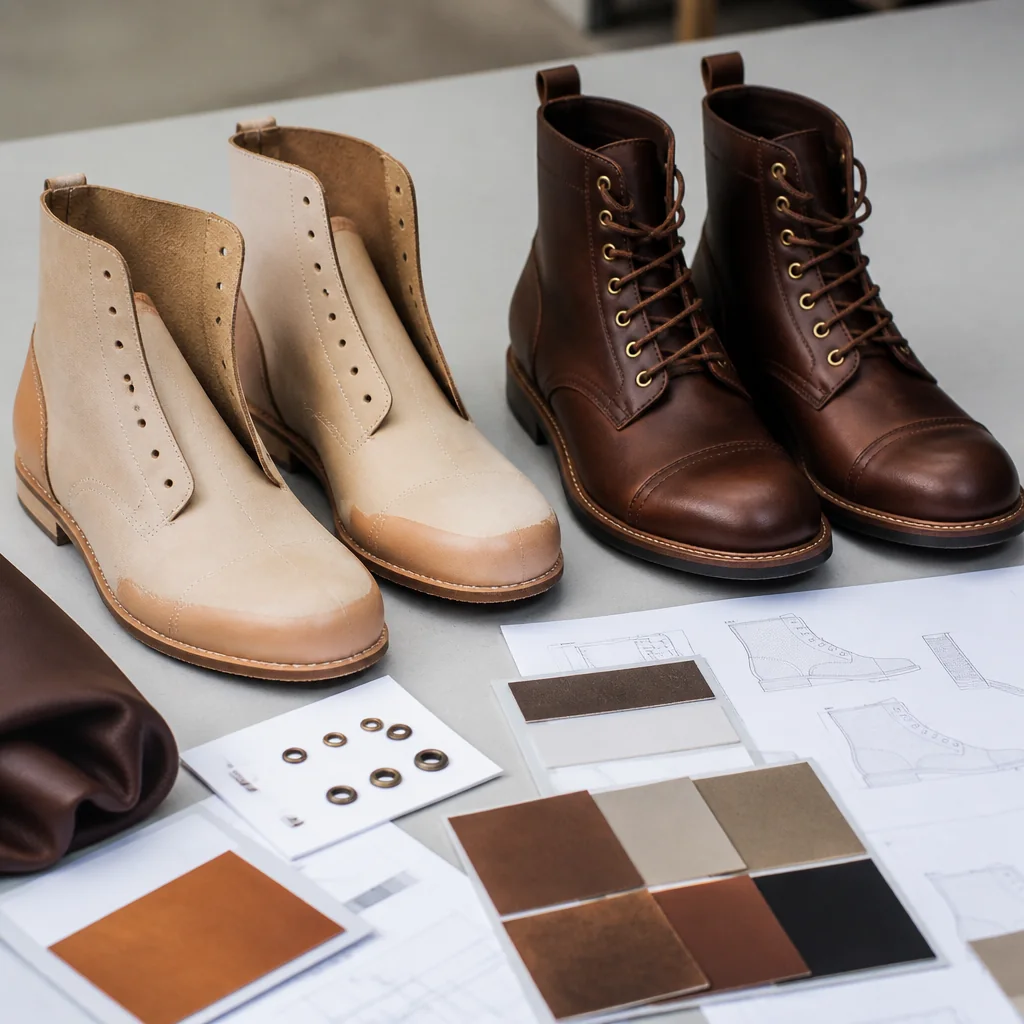
After a brand, importer, or wholesale team freezes a boot style and partial materials, the next request is often a sample or a quote. Path selection can still stall. The gap is rarely one zipper callout or sole sketch. It is residual choices left unnamed: what the buyer has locked, what remains open for factory proposal inside that frame, and which material fields stay confirmation gates rather than redesign rights.
Custom leather boots factory proposal decisions belong in that residual layer. Capture the fixed commercial fields, the bounded items the factory may still propose, and the incoming material controls in one definition. Development, sampling, and quotation can then be assessed as a single product-commercial package instead of disconnected asks.
Why does a frozen style still leave the path unclear?
A style sketch, last preference, or shaft height can look finished while the path stays ambiguous. On the OEM brief step, buyers freeze a commercial frame and, in the same step, state the decisions the factory may propose. Programs that already feel mostly specified still need that pairing.
When residuals stay silent, the factory cannot tell whether the buyer wants a closed build, a narrow construction alternative, or limited substitution inside a price band. Sampling may start on the wrong assumption. Quotation may price an upper or sole alone instead of the full commercial object. Writing custom leather boots residual decisions before any sample request is primary buyer work. A short residual log usually beats another unlabeled trim photo.
Buyer-fixed commercial fields that must be stated first
State buyer-owned frame fields before anything proposable. The OEM brief lists customer, market, style family, target price position, expected quantity, size range, and delivery need. Those fields set responsibility and scope. The factory does not invent them.
- Customer and market: who will sell the boots and where they will be worn or retailed.
- Style family: boot category and silhouette enough to separate dress, work-adjacent, or fashion programs without rewriting the brand book.
- Target price position: the commercial band the build must respect, not a unit price invented later.
- Expected quantity and size range: scale and run shape so path assessment is possible. Do not treat any figure as a published MOQ.
- Delivery need: timing pressure that shows whether a development loop is realistic.
On the quote path, the review step reads style, market, quantity, size range, materials, branding, packaging, and delivery need together. That list reinforces the frame. It does not replace the residual-decision line in the brief. Fixed fields answer what commercial object this is. Residuals answer what remains open for factory proposal inside that object.
Naming residuals the factory may still propose
The brief includes “the decisions the factory may propose” as part of freezing the commercial frame. Name residuals there. Do not treat that line as freestanding design or consulting language. Write each residual as a bounded item the factory may answer inside the buyer-owned frame.
Start with decisions that are still open after style and market are fixed. As editorial method illustrations a buyer might name—not a factory option catalog—examples include a shaft construction alternative within the same silhouette, an outsole compound choice inside a stated price band, or hardware finish options that do not change last or pattern.
- Attach each residual to a constraint. “May propose” should sit next to price position, performance expectation, or branding limit so the reply cannot expand into redesign.
- Keep buyer veto language clear. The factory proposes; the buyer freezes the commercial answer before bulk path selection.
- Do not mix residuals with incoming gates. Leather article, thickness, and lot identity are confirmation fields, not open redesign rights.
If a residual cannot be bounded, reclassify it as buyer work. Finish the brand decision first, then return with a narrower ask. That keeps the RFQ from reading like an open design brief.
Isolated line items versus one commercial package
Contact review language contrasts two approaches. One prices isolated line items. The other reviews style, market, quantity, size range, materials, branding, packaging, and delivery need as one product-commercial package.
Isolated RFQs look efficient and often fail later. A boot upper quoted without packaging and branding assumptions can reverse when labels, boxes, or tissue enter the package. A sole quote without size range and quantity context cannot support a sampling path decision. Materials listed without market and price position invite builds that never fit the commercial frame.
Package review does not guarantee a price. It makes development, sampling, and quotation applicability assessable. For boots programs, keep the residual log with one OEM leather boots commercial package—fixed fields plus open proposable items—rather than a stack of disconnected SKUs. Before sending files, check one habit. If any major field in the review list is missing, or if residuals sit only in chat history, the request is still a partial line-item ask. Complete the package first.
Incoming material controls are gates, not a proposal menu
Incoming confirmation on the factory-quality page is a pre-production control. Controlled materials to review include leather article, color, thickness, lining, outsoles, hardware, packaging, artwork, and lot identity before mixed or unclear materials enter production. Those fields protect the build after commercial decisions are set.
Appearance-range questions on the materials page sit next to those controls. Ask what variation is natural, what becomes a defect, how colors are approved, and how hides or component lots are paired across the order. That is buyer inquiry guidance for consistency risk. It does not expand factory proposal rights into unrestricted material swaps.
| Field group | Role in the handoff | What not to do |
|---|---|---|
| Leather article, color, thickness | Confirm before production mix | Do not treat as open redesign residuals without a written bound |
| Lining, outsoles, hardware | Confirm components match the frozen frame | Do not bury substitutions only in sample comments |
| Packaging, artwork, lot identity | Keep identity and presentation controlled | Do not price packaging as an afterthought line item |
| Appearance-range questions | Define natural variation, defects, color approval, lot pairing | Do not confuse appearance questions with free factory redesign |
When a residual truly involves materials, write the bound explicitly. Editorial example for the buyer: factory may propose lining weight within this price position and color family. Otherwise keep materials on the gate side of the ledger. That separation preserves the brief’s proposable-decision line without swallowing incoming QC language.
One definition package and path applicability questions
Assemble a single definition before sampling or quote requests. The package is editorial structure for the buyer, not a documented factory deliverable beyond the review and brief language already cited.
- Fixed commercial fields: customer, market, style family, target price position, expected quantity, size range, delivery need.
- Residual factory-proposable items: each named, constrained, and still open.
- Materials, branding, and packaging notes aligned with package review, plus incoming confirmation fields and appearance-range questions where relevant.
- One short applicability question: which development, sampling, or quotation options may apply to this definition for this project, so the custom leather boots sampling path can be judged against one package.
That last question is inquiry framing only. It asks the factory to map the packaged definition to a path the buyer can accept or revise. Teams that already maintain tech packs often need only the residual log as the missing page. Attach it so engineering detail and commercial residuals travel together. Link the definition to your internal style code and market, then send it once rather than in fragmented messages.
What these excerpts do not establish
The cited pages do not publish boots-only capacity claims, MOQs, unit prices, lead times, certifications, customer cases, or freestanding development-service menus. They do not turn “decisions the factory may propose” into open design ownership, and they do not list complete option catalogs for lasts, shafts, or hardware beyond the field groups shown.
Any quantity, timeline, or program example not present in those excerpts should stay out of the formal definition unless the buyer labels it clearly as a planning assumption. Editorial checklists here are buyer tools, not factory guarantees.
Share the current definition for assessment
Path selection improves when residuals are written, fixed fields are complete, and incoming controls stay outside the proposal menu. Share the current leather footwear definition, including residual factory-proposable decisions, and ask which development, sampling, or quotation information may apply to the project. Use the request path for that handoff. Keep the brief and package language on OEM and ODM, incoming confirmation, and materials appearance questions as the ceiling for what is claimed here.
Sources and verification
- OEM Shoes & ODM Leather Footwear | Custom Shoe Manufacturer First-party site source
- Request a Quote | Leather Shoe Manufacturer First-party site source
- Leather Shoe Factory in China | Capability & Export QC First-party site source
- Leather Shoe Materials | Full Grain, Suede, Lining & Outsoles First-party site source
Share the current leather footwear definition and ask which development, sampling or quotation options may apply to the project.
Send your project brief