
Product Development
Cap-Toe Oxford Production Specification Checklist
A cap-toe Oxford reference becomes more useful when its published visual terms, material identifiers, commercial inputs, and unresolved acceptance questions stay distinct.
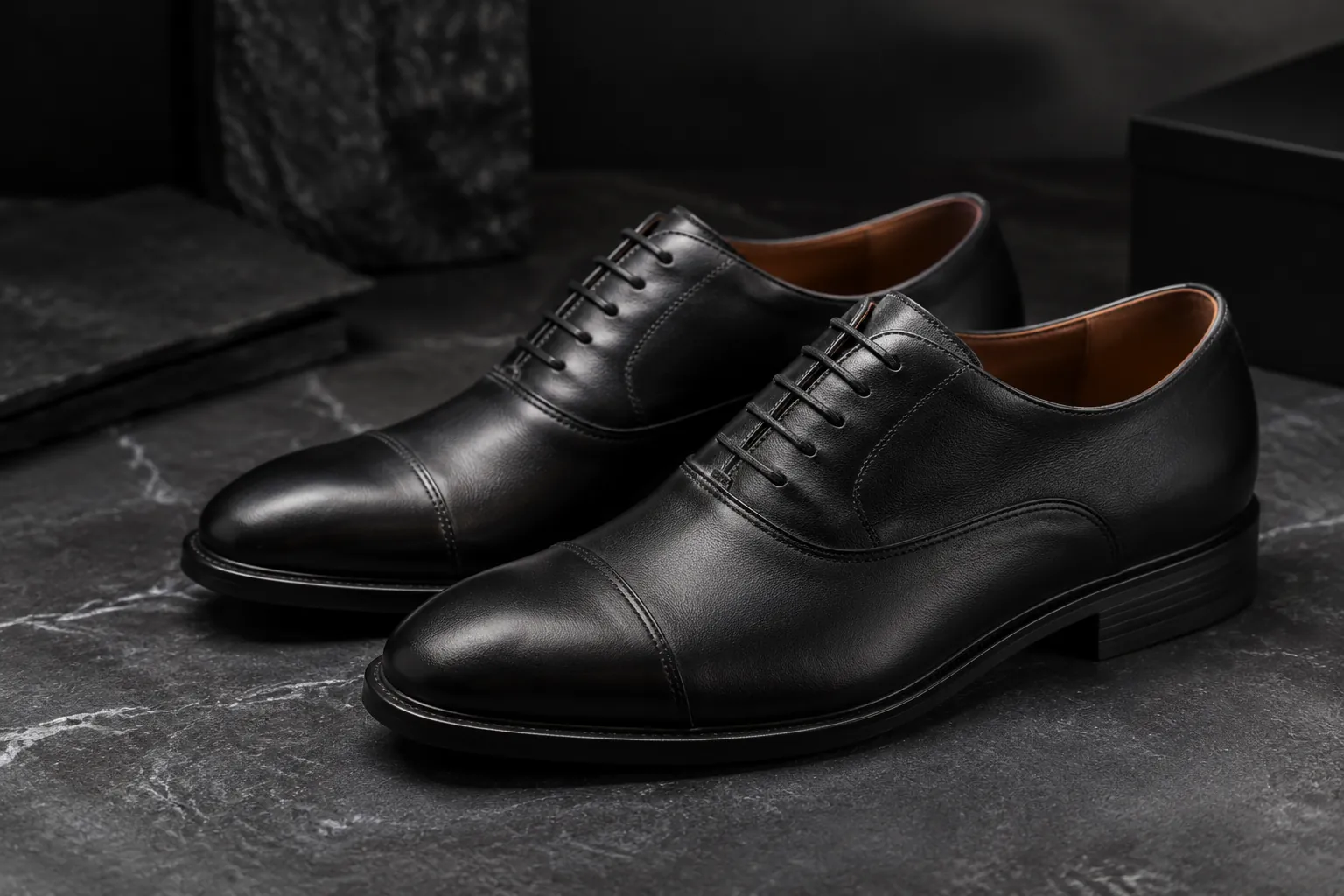
A cap-toe Oxford reference can establish a visual direction. It cannot, by itself, show which published wording a buyer has adopted, identify the material record, or answer how an appearance decision will be accepted. This cap-toe Oxford production specification checklist is editorial buyer guidance for keeping those parts of the brief distinct.
The distinction matters because the site uses two separate descriptions for cap-toe Oxfords. A buyer should treat each description as scoped to the page where it appears. The supplied excerpts do not define toe proportion and toe shape as the same term, and cap placement appears only in the dress-shoes excerpt. Start with the chosen source language rather than building an expanded master list.
Which Oxford description is the reference?
The dress-shoes page describes a cap-toe Oxford with a set of control points. The men's leather-shoes page describes a cap-toe Oxford with attributes that need a documented approval standard. Those are related descriptions, but they have different stated scope.
| Published reference | Wording to retain in the buyer record | How to use it |
|---|---|---|
| Dress-shoes page | Facing gap, toe proportion, cap placement, polish, and pair symmetry are treated as control points. | Use this list when the dress-shoes description is the selected reference. |
| Men's leather-shoes page | Facing gap, toe shape, polish level, and pair symmetry need a documented approval standard. | Use this list when the men's leather-shoes description is the selected reference. |
For a cap-toe Oxford shoe specification, preserve the applicable source terms as written. The excerpts provide no measurement reference, comparison method, or pass-or-fail rule for these terms. Those details belong in the project discussion rather than in an assumed reading of the published descriptions.
Give the chosen wording a place in the brief
A product record becomes easier to review when every visible decision has a named location. The following structure is an editorial recommendation for the buyer. It organizes a reference without presenting buyer-prepared fields as a factory requirement.
- Selected source description
- Identify either the dress-shoes page or the men's leather-shoes page as the source being used for the current style definition.
- Adopted source terms
- Copy the applicable source-specific attribute list into the brief without replacing its terms with generic toe or finish labels.
- Visual reference
- Identify the image, sketch, existing sample, or other reference that communicates the intended appearance.
- Definition record
- Keep the selected reference, its version, the decision owner, and the open questions in one place.
- Unresolved acceptance detail
- State what remains to be agreed instead of inserting an assumed tolerance, method, or threshold.
For example, an editorial record could state: Pair symmetry: reference images attached; comparison method: to be agreed. The entry makes the missing decision visible while avoiding an invented inspection rule.
This approach also keeps the dress-shoes page's leather dress shoe control points from being relabeled as the men's-shoe page's approval-standard attributes. The chosen list supplies the visual vocabulary; the buyer still needs to raise the approval details that are absent from the excerpts.
The commercial frame belongs beside the style
On its contact page, the company says it reviews the style, market, quantity, size range, materials, branding, packaging, and delivery need together rather than pricing them as isolated line items. This is a stated review scope, not a quotation, feasibility finding, or delivery commitment.
Editorially, place those inputs beside the visual definition before sending an inquiry. A brief can identify which information is current, proposed, or still pending. That context prevents the cap-toe Oxford description from being separated from the commercial frame the company says it reviews.
| Commercial-frame input named on the contact page | Editorial buyer record |
|---|---|
| Style and market | State the selected style reference and the intended market. |
| Quantity and size range | Record the current quantity and size-range information without treating either as an agreed term. |
| Materials, branding, and packaging | List the currently available inputs and flag anything still awaiting definition. |
| Delivery need | Describe the project's current delivery need as an inquiry input, not a confirmed date. |
Material identity is a separate record
An Oxford shoe material specification belongs alongside the appearance brief, with its own fields. The factory-quality page states that incoming review covers leather article, color, thickness, lining, outsoles, hardware, packaging, artwork, and lot identity before mixed or unclear materials enter production.
| Published incoming-review scope | Editorial field for the buyer definition |
|---|---|
| Leather article, color, and thickness | Record the available leather article identifier, color reference, and thickness information as separate entries. |
| Lining and outsoles | Identify these components independently rather than leaving them implied by the upper reference. |
| Hardware | Name any hardware that is relevant to the current project and attach its available reference. |
| Packaging and artwork | Keep packaging and artwork inputs with the project record when they apply. |
| Lot identity | Record the available lot-identity information and ask how it should be handled for the project. |
The published incoming-review statement does not describe material testing, leather-grade definitions, supplier qualification, a color-approval method, or broader traceability practice. A material record can therefore name what is known without implying that those additional controls have been established.
What still needs to be agreed?
The supplied excerpts describe visual terms, incoming-review scope, and the product and commercial frame. They do not provide an individual cap-toe Oxford acceptance protocol. A buyer can make the unanswered items explicit before treating the brief as complete.
- Geometry: measurement locations, dimensional references, measurement method, and tolerances.
- Appearance: leather-grade definitions, color-approval method, finish comparison conditions, and defect expectations.
- Review: inspection standard, defect classification, sampling basis, and acceptance or rejection criteria.
- Development and commercial information: sample sequence, testing scope, minimum order quantity, pricing, lead time, packing details, and manufacturing capacity.
These are project questions, not conclusions supported by the available excerpts. Marking a field as pending is more useful than filling it with a factual-looking rule that no source establishes.
An inquiry that preserves the open issues
Send the current footwear definition with the commercial-frame inputs and the unanswered questions kept visible. Select one of the source-specific visual records below rather than combining both descriptions into a single attribute list.
| Inquiry item | Information to provide |
|---|---|
| Dress-shoes reference selected | Facing gap, toe proportion, cap placement, polish, and pair symmetry. |
| Men's leather-shoes reference selected | Facing gap, toe shape, polish level, and pair symmetry. |
| Material record | Available leather article, color, thickness, lining, outsole, hardware, packaging, artwork, and lot-identity information. |
| Commercial frame | Market, quantity, size range, materials, branding, packaging, and delivery need. |
| Open questions | The unresolved acceptance, development, and commercial-information questions for the project. |
Use the contact page to share the definition and ask for clarification about whether development, sampling, MOQ, packing, or quotation information is relevant to the project. That request seeks information; it does not represent those topics as confirmed services, terms, or commitments.
Sources and verification
- Custom Leather Dress Shoes Manufacturer | OEM & Private Label First-party site source
- Men's Leather Shoes Manufacturer | Custom Oxfords & Loafers First-party site source
- Leather Shoe Factory in China | Capability & Export QC First-party site source
- Request a Quote | Leather Shoe Manufacturer First-party site source
Share the current leather footwear definition and ask which development, sampling or quotation options may apply to the project.
Send your project brief