
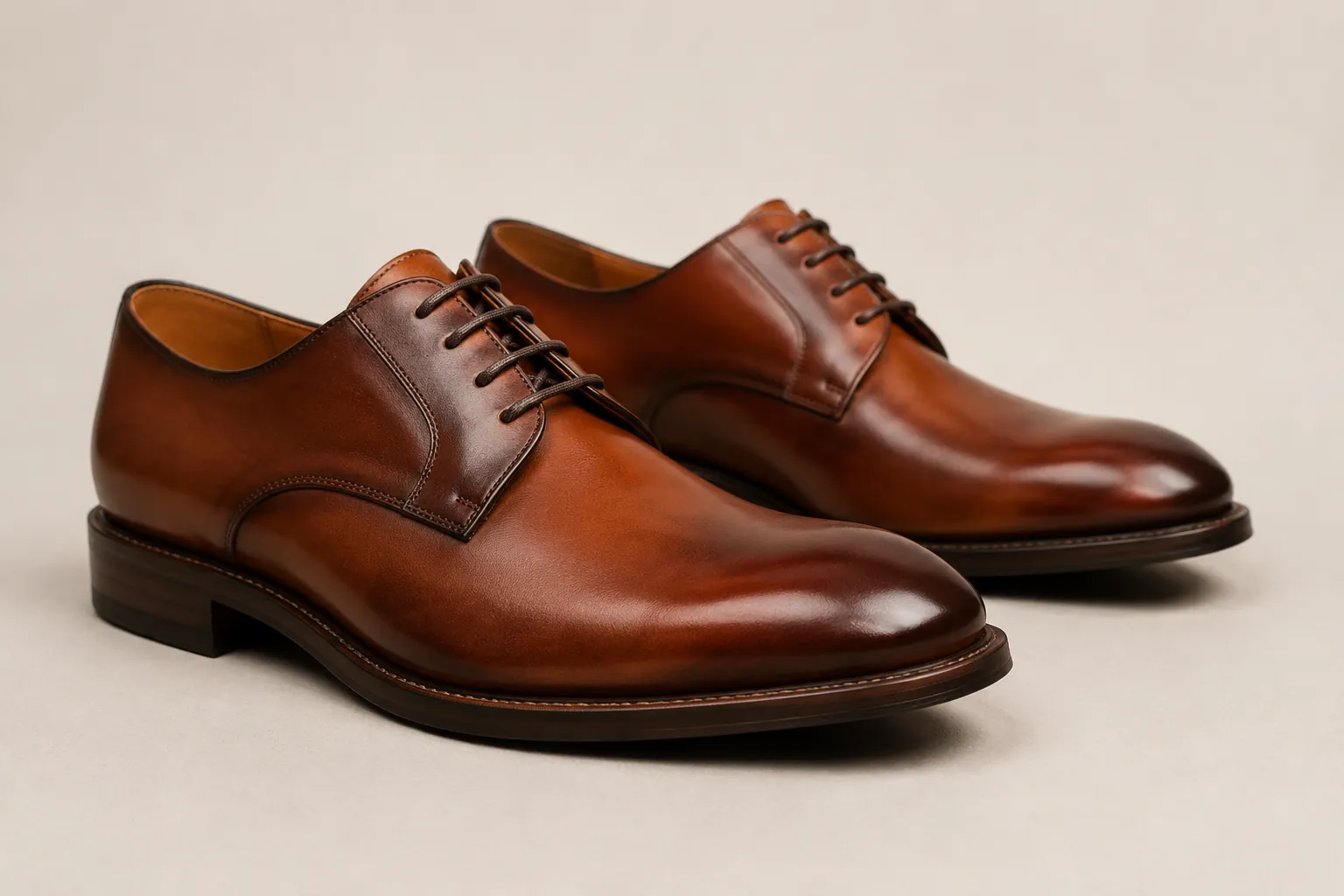
Direct answer
A balanced answer is not five interchangeable SKUs: lead with Espresso smooth calf, then add Cognac burnished calf, Medium brown pebble grain, Brown suede, and Antique hand-finished brown only for the roles they can defend. Espresso smooth calf leads because espresso smooth calf is the most dependable core because its dark neutral shade and clean surface support broad office-to-weekend merchandising; the others span finish-led premium storytelling, practical textured-leather use, seasonal texture and softer premium positioning, and finish-led premium storytelling. Move another style to number one when the range is built around cognac depth, textured grain, seasonal suede or artisanal antique finishing.
Five sourcing roles for men's brown penny-loafer
Ranking starts with the range job, then checks whether one approved penny last and saddle pattern held constant unless a leather article's thickness or stretch requires refitting, espresso smooth calf, cognac burnished calf, pebble grain, suede and antique hand-finished leather with separate masters, and a consistent penny-loafer build where possible, with article-specific cutting, lasting, finishing and sole-edge treatments can be approved without hiding cost or quality assumptions. A style that suits buyers who have not fixed the penny shape, sole construction or target price architecture before selecting finishes can still be valid, but not for this brief.
Best for: classic leather-led merchandising in men's brown penny-loafer ranges
Espresso smooth calf
Commercially, Espresso smooth calf works through the fact that it creates a distinct material or styling tier while the underlying range architecture stays visible, while the smooth surface supports clean pattern lines and controlled polishing. The factory discussion should focus on a name or color swatch alone does not define leather hand, fit behavior or bulk repeatability; natural grain, thickness and finish absorption require careful cutting and pair matching, since that issue feeds directly into undertone, shade spacing, grain or nap match, burnish map, saddle alignment, crease appearance, edge color and reorder references.
Buyer check: Record physical material standard, pattern reference, finished-pair appearance and intended range role, plus hide grade, panel placement, thickness, grain match, finish absorption and pair shade against both the physical sample and written specification, with undertone, shade spacing, grain or nap match, burnish map, saddle alignment, crease appearance, edge color and reorder references reviewed on paired shoes rather than single units.
Best for: finish-led premium storytelling in men's brown penny-loafer ranges
Cognac burnished calf
In this shortlist, Cognac burnished calf covers finish-led premium storytelling. Its specification is more demanding than the sketch suggests: a name or color swatch alone does not define leather hand, fit behavior or bulk repeatability; operator technique and rubbing can create uncontrolled toe, seam and pair-to-pair contrast can alter fit, appearance or reorder consistency.
Buyer check: Use the sample round to resolve physical material standard, pattern reference, finished-pair appearance and intended range role, plus base shade, burnish map, intensity limits, rub resistance, pair match and repair method, then confirm whether the decision changes the MOQ plan: quote each leather article and finish at its own minimum; consolidate soles and linings only where the brown shade and specification remain compatible.
Best for: practical textured-leather use in men's brown penny-loafer ranges
Medium brown pebble grain
Medium brown pebble grain supports it creates a distinct material or styling tier while the underlying range architecture stays visible, while the textured surface masks light wear and gives a more relaxed material character, so it has a clear job in office, smart casual, travel, heritage and seasonal menswear. Keep it out of briefs aimed at high-gloss formal programs that depend on a perfectly smooth surface; those conditions magnify the risk that a name or color swatch alone does not define leather hand, fit behavior or bulk repeatability; grain scale and emboss clarity can differ between panels or leather lots.
Buyer check: Make physical material standard, pattern reference, finished-pair appearance and intended range role, plus grain scale, emboss definition, panel matching, thickness and edge appearance a named approval point and assign the evidence needed to repeat undertone, shade spacing, grain or nap match, burnish map, saddle alignment, crease appearance, edge color and reorder references during inline and final review.
Best for: seasonal texture and softer premium positioning in men's brown penny-loafer ranges
Brown suede
The reason to retain Brown suede is that it creates a distinct material or styling tier while the underlying range architecture stays visible, while the napped surface adds tonal depth and a softer seasonal material story. Before assigning it a range slot, confirm that a name or color swatch alone does not define leather hand, fit behavior or bulk repeatability; nap direction, shade, rubbing and contamination can vary more visibly than on smooth leather can be controlled within the material and component plan.
Buyer check: Compare physical material standard, pattern reference, finished-pair appearance and intended range role, plus pair shade, nap direction, panel lay, color rub, brushing standard and bagging across the selected size set, not just the photography size, and retain the approved findings with the fit reference.
Best for: finish-led premium storytelling in men's brown penny-loafer ranges
Antique hand-finished brown
Antique hand-finished brown offers it creates a distinct material or styling tier while the underlying range architecture stays visible, while layered finishing adds depth and helps the color read above a flat commodity brown without duplicating the exact role of the styles above it. It becomes a poor choice for reorder programs that lack a physical color and burnish master, because a name or color swatch alone does not define leather hand, fit behavior or bulk repeatability; operator technique and rubbing can create uncontrolled toe, seam and pair-to-pair contrast.
Buyer check: Freeze physical material standard, pattern reference, finished-pair appearance and intended range role, plus base shade, burnish map, intensity limits, rub resistance, pair match and repair method before color expansion; later material changes must trigger another review of undertone, shade spacing, grain or nap match, burnish map, saddle alignment, crease appearance, edge color and reorder references where they affect the build.
How buyers should read brown penny loafers
Search language around brown penny loafers mixes retail recommendation intent with a factory range decision. For a men's brown penny-loafer collection, the useful interpretation is whether the buyer can achieve creating five credible material tiers without allowing shade names to replace physical standards through one approved penny last and saddle pattern held constant unless a leather article's thickness or stretch requires refitting, espresso smooth calf, cognac burnished calf, pebble grain, suede and antique hand-finished leather with separate masters and a consistent penny-loafer build where possible, with article-specific cutting, lasting, finishing and sole-edge treatments.
- brown penny loafersTreat the phrase as a demand signal for men's brown penny-loafer ranges, not as evidence that every candidate suits buyers who have not fixed the penny shape, sole construction or target price architecture before selecting finishes.
- brown loafers pennyFor a sourcing team, this wording should open a brief for office, smart casual, travel, heritage and seasonal menswear, then narrow the choice through undertone, shade spacing, grain or nap match, burnish map, saddle alignment, crease appearance, edge color and reorder references rather than a consumer-style popularity score.
- penny brown loafersThe word order changes, but the purchasing question remains whether the buyer can achieve creating five credible material tiers without allowing shade names to replace physical standards; quotations should therefore follow the same component-level MOQ plan.
- penny loafers brownUse this variant to compare espresso smooth calf, cognac burnished calf, pebble grain, suede and antique hand-finished leather with separate masters and a consistent penny-loafer build where possible, with article-specific cutting, lasting, finishing and sole-edge treatments, with fit judged against one approved penny last and saddle pattern held constant unless a leather article's thickness or stretch requires refitting instead of the ranking position alone.
Related buyer searches
The related low-difficulty searches stay inside the same sourcing boundary: shade, leather hand and finish QC for office, smart casual, travel, heritage and seasonal menswear. They should not broaden the brief into buyers who have not fixed the penny shape, sole construction or target price architecture before selecting finishes or bypass approval of undertone, shade spacing, grain or nap match, burnish map, saddle alignment, crease appearance, edge color and reorder references.
- brown suede penny loafers
- suede brown penny loafers
- penny loafers suede brown
Five controls for men's brown penny-loafer
A comparable quotation for a men's brown penny-loafer collection needs more than five style names. The table fixes one approved penny last and saddle pattern held constant unless a leather article's thickness or stretch requires refitting, espresso smooth calf, cognac burnished calf, pebble grain, suede and antique hand-finished leather with separate masters, a consistent penny-loafer build where possible, with article-specific cutting, lasting, finishing and sole-edge treatments, the rule to quote each leather article and finish at its own minimum; consolidate soles and linings only where the brown shade and specification remain compatible, and the QC evidence needed before Espresso smooth calf or any alternative becomes a bulk reference.
| Control point | What the buyer should define | Why it matters |
|---|---|---|
| Last, opening and size grading | Hold one approved last, pattern and fitting reference constant while comparing Espresso smooth calf, Medium brown pebble grain, and Antique hand-finished brown; recheck any material article that changes hand or thickness. | These options are finish or color directions rather than excuses to move the shoe shape; keeping the platform fixed reveals whether espresso smooth calf, cognac burnished calf, pebble grain, suede and antique hand-finished leather with separate masters changes closure, creasing or heel hold. |
| Upper leather and visible components | Name and physically approve espresso smooth calf, cognac burnished calf, pebble grain, suede and antique hand-finished leather with separate masters; include thickness or hand, color and finish references, lining, reinforcement, thread and any hardware used by the five options. | The shortlist shifts between Espresso smooth calf and Antique hand-finished brown, so material substitutions can change cutting yield, MOQ, stretch, finishing response and pair matching rather than merely changing color. |
| Construction, bottom and wear context | Define a consistent penny-loafer build where possible, with article-specific cutting, lasting, finishing and sole-edge treatments; state the intended conditions of office, smart casual, travel, heritage and seasonal menswear and request only the performance checks relevant to that market and use. | The same upper concept can behave differently when sole weight, flex, pitch, stitch path or bond preparation changes, which is why Cognac burnished calf cannot inherit Brown suede's construction approval. |
| MOQ and assortment architecture | Build the quotation around this rule: quote each leather article and finish at its own minimum; consolidate soles and linings only where the brown shade and specification remain compatible. Show pairs by style, color, material, sole and size rather than only a collection total. | For a men's brown penny-loafer collection, the apparent winner can change once leather articles, hardware finishes, sole colors and tooling are separated into their real minimum-order drivers. |
| QC evidence and reorder reference | Turn undertone, shade spacing, grain or nap match, burnish map, saddle alignment, crease appearance, edge color and reorder references into photographs, measurements or approved physical references, with responsibility for inline correction and final release stated in the quality plan. | For a men's brown penny-loafer collection, these controls preserve undertone, shade spacing, grain or nap match, burnish map, saddle alignment, crease appearance, edge color and reorder references and prevent a reorder from being judged against memory, a web image or an unrepresentative showroom pair. |
From men's brown penny-loafer shortlist to controlled order
This sequence turns the ranking into a development path for men's brown penny-loafer ranges. It keeps creating five credible material tiers without allowing shade names to replace physical standards visible while decisions on fit, components, quantity splits and undertone, shade spacing, grain or nap match, burnish map, saddle alignment, crease appearance, edge color and reorder references are still reversible.
Translate search demand into range roles
Give Espresso smooth calf the lead job of classic leather-led merchandising, then state the narrower jobs for Cognac burnished calf, Medium brown pebble grain, Brown suede and Antique hand-finished brown. Remove a candidate if it duplicates another style in men's brown penny-loafer ranges without adding fit, occasion or margin value.
Engineer each option before decoration
Map one approved penny last and saddle pattern held constant unless a leather article's thickness or stretch requires refitting, espresso smooth calf, cognac burnished calf, pebble grain, suede and antique hand-finished leather with separate masters, and a consistent penny-loafer build where possible, with article-specific cutting, lasting, finishing and sole-edge treatments for every option. Mark what can genuinely be shared and apply this MOQ rule before sampling: quote each leather article and finish at its own minimum; consolidate soles and linings only where the brown shade and specification remain compatible.
Inspect the differentiating details
Use production-intent materials to review undertone, shade spacing, grain or nap match, burnish map, saddle alignment, crease appearance, edge color and reorder references in the buyer's selected fit sizes. The sample round should expose the risks of the lowest-ranked options, not only perfect the photography pair of Espresso smooth calf.
Release only the viable assortment
For a men's brown penny-loafer collection, attach the final style-color-size split, approved physical references and defect controls to the purchase order. Reorders should return to the same evidence, and any change affecting undertone, shade spacing, grain or nap match, burnish map, saddle alignment, crease appearance, edge color and reorder references should require written reapproval.
Risks specific to men's brown penny-loafer
The highest exposure in this brief sits at the junction of one approved penny last and saddle pattern held constant unless a leather article's thickness or stretch requires refitting, espresso smooth calf, cognac burnished calf, pebble grain, suede and antique hand-finished leather with separate masters, and a consistent penny-loafer build where possible, with article-specific cutting, lasting, finishing and sole-edge treatments. Raise the three controls below before final sampling, especially if the range may drift toward buyers who have not fixed the penny shape, sole construction or target price architecture before selecting finishes.
Cognac burnished calf is approved with only a generic color or leather description
Control: Approve espresso smooth calf, cognac burnished calf, pebble grain, suede and antique hand-finished leather with separate masters with physical standards and written variation limits; include undertone, shade spacing, grain or nap match, burnish map, saddle alignment, crease appearance, edge color and reorder references where finish or trim affects pair matching.
A shared pattern hides the hand difference between Espresso smooth calf and Antique hand-finished brown
Control: Keep one approved penny last and saddle pattern held constant unless a leather article's thickness or stretch requires refitting fixed, but refit and flex each approved leather or finish article before the comparison is signed off.
The men's brown penny-loafer total is mistaken for each component MOQ
Control: Apply the actual sourcing plan - quote each leather article and finish at its own minimum; consolidate soles and linings only where the brown shade and specification remain compatible - and remove any option whose separate leather, sole or hardware commitment cannot be justified by its range role.
RFQ inputs for men's brown penny-loafer
Send references for Espresso smooth calf through Antique hand-finished brown, then state one approved penny last and saddle pattern held constant unless a leather article's thickness or stretch requires refitting, espresso smooth calf, cognac burnished calf, pebble grain, suede and antique hand-finished leather with separate masters, a consistent penny-loafer build where possible, with article-specific cutting, lasting, finishing and sole-edge treatments, and the intended conditions of office, smart casual, travel, heritage and seasonal menswear. Ask the manufacturer to return assumptions and exclusions against the actual style-color-size split.
- Last, opening and size grading: Hold one approved last, pattern and fitting reference constant while comparing Espresso smooth calf, Medium brown pebble grain, and Antique hand-finished brown; recheck any material article that changes hand or thickness.
- Upper leather and visible components: Name and physically approve espresso smooth calf, cognac burnished calf, pebble grain, suede and antique hand-finished leather with separate masters; include thickness or hand, color and finish references, lining, reinforcement, thread and any hardware used by the five options.
- Construction, bottom and wear context: Define a consistent penny-loafer build where possible, with article-specific cutting, lasting, finishing and sole-edge treatments; state the intended conditions of office, smart casual, travel, heritage and seasonal menswear and request only the performance checks relevant to that market and use.
- MOQ and assortment architecture: Build the quotation around this rule: quote each leather article and finish at its own minimum; consolidate soles and linings only where the brown shade and specification remain compatible. Show pairs by style, color, material, sole and size rather than only a collection total.
- QC evidence and reorder reference: Turn undertone, shade spacing, grain or nap match, burnish map, saddle alignment, crease appearance, edge color and reorder references into photographs, measurements or approved physical references, with responsibility for inline correction and final release stated in the quality plan.
- Order architecture: Show the estimated pairs for each of Espresso smooth calf, Cognac burnished calf, Medium brown pebble grain, Brown suede and Antique hand-finished brown, including colors, materials and sizes; apply this consolidation rule: quote each leather article and finish at its own minimum; consolidate soles and linings only where the brown shade and specification remain compatible.
- Market requirements: Name the destination, channel and use case - office, smart casual, travel, heritage and seasonal menswear - plus labeling, packaging and any buyer-specified tests relevant to that market.
- Approval path: Identify who will approve fit and appearance, which confirmation sizes will be reviewed, and how undertone, shade spacing, grain or nap match, burnish map, saddle alignment, crease appearance, edge color and reorder references will be recorded for bulk release.
Buying questions for men's brown penny-loafer
These answers assume the intended use is office, smart casual, travel, heritage and seasonal menswear and that component minimums are reviewed by style, color and size rather than hidden inside a collection total.
Why does Espresso smooth calf lead the men's brown penny-loafer shortlist?
It leads because espresso smooth calf is the most dependable core because its dark neutral shade and clean surface support broad office-to-weekend merchandising. That is a range decision, not an absolute product claim; choose another lead when the range is built around cognac depth, textured grain, seasonal suede or artisanal antique finishing.
Can Espresso smooth calf and Brown suede share a last, sole or material order?
Only where the approved fit and component geometry genuinely match. The planning rule is to quote each leather article and finish at its own minimum; consolidate soles and linings only where the brown shade and specification remain compatible; ask the supplier to show which minima belong to leather articles, sole units, colors, hardware and finished styles instead of assuming they combine.
When is the men's brown penny-loafer shortlist unsuitable?
Use a different brief for buyers who have not fixed the penny shape, sole construction or target price architecture before selecting finishes. This shortlist is built around office, smart casual, travel, heritage and seasonal menswear, so carrying it into another use case without revisiting one approved penny last and saddle pattern held constant unless a leather article's thickness or stretch requires refitting, a consistent penny-loafer build where possible, with article-specific cutting, lasting, finishing and sole-edge treatments and the QC plan would create false comparability.